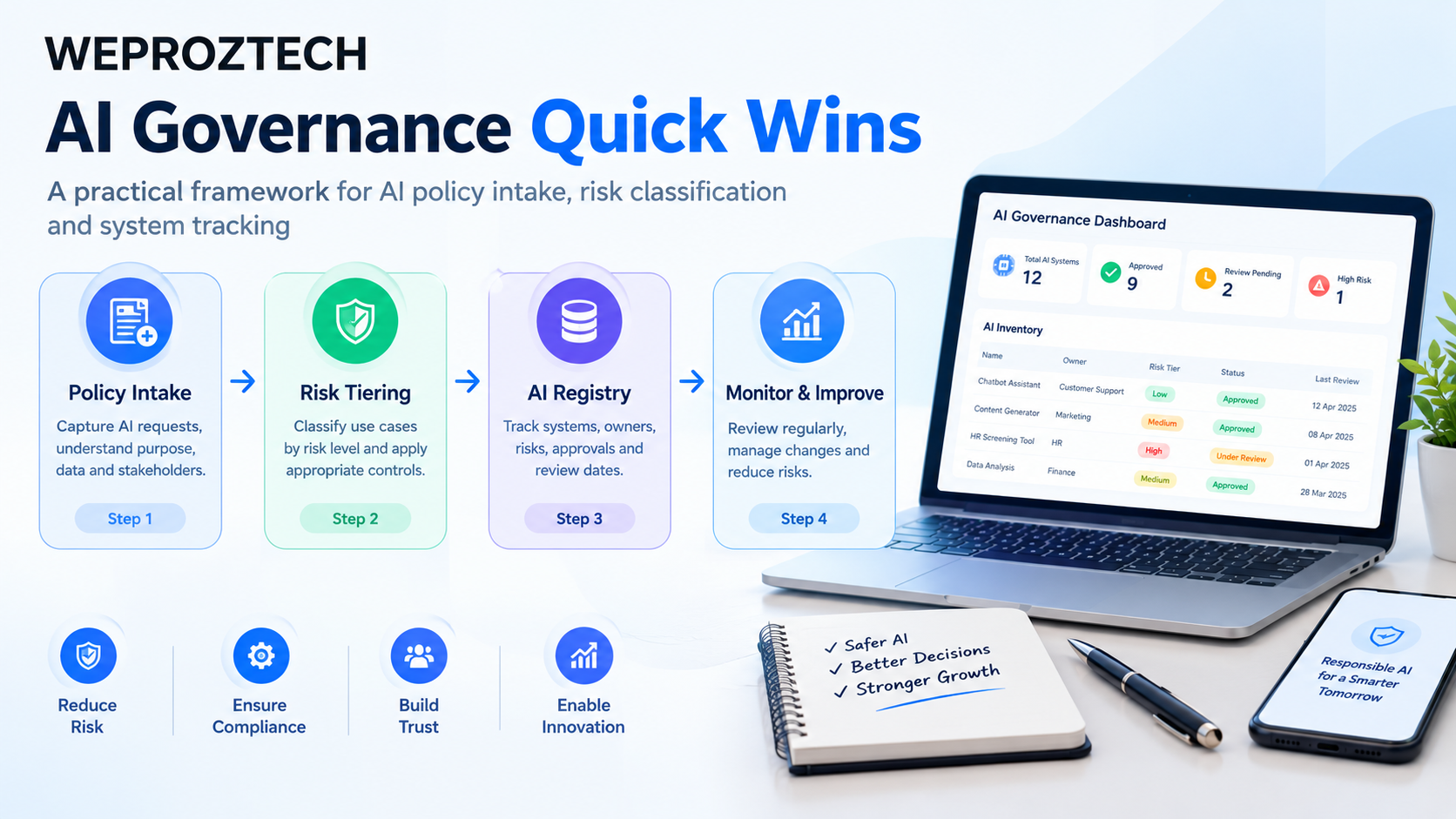
Artificial intelligence is becoming part of everyday business operations, from customer support and marketing to software development, recruitment and data analysis. But as more teams adopt AI tools, businesses need a clear way to understand which systems are being used, what risks they create and who is responsible for them.
AI governance does not have to begin with a lengthy policy document or a complex compliance programme. Businesses can make meaningful progress through a few practical steps: introduce a simple AI policy intake process, classify AI use cases by risk, maintain a central AI registry and assign clear ownership.
These AI governance quick wins help organisations bring visibility and accountability to AI adoption without unnecessarily slowing down innovation. For companies planning new AI workflows, WEPROZTECH's AI consulting services can also support the planning and implementation of suitable AI solutions.
What Is AI Governance and Why Does It Matter?
AI governance is the combination of policies, processes, responsibilities and controls used to manage how an organisation develops, purchases and uses artificial intelligence. It covers more than technical security. Depending on the application, it may also involve data privacy, accuracy, fairness, transparency, human oversight, intellectual property and regulatory requirements.
For example, using an AI tool to summarise a public article is different from using an AI system to screen job applicants or make decisions about customers. Both use AI, but their potential impact and the level of oversight they require can be very different.
The NIST AI Risk Management Framework provides a useful voluntary foundation for identifying, assessing and managing AI risks across the system lifecycle. Its approach covers governance alongside understanding, measuring and managing risk
For a business getting started, the goal should be simple: know where AI is being used, understand what each use case does and apply controls proportionate to its potential impact.
1. Start with a Simple AI Policy Intake Process
One of the quickest ways to improve AI governance is to introduce a standard intake form for new AI tools, projects and workflows. Without an intake process, teams may start using AI services independently, making it difficult for IT, security or management to understand where business information is going.
The form does not need to be complicated. It should collect the information required to make an initial decision before a tool or use case is approved.
Useful questions include:
-
What is the business purpose of the AI tool or project?
-
Which team will use it, and who owns the use case?
-
Will it process personal, confidential, customer or other sensitive data?
-
Will AI outputs influence decisions about people, money, access or business operations?
-
Does the tool connect to company applications, external APIs or automated workflows?
-
Will a human review important outputs before action is taken?
Based on these answers, the request can be approved, sent for further review or declined until the identified concerns are addressed.
Keep the process easy to follow. A low-risk productivity tool should not have to complete the same review as an AI system that makes consequential decisions. A short intake process with clear escalation rules helps teams adopt useful tools while bringing potentially risky applications to the attention of the right people.
For businesses introducing AI-powered customer communication or lead management, WEPROZTECH's AI Agents for Small Businesses in India article provides a related example of how AI can be applied to business workflows.
2. Introduce Risk Tiering for AI Use Cases
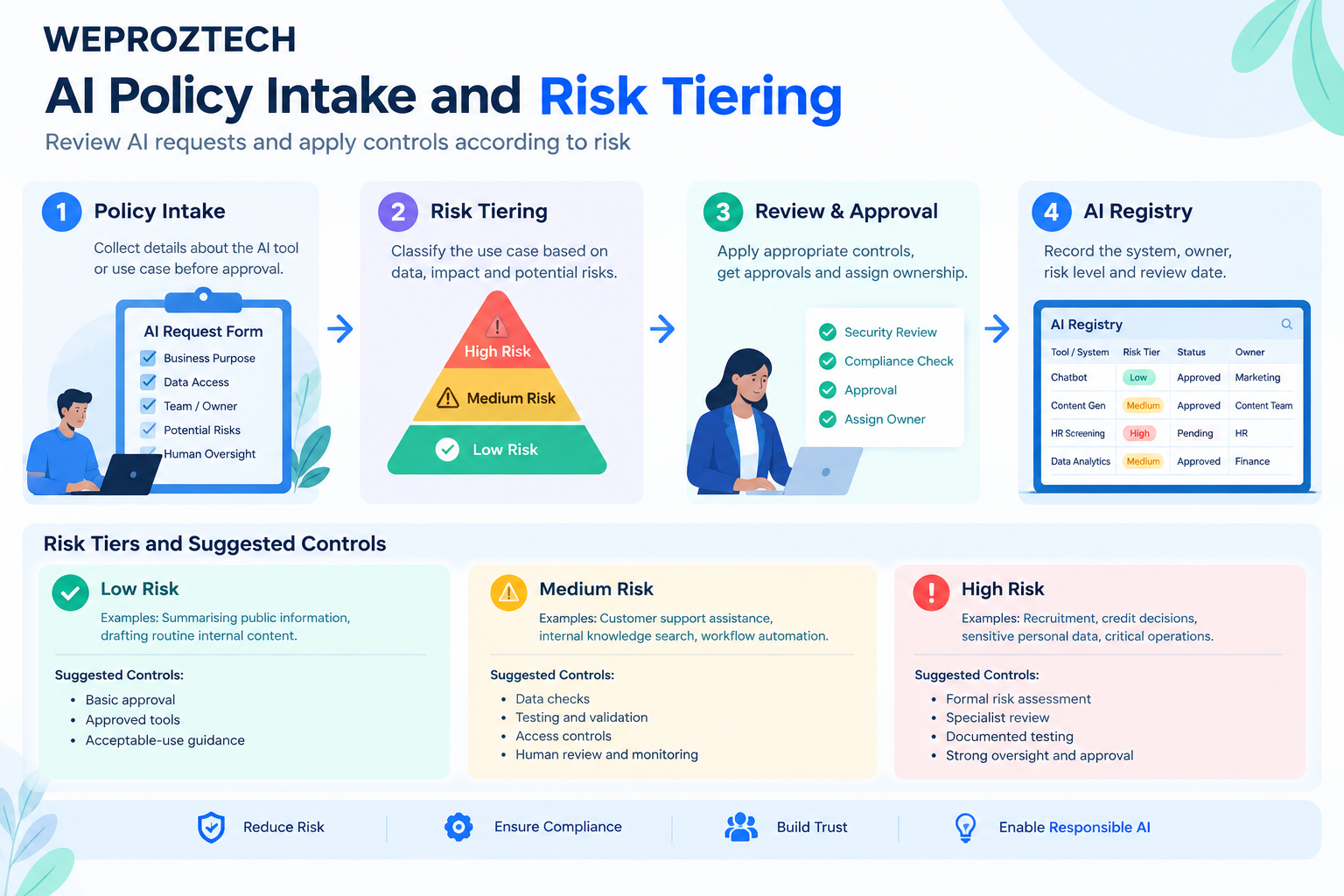
Risk tiering helps an organisation decide how much review and oversight an AI application needs. Instead of treating every AI tool as equally risky, businesses can classify use cases according to their purpose, the data they handle, the people affected and the consequences of an incorrect result.
A practical starting point is a three-tier internal model. This is an example for business governance, not a replacement for a legal classification under applicable regulations.
|
Risk tier |
Typical examples |
Suggested controls |
|---|---|---|
|
Low risk |
Summarising public information, drafting routine internal content |
Basic approval, approved tools and acceptable-use guidance |
|
Medium risk |
Customer-support assistance, internal knowledge search, business workflow automation |
Data checks, testing, access controls, human review and monitoring |
|
High risk |
AI influencing recruitment, credit decisions, sensitive personal data or critical operations |
Formal risk assessment, specialist review, documented testing, strong oversight and approval before deployment |
The actual tier should depend on the context. A customer-support chatbot answering general questions may have a different risk profile from one that accesses confidential account records or makes decisions without human review.
The European Commission's overview of the EU AI Act explains the regulation's risk-based approach. Its legal categories and obligations should not be confused with the three-tier internal model above. Businesses should determine which legal requirements apply to their own systems and jurisdictions
For each tier, define who can approve a request, what evidence is required and when a use case must be escalated. Review the classification whenever the system's purpose, data access or level of autonomy changes.
 3. Build a Central AI Registry
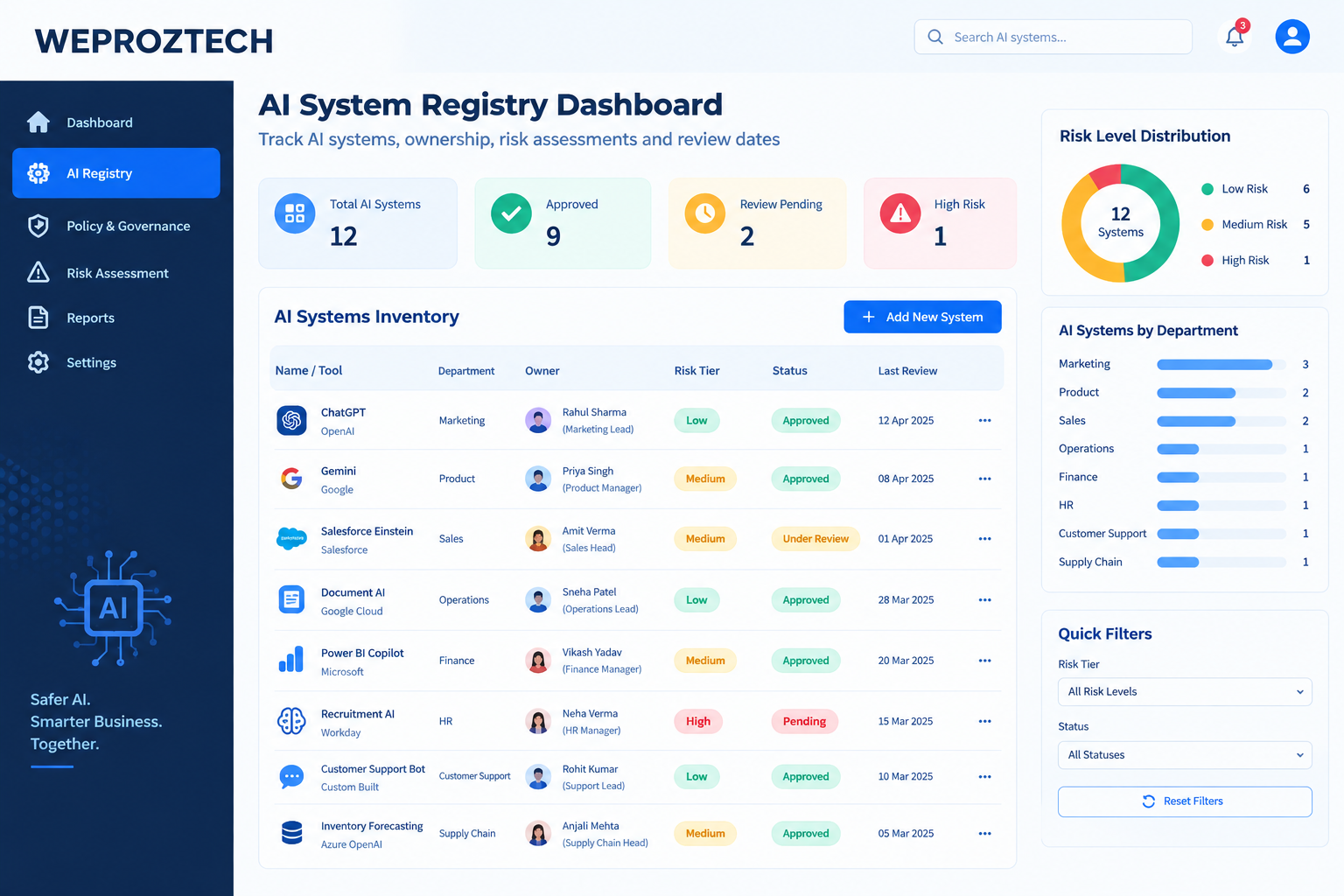
An AI registry is a central record of the AI systems and use cases an organisation develops, buys or uses. It gives management a clearer picture of the AI landscape and makes it easier to track ownership, risks, approvals and changes.
A spreadsheet is often enough for an initial registry. A business does not need to buy a specialist governance platform before establishing basic visibility.
Useful registry fields include:
-
AI tool or system name, provider and version where known
-
Business purpose and department
-
Business owner and technical contact
-
Data types processed and connected systems
-
Risk tier and date of the last assessment
-
Approval status and required safeguards
-
Human oversight and monitoring arrangements
-
Known limitations, incidents and review date
For example, a marketing team might register a content assistant, while customer operations registers an AI chatbot connected to support information. The registry should record the different purposes and data access of these systems instead of treating them as one generic AI tool.
The NIST Generative AI Profile discusses maintaining AI system inventories and capturing information relevant to generative AI risks, including underlying models and human oversight responsibilities. This makes it a useful reference when deciding what information to record.
Assign someone to maintain the registry and establish a simple update rule: new AI use cases must be registered, and material changes must trigger a review. Otherwise, the register can quickly become outdated.
 4. Connect Policy, Risk Tiering and the Registry
These three controls work best when they form one process rather than separate administrative tasks. Policy intake captures the request, risk tiering determines the required review, and the registry records the decision and ongoing responsibilities.
1. Policy Intake
Collect the purpose, owner, data and proposed use.
2. Risk Tiering
Assign the appropriate review and safeguards.
3. AI Registry
Record the decision, owner, controls and review date.
4. Monitor and Review
Update the record when the system or its risks change.
This workflow gives teams a repeatable way to manage AI adoption. It also creates a record of why a use case was approved and which controls were expected to remain in place.
For technical implementations, WEPROZTECH's systems integration services can be relevant when AI applications need to exchange information with existing business systems. The governance process should still define access permissions, ownership and approval requirements before integrations are enabled.
5. Set Minimum AI Policy Rules and Ownership
A short, practical AI policy is more useful than a long document employees cannot easily apply. It should explain which tools are approved, what information must not be entered into them, when human review is required and how staff should report errors or possible data exposure.
The policy should also identify responsibility. Business owners understand the purpose and consequences of a use case; technical teams manage implementation and security; and legal, privacy or compliance specialists review issues within their remit. Smaller organisations may assign several of these responsibilities to the same person, provided the responsibilities remain clear.
At a minimum, establish rules for sensitive data, external AI services, output verification, recordkeeping, access permissions and incident reporting. If an AI system can send messages, update records or trigger other actions automatically, document which actions it can take and where human approval is required.
For organisations exploring autonomous workflows, WEPROZTECH's Agentic Intelligence Development service is relevant to the development side of such systems. Governance controls should be designed alongside the workflow rather than added only after deployment.
6. A Practical 30-Day AI Governance Quick-Wins Plan
Businesses can start with a small, measurable plan instead of attempting to govern every possible AI scenario at once.
Week 1: Establish visibility. Ask department heads to identify the AI tools and use cases their teams already use. Create a simple intake form and nominate a responsible owner.
Week 2: Classify the main use cases. Apply the initial risk tiers, identify sensitive-data handling and flag applications that need specialist review. Do not assume a use case is safe simply because it uses a popular AI product.
Week 3: Create the registry and publish basic rules. Record the identified systems, approval status, owners and safeguards. Share a short acceptable-use policy and explain how employees can request approval for new tools.
Week 4: Review and improve. Check whether records are complete, approvals are documented and high-risk applications have appropriate oversight. Assign dates for follow-up reviews and update the process based on employee feedback.
At the end of the month, measure practical outcomes: the percentage of identified AI use cases registered, the number with named owners, the percentage assessed for risk and the number awaiting approval. These measures help management see whether the process is improving visibility and accountability.
The 30-day timeline is a suggested starting point, not a regulatory deadline. The right pace will depend on the organisation's size, existing systems and risk exposure.
How WEPROZTECH Can Help with AI Governance and Implementation
Good AI governance combines business policies with the technical systems that enforce them. Depending on the organisation's requirements, this may involve AI consulting, secure API connections, workflow automation, access controls, monitoring and integration with existing applications.
WEPROZTECH offers AI consulting, AI automation, custom API development and systems integration. These services can help businesses plan and implement AI-enabled workflows with suitable technical controls.
For example, an organisation introducing an AI customer-support assistant could document the use case, classify its risk, register the system, restrict its access to approved information and define when a human should take over. The exact safeguards should reflect the application's data, capabilities and potential impact.
AI governance is not a one-time compliance exercise. Systems change, vendors update models and teams discover new uses. A repeatable process makes those changes easier to identify and review.
Final Thoughts
AI governance quick wins begin with three practical controls: policy intake, risk tiering and an AI registry. Together, they help organisations understand how AI is being used, identify applications that need closer scrutiny and assign clear responsibility for ongoing oversight.
Businesses do not need to build a complicated governance programme on day one. Starting with a clear intake process, proportionate risk reviews, a maintained registry and basic employee guidance creates a foundation that can grow as AI adoption expands.
The important step is to make governance part of normal business operations, so teams can continue to innovate while managing risks in a more structured way.
Frequently Asked Questions (FAQs)
AI governance quick wins are simple steps businesses can take to manage AI responsibly, such as creating an AI policy intake process, classifying AI risks, maintaining an AI registry, and assigning clear ownership.
An AI policy intake process is a standard way to review new AI tools and use cases before approval. It helps businesses understand the tool’s purpose, data access, potential risks, responsible team, and required human oversight.
AI risk tiering is the process of grouping AI applications into risk levels, such as low, medium, and high. Each level receives appropriate review and safeguards based on the data involved and the potential impact of the AI system.
An AI registry is a central record of the AI tools and systems used by an organization. It can include each system’s purpose, owner, provider, risk level, data access, approval status, safeguards, and review date.
Small businesses can begin with a short AI usage policy, a simple approval form, a spreadsheet-based AI registry, and clear rules for sensitive data and human review. These steps can create a practical foundation without requiring an expensive governance platform.
WEPROZTECH can help businesses assess AI use cases, plan AI policies, integrate AI tools with existing systems, and develop automation solutions with appropriate controls and human oversight. Businesses can explore AI consulting services to discuss their requirements.