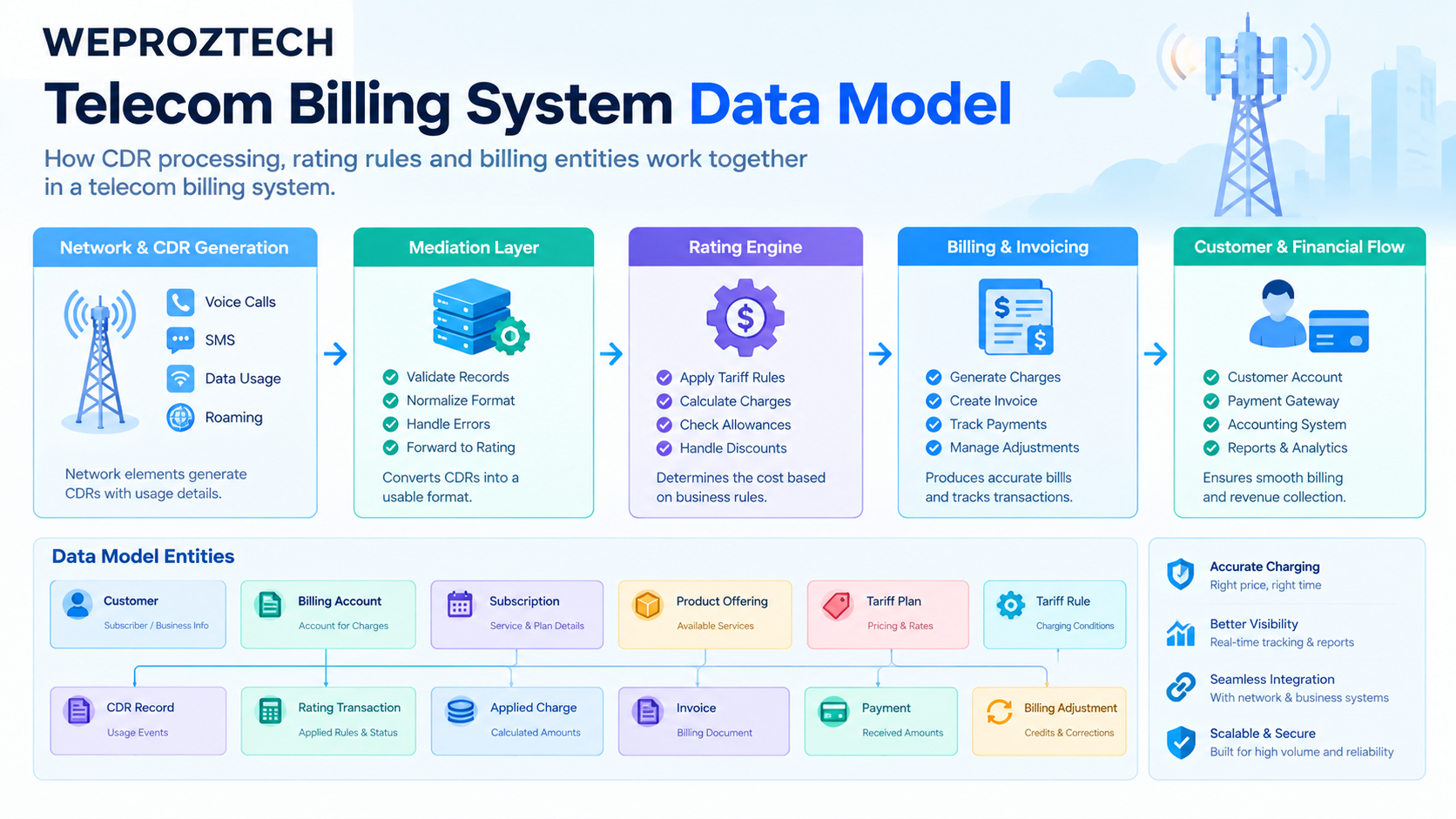
A telecom billing system processes customer subscriptions, call records, data usage, pricing rules and payments to generate accurate bills. A well-designed telecom billing system data model connects these components and helps telecom operators, internet service providers and communication platforms manage high volumes of usage data.
The database schema must support accurate charging, reliable data processing, transaction tracking and integration with other business systems. Its design depends on the services offered, billing model and expected transaction volume.
Key Entities in a Telecom Billing System
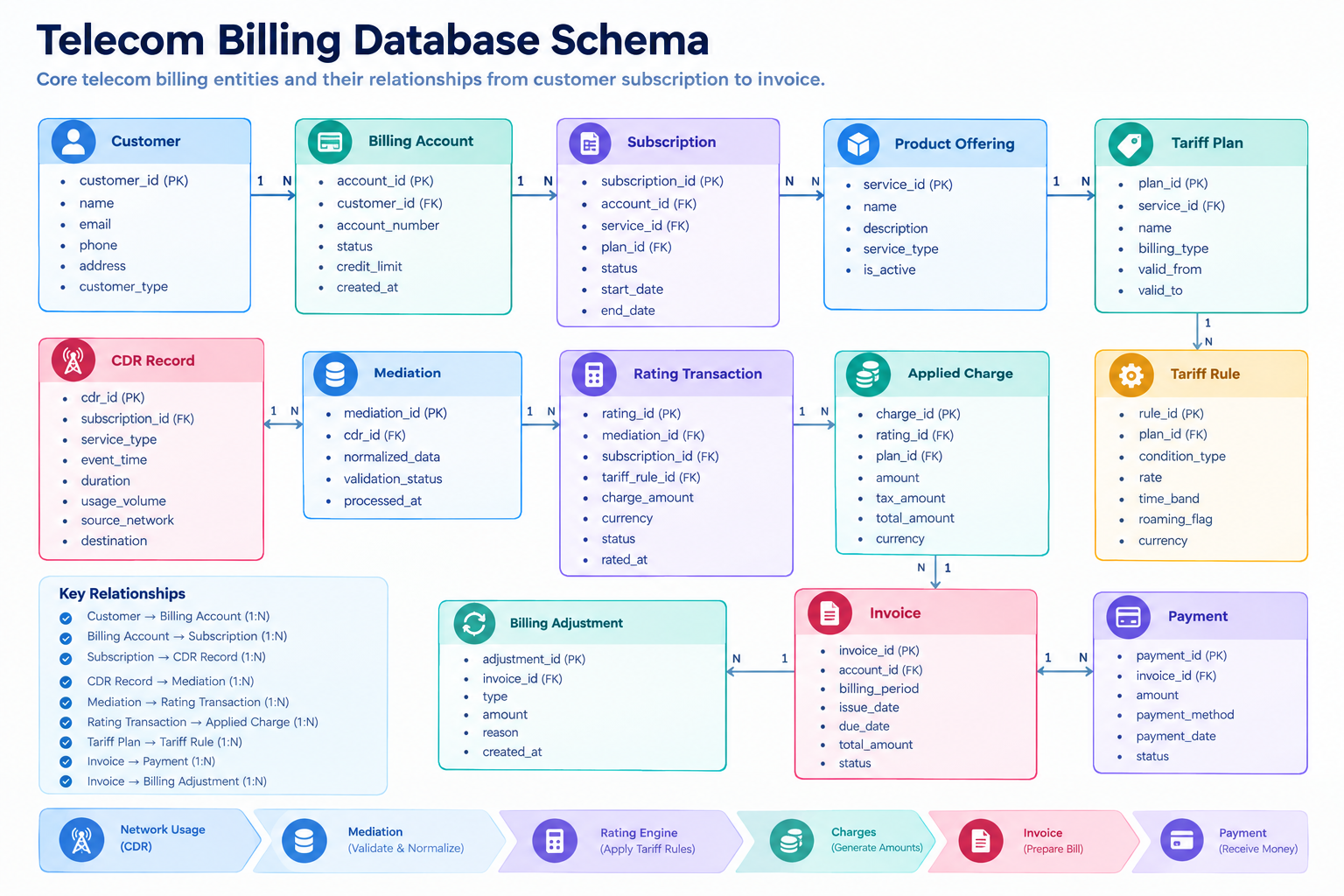
A telecom billing database contains several connected entities. The Customer entity stores subscriber or business information, while the Billing Account identifies the account responsible for charges. Keeping them separate allows enterprise customers to manage multiple subscriptions under one account.
The Subscription entity records the service a customer uses, including its status, activation date and selected plan. The Product Offering defines available packages, while the Tariff Plan contains pricing rules, recurring fees, usage rates, allowances and discounts.
The CDR Record stores information about a communication event. The Rating Transaction records the result of applying pricing rules, and the Applied Charge stores the resulting charge. Finally, Invoice, Payment and Billing Adjustment entities manage billing documents, received payments and authorized corrections.
For a standardized approach to telecom information architecture, developers can refer to the TM Forum Information Framework (SID), which provides a reference information model and shared business vocabulary for communications service providers.
Understanding CDR Processing and the Rating Engine
A Call Detail Record (CDR) contains information about a network usage event. Depending on the service, it may include event time, duration, service identifiers, usage volume and references to network elements. CDR formats differ across technologies, so billing software must validate and normalize records before rating them.
A typical workflow starts when network systems generate usage records. A mediation layer collects the records, checks their format, converts them into a consistent structure and sends valid events to the appropriate billing process. Invalid records should be flagged for investigation instead of silently discarded.
The rating engine identifies the applicable customer or service, checks the tariff rules and calculates the charge. Pricing may depend on call duration, destination, data volume, roaming status, time of use, discounts or remaining package allowance.
For example, if a customer has a monthly data allowance, the rating engine checks whether the recorded usage falls within the package or attracts an additional charge. Prepaid systems may also need real-time balance checks and charging decisions.
The 3GPP CDR specification available through ETSI provides technical details about CDR parameters and encoding for the specified release.
Designing a Reliable Telecom Billing Database Schema
A practical logical schema may include these core tables:
| Entity | Purpose |
|---|---|
customer |
Subscriber or business details |
billing_account |
Account responsible for charges |
subscription |
Active or historical service subscriptions |
product_offering |
Available packages and services |
tariff_plan |
Pricing plan information |
tariff_rule |
Conditions and rates used for charging |
cdr_record |
Normalized call detail records |
rating_transaction |
Rating results and processing status |
applied_charge |
Calculated charges |
invoice |
Billing documents |
payment |
Payments received |
billing_adjustment |
Credits and authorized corrections |
This is an illustrative schema, not a mandatory industry-wide database design. Depending on the application, some entities may be combined or separated.
Use stable identifiers and clear relationships between records. Store the relevant tariff version with the rating result so that historical charges remain traceable even when pricing changes. Appropriate indexes, date-based partitioning and efficient processing queues can help large billing platforms handle growing data volumes.
The system should also prevent duplicate processing, track failed jobs and retain links to original CDR records. These controls make it easier to investigate billing disputes and correct processing errors.
 Billing Accuracy, Security and System Integration
Billing accuracy depends on more than database structure. Missing CDRs, duplicated events, delayed records and incorrect tariff rules can lead to revenue leakage or customer complaints. Reconciliation processes should compare received usage records with rated transactions and invoiced charges, while exception reports help teams identify mismatches.
Security is equally important because telecom usage data may contain sensitive subscriber information. Access controls, encryption, audit logs and suitable retention policies help protect records and support operational requirements.
Telecom billing platforms often integrate with CRM systems, payment gateways, network infrastructure, accounting software and reporting tools. TM Forum Open APIs provide standardized interfaces that can help organizations plan interoperability between systems.
Businesses building connected applications can explore WEPROZTECH Systems Integration Services, Data Integration Services and Custom API Development Services.
For related technical reading, explore WEPROZTECH's Upstream Oil and Gas Software article for another example of specialized software used to manage complex operational data.
How WEPROZTECH Can Help
Developing a telecom billing platform requires careful planning of database entities, charging logic, integrations and operational controls. WEPROZTECH helps businesses plan and develop custom software, APIs and connected application workflows based on their requirements.
Whether the project involves modernizing a legacy billing process or building a new platform, the design should reflect the expected transaction volume, pricing models, reporting needs and integration requirements. Explore WEPROZTECH's services to discuss a custom software development project.
Conclusion
A reliable telecom billing system data model connects customers, subscriptions, CDRs, tariff rules, rating transactions, charges and invoices through clear relationships. Accurate validation, duplicate handling, reconciliation and secure integrations help maintain billing reliability as usage grows.
Planning the complete usage-to-invoice workflow before implementation gives development teams a stronger foundation for scalable and maintainable telecom billing software.
Can WEPROZTECH develop custom telecom billing software?
WEPROZTECH offers software development, API development and system integration services that can support custom telecom billing projects. Requirements should be assessed based on the charging model, data volume, integrations and operational needs.Need a custom telecom billing solution for your business? Contact WEPROZTECH to discuss your project requirements and development needs.
Frequently Asked Questions (FAQs)
A telecom billing system data model defines how customers, subscriptions, CDRs, tariff plans, rating transactions, charges and invoices are stored and connected in a billing platform.
A Call Detail Record (CDR) contains information about a communication or network usage event. Billing systems process these records to determine applicable charges and prepare billing transactions.
A rating engine applies pricing rules to usage events. It calculates charges based on factors such as service type, duration, data volume, destination, tariff plan, discounts and package allowances.
Common entities include customer, billing account, subscription, tariff plan, CDR record, rating transaction, applied charge, invoice, payment and billing adjustment. The exact schema depends on the platform's requirements.
It can use unique event identifiers, duplicate detection, idempotent processing, transaction status tracking and reconciliation checks to prevent the same usage record from being charged more than once.
```