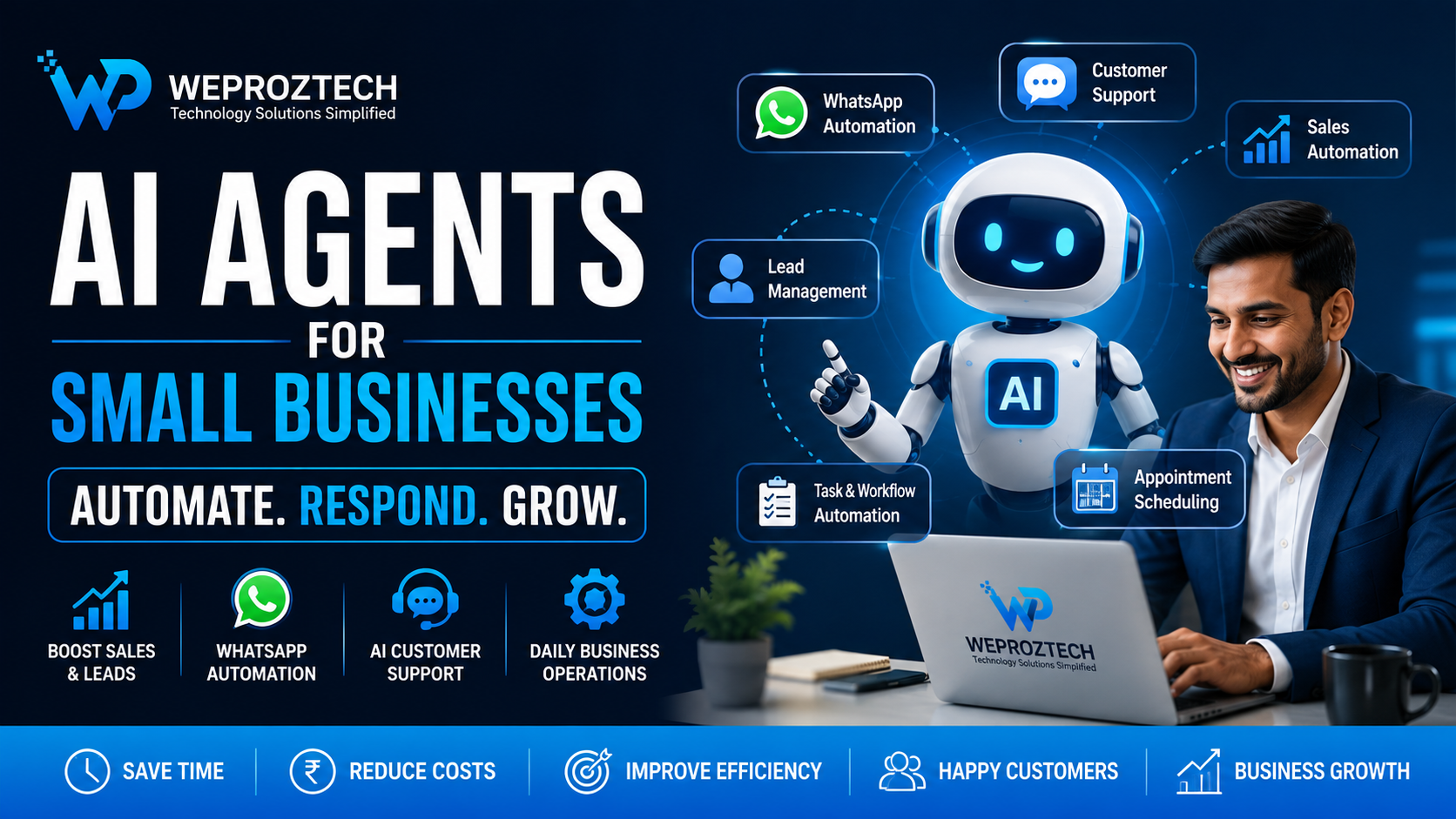
AI Agents for Small Businesses in India: How to Automate Sales, WhatsApp, Customer Support and Daily Operations in 2026
Small businesses in India are under constant pressure to do more with limited time and resources.
A business owner may be handling customer enquiries in the morning, following up with leads in the afternoon, managing WhatsApp messages throughout the day and reviewing operations at night. As the business grows, these repetitive tasks can consume hours that could otherwise be spent on strategy, customers and growth.
This is where AI agents for small businesses in India can make a meaningful difference.
An AI agent is more than a simple chatbot. Depending on how it is designed and connected to business systems, it can help understand requests, retrieve relevant information, follow defined workflows and take approved actions across tools and platforms.
For example, an AI-powered business workflow may help:
- Respond to customer enquiries
- Capture and qualify leads
- Handle common WhatsApp questions
- Schedule appointments
- Send follow-up messages
- Update a CRM
- Route complex requests to human employees
- Generate summaries and reports
- Assist with repetitive operational tasks
The goal is not necessarily to replace people. For most small businesses, the practical goal is to reduce repetitive work and help teams respond faster and more consistently.
In this guide, we explain how AI agents can support Indian businesses in 2026, where they can be useful, how they differ from traditional chatbots, what to consider before implementation and how businesses can begin building AI-powered automation.
Quick Answer: What Are AI Agents for Small Businesses?
AI agents are software systems that can use artificial intelligence to understand goals, process information and carry out defined tasks or workflows.
For a small business, an AI agent could be connected to tools such as:
- WhatsApp or other messaging channels
- Website chat
- CRM software
- Calendars
- Product databases
- Internal documents
- Spreadsheets
- Support systems
A customer might ask:
"What is the price of your service and how can I book a consultation?"
Instead of only displaying a fixed pre-written reply, an AI-powered workflow may be designed to identify the service, retrieve approved information, answer the question, collect the customer's details and offer the next available booking step.
The exact capabilities depend on the AI model, integrations, permissions and workflow designed for the business.
Why Small Businesses in India Are Looking at AI Automation
India has millions of small and growing businesses, but many still rely heavily on manual processes.
Consider a typical service business.
A customer sends a WhatsApp message asking for pricing.
The business owner or employee replies manually.
The customer does not respond.
Later, the business may forget to follow up.
Another lead sends a message through the website. That enquiry may be copied manually into a spreadsheet or CRM.
These individual tasks may appear small. However, when repeated dozens or hundreds of times, they consume significant time.
AI automation for small businesses can help create more structured workflows around repetitive processes.
Common business challenges include:
- Slow responses to enquiries
- Missed WhatsApp messages
- Forgotten lead follow-ups
- Repetitive customer questions
- Manual data entry
- Difficulty managing enquiries from multiple channels
- Limited availability outside working hours
- Inconsistent responses between team members
- Time-consuming reporting
A well-designed AI system can assist with these workflows while allowing human employees to focus on decisions, relationships and complex situations.
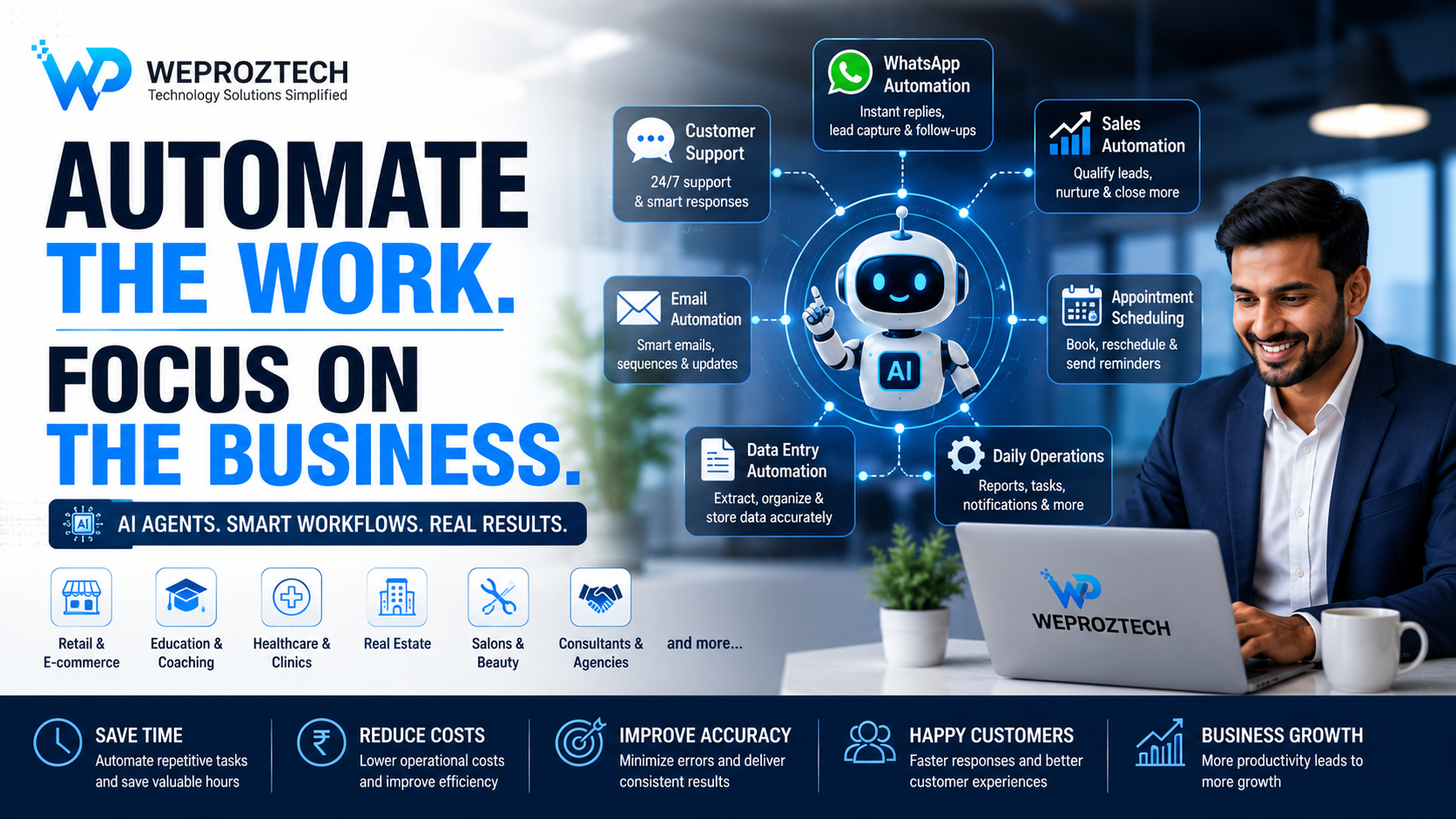 How AI Agents Can Help Small Businesses
The best way to understand AI agents is to look at practical business use cases.
1. AI Sales Agents
Sales teams often spend a significant amount of time on repetitive activities.
For example:
- Answering initial enquiries
- Collecting contact details
- Explaining services
- Qualifying leads
- Following up with prospects
- Updating CRM records
An AI sales agent can support parts of this workflow.
Example workflow
Customer Enquiry
       ↓
AI Understands the Request
       ↓
Answers Approved Questions
       ↓
Collects Lead Details
       ↓
Qualifies the Requirement
       ↓
Creates/Updates CRM Record
       ↓
Routes High-Intent Lead to Sales Team
For example, a website visitor may ask:
"I need an e-commerce website. How much will it cost?"
An AI assistant can be configured to ask relevant questions such as:
- What products do you sell?
- Approximately how many products will be listed?
- Do you need online payments?
- Do you already have a domain?
- What is your approximate project timeline?
The qualified enquiry can then be forwarded to the appropriate team member.
Benefits
- Faster initial responses
- More structured lead collection
- Reduced repetitive sales work
- Better lead routing
- Fewer missed enquiries
The AI system should not make unsupported promises about pricing, delivery or features. Businesses should define approved information and clear escalation rules.
2. WhatsApp AI Automation for Businesses
WhatsApp is an important communication channel for many businesses in India.
Customers may use it to:
- Ask about products
- Request prices
- Book appointments
- Check availability
- Ask about delivery
- Request support
- Follow up on previous conversations
Managing every message manually can become difficult as enquiry volume increases.
A WhatsApp AI automation system can help handle selected conversations.
Example
A customer sends:
"Hello, I want to know about your website development services."
The system could:
- Identify the enquiry type.
- Provide approved introductory information.
- Ask qualifying questions.
- Collect contact information with appropriate consent.
- Create or update a lead.
- Notify a human sales representative when required.
Possible use cases
For a salon
- Service enquiries
- Appointment requests
- Price-related FAQs
- Booking reminders
For a coaching institute
- Course information
- Fee enquiries
- Admission questions
- Demo class requests
For an e-commerce business
- Product information
- Order-related guidance
- Frequently asked questions
- Support routing
For a real estate business
- Property enquiry collection
- Location preferences
- Budget qualification
- Site visit scheduling
The implementation should follow the messaging platform's applicable policies and should not be used for unsolicited spam or abusive bulk messaging.
3. AI Customer Support Agents
Customer support often involves answering similar questions repeatedly.
Examples include:
- What are your working hours?
- What services do you offer?
- Where are you located?
- How can I book?
- What documents are required?
- What is the process?
- How can I contact support?
An AI customer support agent can help answer common questions using business-approved information.
A useful support structure looks like this:
Level 1: AI handles common questions
The AI provides answers based on approved FAQs, knowledge bases and business information.
Level 2: AI collects context
If the question requires human assistance, the system collects relevant details before escalation.
Level 3: Human support
Complex, sensitive or unusual issues are transferred to a human employee.
This approach can reduce repetitive workload without pretending that automation can solve every problem.
AI Agent vs Traditional Chatbot: What Is the Difference?
The terms are sometimes used interchangeably, but there can be an important difference.
| Feature | Traditional Chatbot | AI Agent |
|---|---|---|
| Predefined replies | Common | Can also use approved knowledge |
| Understand natural language | Limited or structured | Usually more flexible |
| Multi-step workflows | Limited | Can be designed for multi-step tasks |
| Tool integrations | Sometimes | Often central to the workflow |
| CRM updates | Basic integration | Can be part of an automated workflow |
| Context handling | Varies | Can support broader contextual workflows |
| Human handoff | Yes | Yes |
| Autonomous actions | Usually limited | Possible within defined permissions |
An AI agent is not automatically better in every situation.
For a simple FAQ with five fixed questions, a traditional chatbot may be enough.
For a workflow involving information retrieval, lead qualification, CRM updates and human escalation, a more advanced AI-powered agent architecture may be useful.
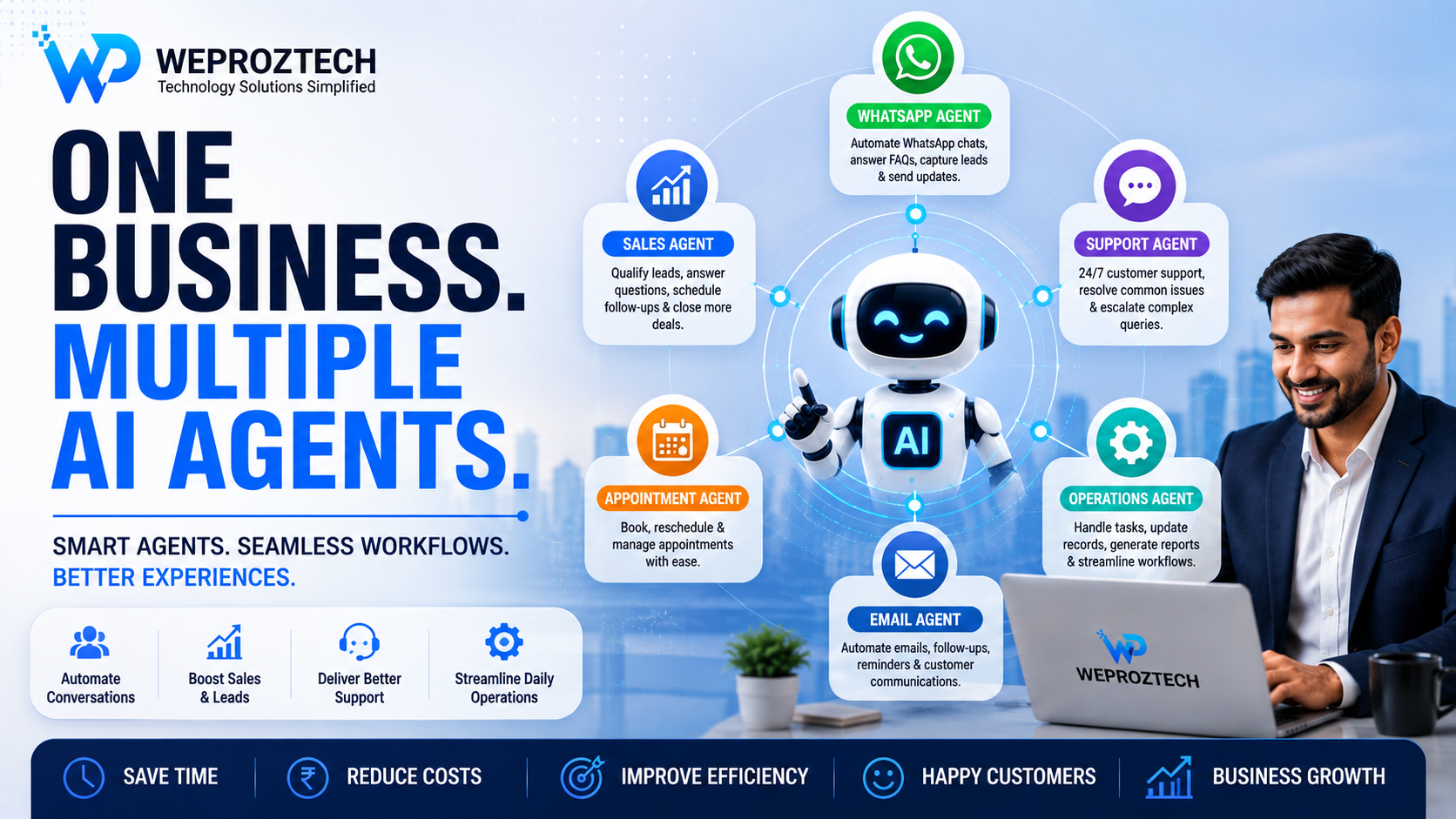 Types of AI Agents Businesses Can Use
Different business problems require different automation.
AI Sales Agent
Designed to help with:
- Initial lead conversations
- Lead qualification
- Service information
- Follow-up workflows
- CRM updates
- Sales team notifications
AI Customer Support Agent
Designed to help with:
- Frequently asked questions
- Support ticket routing
- Knowledge base assistance
- Initial troubleshooting
- Human escalation
AI WhatsApp Agent
Designed to support:
- Customer conversations
- Service enquiries
- Appointment requests
- Lead collection
- Follow-up workflows
AI Appointment Agent
Can assist with:
- Checking availability
- Scheduling appointments
- Sending reminders
- Rescheduling requests
AI Operations Agent
Can assist with selected internal workflows such as:
- Data extraction
- Email processing
- Document summaries
- Spreadsheet updates
- Report generation
- Task routing
AI Knowledge Assistant
Can help employees search approved internal information such as:
- Policies
- Service documentation
- Product information
- Training materials
- Internal FAQs
A Real Example: How an AI Agent Can Automate a Business Workflow
Imagine a digital services company receiving 50 enquiries every day.
Without automation:
Website Lead → Manual Reply → Manual Questions
→ Manual Follow-up → Manual CRM Entry
With an AI-assisted workflow:
Website / WhatsApp Enquiry
            ↓
       AI Assistant
            ↓
     Understands Intent
            ↓
      Retrieves Approved Info
            ↓
       Asks Key Questions
            ↓
       Qualifies the Lead
            ↓
      Updates CRM / Database
            ↓
High-Intent Lead → Human Sales Team
The business can define exactly what the system is allowed to do.
For example, the AI may be allowed to:
✅ Answer approved questions
✅ Collect business requirements
✅ Create a lead record
✅ Schedule an available appointment
But not:
❌ Offer unapproved discounts
❌ Make legal or financial commitments
❌ Invent pricing
❌ Send sensitive information
❌ Replace required human decisions
This controlled approach is generally more practical for business use.
How AI Agents Can Improve Lead Management
Lead management is one of the strongest use cases for AI automation.
A business may receive leads from:
- Website forms
- Google Business Profile
- Social media
- Advertising campaigns
- Landing pages
Without a central workflow, some leads may be missed.
An AI-powered lead workflow can help classify enquiries.
Example lead categories
Hot Lead
Customer has a clear requirement and wants to speak with the team.
Warm Lead
Customer is interested but needs more information.
Cold Lead
Customer is researching without immediate buying intent.
The exact classification rules should be designed around the business rather than relying blindly on AI-generated assumptions.
The system can then trigger different follow-up workflows.
AI Automation for Daily Business Operations
AI agents are not limited to customer-facing conversations.
They can also support internal work.
Email Processing
An AI workflow may help:
- Categorize incoming emails
- Summarize long messages
- Extract action items
- Route emails to appropriate departments
Document Processing
Businesses often receive:
- Forms
- Invoices
- Applications
- PDFs
- Contracts
- Reports
AI-assisted systems can help extract relevant information, subject to appropriate review and privacy controls.
Reporting
An automation system can collect data from connected tools and help generate summaries.
For example:
- Number of leads received
- Lead sources
- Common customer questions
- Appointment activity
- Support trends
Human review remains important, especially when reports influence significant business decisions.
Which Small Businesses Can Benefit From AI Agents?
AI automation can be adapted for many industries.
Clinics and Healthcare Businesses
Potential uses:
- Appointment enquiries
- General service information
- Reminder workflows
- Administrative routing
Healthcare-related systems require extra care around privacy, accuracy and applicable regulations.
Salons and Beauty Businesses
Potential uses:
- Appointment requests
- Service FAQs
- Pricing information
- Booking reminders
Coaching and Educational Institutes
Potential uses:
- Course enquiries
- Admission questions
- Lead collection
- Counselling appointment scheduling
Real Estate Businesses
Potential uses:
- Property enquiries
- Requirement collection
- Budget and location preferences
- Site visit requests
Restaurants
Potential uses:
- Menu-related information
- Reservation workflows
- Customer enquiries
E-commerce Businesses
Potential uses:
- Product discovery
- Frequently asked questions
- Customer support routing
- Order-related assistance
Professional Service Businesses
Such as agencies, consultants and service providers.
Potential uses:
- Initial client qualification
- Consultation scheduling
- Service FAQs
- Lead management
How Much Does AI Automation Cost for a Small Business in India?
There is no single price for every AI agent.
The cost depends on factors such as:
- Number of workflows
- AI model usage
- Message volume
- WhatsApp or other platform integrations
- CRM integration
- Database requirements
- Knowledge base size
- Custom development
- Hosting and infrastructure
- Security requirements
- Ongoing monitoring and maintenance
A simple FAQ assistant may require significantly less work than a custom multi-agent system connected to WhatsApp, CRM, calendars, databases and internal tools.
Businesses should evaluate the expected value rather than only looking at the initial development cost.
For example:
If automation saves several hours of repetitive work every week and reduces missed enquiries, the business may achieve a meaningful operational benefit.
However, the expected ROI should be measured using actual business data.
How to Choose the Right AI Agent Solution
Before building an AI agent, start with the business problem.
Do not begin with:
"We need AI because everyone is using AI."
Instead ask:
What task is repetitive?
For example:
- Responding to FAQs
- Collecting leads
- Scheduling appointments
What information does the AI need?
Create an approved knowledge source.
What actions should it be allowed to perform?
Define permissions clearly.
When should a human take over?
Create escalation rules.
How will performance be measured?
Possible metrics include:
- Response time
- Lead response rate
- Number of enquiries handled
- Appointment conversion
- Human workload reductio
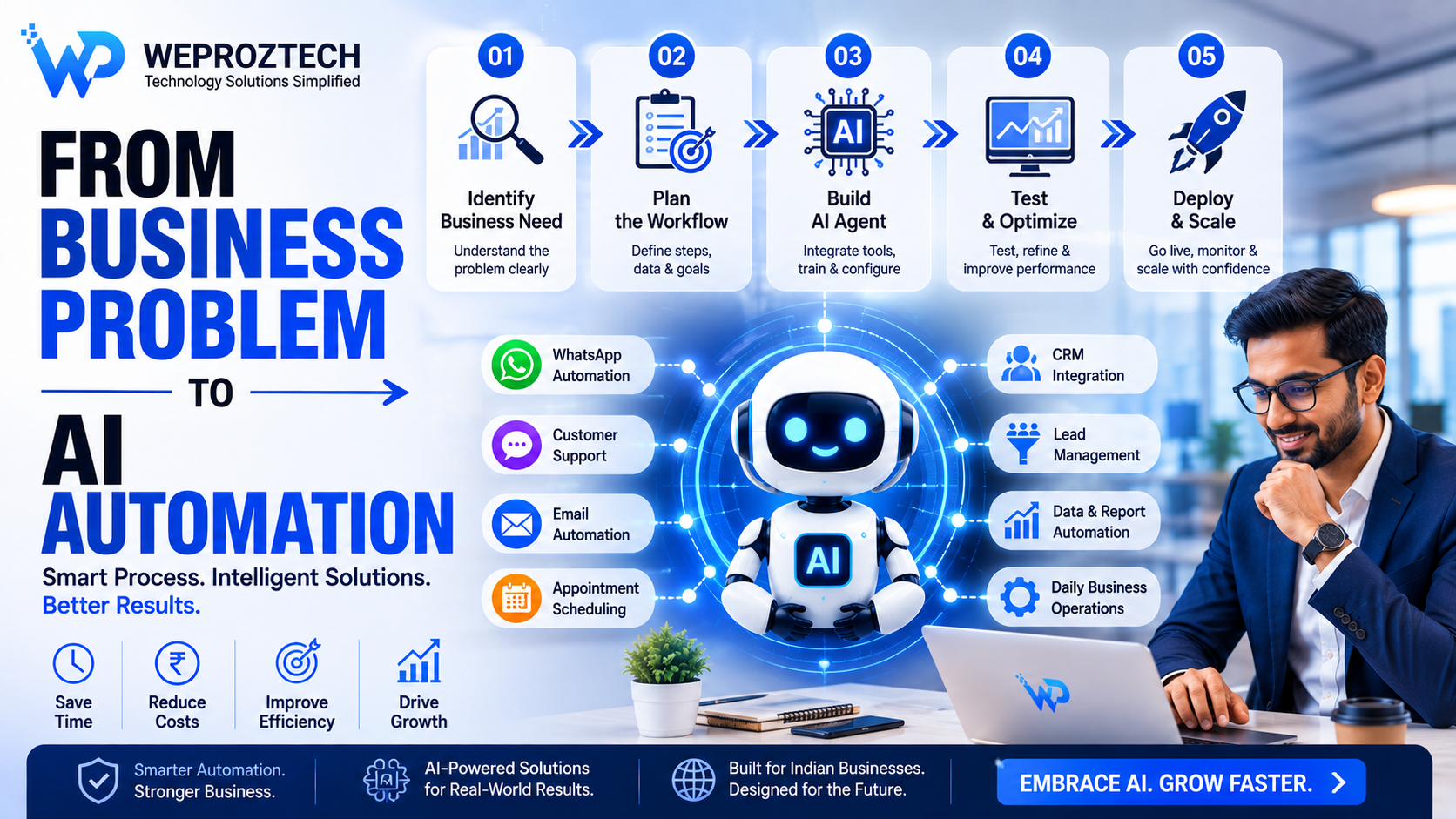 How to Build an AI Agent for Your Business
A practical AI implementation process can look like this.
Step 1: Identify One High-Value Workflow
Start small.
For example:
Automate initial website and WhatsApp enquiries.
Do not try to automate every department immediately.
Step 2: Map the Existing Process
Document:
Customer Message
↓
Who Receives It?
↓
What Information Is Needed?
↓
What Questions Are Asked?
↓
What Happens Next?
↓
Where Is the Lead Stored?
This helps identify unnecessary manual steps.
Step 3: Create an Approved Knowledge Base
The AI needs reliable information.
This may include:
- Service descriptions
- FAQs
- Pricing rules
- Product information
- Business policies
- Process documentation
Poor or outdated information can result in poor responses.
Step 4: Choose the Required Integrations
Depending on the workflow:
- Website
- CRM
- Calendar
- Database
- Internal systems
Step 5: Define AI Permissions
Specify exactly what the system can and cannot do.
Step 6: Test With Realistic Scenarios
Test:
- Normal questions
- Ambiguous questions
- Incorrect information
- Multiple questions
- Requests outside the knowledge base
- Requests requiring human support
Step 7: Launch Gradually
Start with one workflow.
Monitor results.
Improve the system based on actual conversations and business outcomes.
Common Mistakes Businesses Should Avoid
1. Trying to Automate Everything Immediately
Start with one valuable workflow.
2. Giving AI Access to Everything
Use appropriate permissions and limit access to necessary systems.
3. Using Outdated Information
The knowledge base should be reviewed regularly.
4. Removing Human Support
Customers should have a clear path to reach a person when necessary.
5. Ignoring Privacy and Security
Consider what data the system processes and where it is stored.
6. Measuring Only the Number of Conversations
The real question is whether automation improves useful business outcomes.
AI Agents and Human Employees: Replacement or Support?
For many small businesses, the most practical model is:
AI + Human Team
AI can assist with repetitive and structured tasks.
Humans remain important for:
- Complex decisions
- Negotiations
- Sensitive customer situations
- Creative strategy
- Relationship building
- Exceptions and unusual cases
- Final approval for important actions
A successful implementation often focuses on helping employees work more efficiently rather than attempting to remove every human interaction.
The Future of AI Agents for Small Businesses in India
AI technology is becoming easier to integrate into everyday business software.
Over time, more businesses may use AI-powered workflows for:
- Customer communication
- Lead management
- Internal knowledge access
- Sales assistance
- Reporting
- Document processing
- Scheduling
- Operational workflows
However, the businesses likely to benefit most will not necessarily be those using the most AI tools.
They will be the businesses that identify the right problems and build useful, controlled workflows around them.
The question is shifting from:
"Should my business use AI?"
to:
"Which repetitive business process should we improve first?"
That is a much more practical starting point.
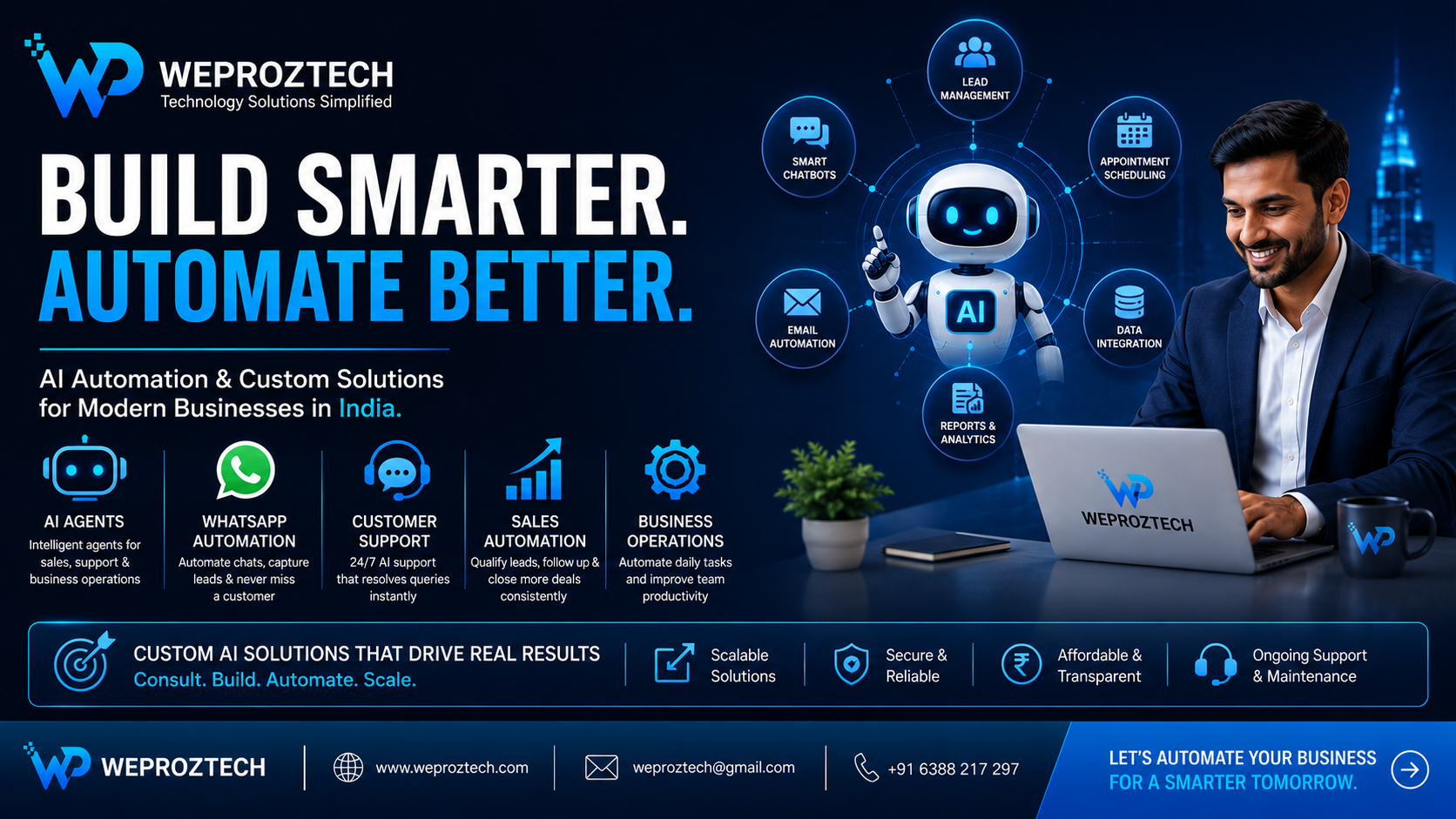
How WEPROZTECH Can Help With AI-Powered Business Solutions
WEPROZTECH helps businesses explore and build technology solutions based on their requirements.
Depending on the project, an AI-powered business solution may involve:
- Custom AI workflows
- AI-powered web applications
- Business automation systems
- AI customer support assistants
- Lead management workflows
- Website integrations
- Mobile applications
- CRM-connected solutions
- Custom software development
- Cloud and hosting infrastructure
Every business has different processes. Instead of using a one-size-fits-all automation system, the workflow should be designed around the actual requirements of the business.
Businesses can start by identifying one repetitive process and evaluating whether automation can improve speed, consistency or efficiency.
Explore WEPROZTECH's technology solutions and discuss your business requirements through the official website.
 Frequently Asked Questions About AI Agents for Small Businesses
What is an AI agent for a small business?
An AI agent is a software system that can use artificial intelligence to understand requests, process information and assist with defined tasks or workflows. Depending on its integrations and permissions, it can support areas such as customer enquiries, lead management, scheduling and internal operations.
Can AI agents automate WhatsApp conversations?
AI-powered workflows can assist with selected WhatsApp business conversations, such as answering approved FAQs, collecting lead information and routing customers to human employees. Businesses should use approved integrations and follow applicable platform policies.
Are AI agents better than chatbots?
It depends on the use case. A simple chatbot may be sufficient for fixed FAQs. AI agents can be more useful for workflows requiring flexible language understanding, information retrieval, integrations and multi-step processes.
Can a small business afford AI automation?
The cost depends on the complexity of the workflow, integrations, AI usage, infrastructure and development requirements. A business can begin with one high-value automation instead of building a large system immediately.
Can AI agents replace employees?
AI agents can automate or assist with repetitive tasks, but human employees remain important for complex decisions, relationships, exceptions and sensitive situations.
What is the best first process to automate with AI?
For many small businesses, a good starting point is a repetitive process with clear steps, such as initial customer enquiries, FAQ responses, lead qualification or appointment scheduling.
How long does it take to build an AI agent?
A simple workflow can require much less development than a custom system with multiple integrations. The timeline depends on the complexity, available data, integrations, testing and business requirements.
Final Thoughts
AI agents are becoming a practical option for businesses that want to reduce repetitive work and improve how they handle enquiries and everyday operations.
For small businesses in India, the best approach is not to automate everything at once.
Start with one real problem.
It could be:
- Too many unanswered WhatsApp messages
- Slow lead follow-up
- Repetitive customer questions
- Manual appointment scheduling
- Time-consuming data entry
Map the process, define the desired outcome, establish appropriate human oversight and test automation carefully.
The businesses that approach AI as a tool for solving real operational problems—rather than simply following a trend—will be in a stronger position to use automation effectively.
Ready to Explore AI Automation for Your Business?
If you are looking to explore a custom AI-powered workflow, website, application or business automation solution, visit:
WEPROZTECH – Technology and Digital Solutions
WEPROZTECH helps businesses build digital solutions tailored to their operational and technology requirements.