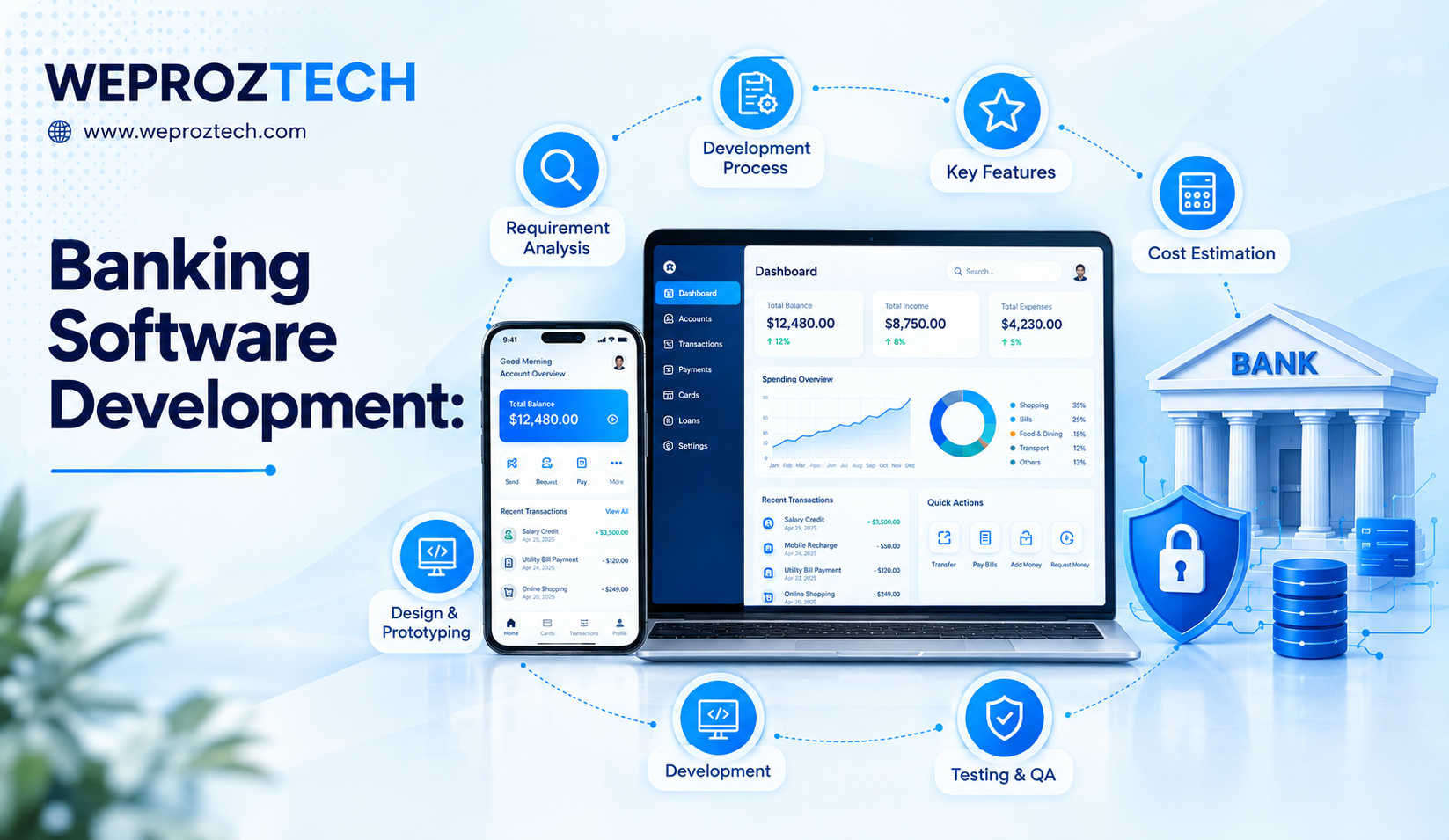
Banking software development is the process of building secure digital systems that help banks, NBFCs, fintech companies and other financial businesses manage customers, accounts, transactions, payments, compliance and internal operations.
Modern banking is no longer limited to branches and traditional banking systems. Customers expect mobile access, instant payments, digital onboarding, real-time notifications and secure self-service. At the same time, financial businesses need strong security, reliable APIs, fraud monitoring, KYC/AML workflows and scalable infrastructure.
A reliable banking software development company can help businesses build custom banking platforms that connect mobile apps, web portals, payment systems, APIs, databases and third-party financial services.
Why Banking Software Development Is Important
Digital banking has changed customer expectations. People want to check balances, transfer money, make payments and manage cards without visiting a branch.
For financial businesses, custom banking software can help with:
- Customer and account management
- Digital onboarding and KYC
- Fund transfers and payments
- Transaction tracking
- Loan and financial workflows
- Fraud monitoring
- Notifications and customer support
- Reporting and analytics
- API and third-party integrations
- Internal banking operations
Businesses can also connect banking software with their existing ERP, CRM and other enterprise systems through custom integrations.Enterprise ERP Solutions
Traditional Banking vs Digital Banking
| Traditional Banking | Digital Banking |
|---|---|
| Branch-based services | Mobile and web-based services |
| Manual processes | Automated workflows |
| Limited operating hours | 24/7 access |
| Paper-based documentation | Digital documentation |
| Slower processing | Real-time processing |
| Separate systems | API-connected ecosystem |
| Manual customer support | Digital and AI-assisted support |
The goal of banking software development is not simply to create another banking application. It is to build a connected technology ecosystem that makes financial services faster, safer and easier to manage.
Banking Software Development Market in 2026
Banking technology is moving toward AI, payments modernization, better digital experiences, cybersecurity and connected financial platforms.
KPMG's 2026 banking research highlights continued investment in AI, cybersecurity, payments and data capabilities. It also reports that online and mobile channels remain major customer experience priorities, while banks are increasingly applying AI to areas such as cybersecurity and fraud detection.
For businesses, this creates opportunities to develop:
- Digital banking platforms
- Mobile banking applications
- Payment solutions
- Fintech applications
- Banking APIs
- Customer portals
- Loan management systems
- AI-powered financial tools
- Fraud detection system
Key Features of Banking Software
A modern banking software solution can include different modules depending on the business model.
1. Customer Management
Manage customer profiles, accounts, KYC information, documents and communication from a centralized system.
2. Account Management
Customers and authorized staff can access account information, balances, statements and transaction history.
3. Payments and Fund Transfers
Banking platforms can integrate payment gateways, transfer systems and other financial services through secure APIs.
4. Digital KYC
Digital onboarding can reduce manual verification and make customer registration faster.
5. Transaction Management
The system can record, process and monitor financial transactions with appropriate authorization and audit controls.
6. Notifications
SMS, email, push notifications and other communication channels can keep customers informed about account activity.
7. Admin Dashboard
Administrators can manage users, permissions, transactions, reports, alerts and system activities from a centralized dashboard.
8. Reporting and Analytics
Business teams can use dashboards and reports to understand transactions, customers, operations and financial activity.
Banking Software Security and Fraud Prevention
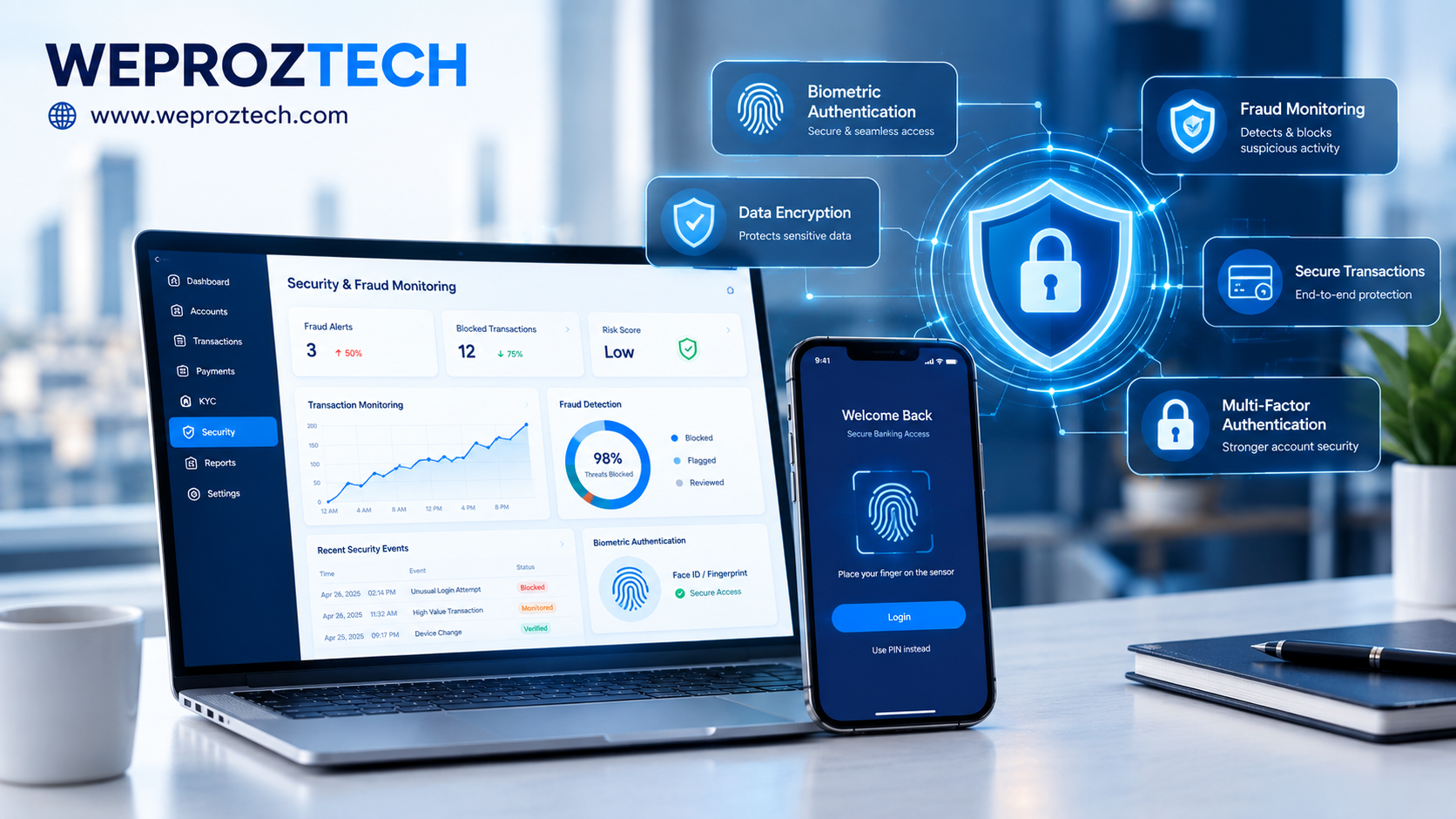
Security is one of the most important parts of banking software development because financial applications handle sensitive customer and transaction data.
A secure banking platform can use:
- Multi-factor authentication
- Biometric authentication
- Encryption
- Role-based access control
- Secure API authentication
- Transaction monitoring
- Audit logs
- Fraud detection
- Session management
- Vulnerability testing
- Secure data storage
- Backup and disaster recovery
Security should be considered from the architecture stage rather than added after development.
For regulated entities, RBI's IT outsourcing directions also address application development, maintenance and testing, network/security solutions, data centres, cloud computing and managed security services.
 KYC, AML and Regulatory Requirements
Banking software often needs to support KYC, AML and customer due-diligence processes.
Depending on the financial business and applicable regulations, software may include:
- Customer verification
- Document collection
- Risk classification
- Transaction monitoring
- Suspicious activity alerts
- Audit trails
- Periodic KYC updates
- Compliance reporting
RBI updated its KYC Directions in June 2025, including provisions related to periodic KYC updates for certain low-risk individual customers.
Therefore, software requirements should be designed around the applicable regulatory framework rather than treating compliance as a simple add-on.
Open Banking and API Integration
Modern banking software rarely works as a completely isolated system.
APIs can connect banking platforms with:
- Payment gateways
- KYC providers
- CRM systems
- ERP platforms
- Accounting software
- Notification services
- Identity verification systems
- Fintech applications
- External financial platforms
Banking Platform → Secure API Layer → Payment/KYC/CRM/ERP Services
WEPROZTECH provides custom API development and systems integration for businesses that need to connect multiple applications and services
Mobile Banking Software
Mobile banking is an important part of modern banking software development.
A mobile banking application can provide:
- Secure login
- Biometric authentication
- Account balances
- Money transfers
- Bill payments
- Transaction history
- Card management
- Digital KYC
- Push notifications
- Customer support
- Security alerts
The mobile app should normally work with a secure backend and API layer rather than directly accessing sensitive databases.
AI in Banking Software Development
AI is becoming an important part of modern financial technology.
AI can support:
- Fraud detection
- Customer support
- Risk analysis
- Document processing
- Transaction monitoring
- Customer personalization
- Credit assessment
- Operational automation
KPMG's 2026 research notes that financial institutions are increasingly using AI across fraud detection, cybersecurity, risk and customer operations.
In India, AI is also increasingly being positioned as an intelligence layer over digital financial infrastructure, with applications in fraud detection, credit assessment, customer service and risk management AI Consulting Services
Common Challenges in Banking Software Development
Developing financial software is more complex than building a standard business application.
Security Risks
Financial platforms are attractive targets for fraudsters and cybercriminals. Security needs to cover applications, APIs, infrastructure, databases and user accounts.
Legacy System Integration
Banks and financial businesses may already use older systems. New software needs to integrate with these systems without disrupting existing operations.
Regulatory Compliance
KYC, AML, data protection, outsourcing and other regulatory requirements can affect architecture, workflows and data management.
Scalability
The platform should be able to handle increasing customers, transactions and API requests without performance problems.
Fraud Prevention
Real-time transaction monitoring and risk-based controls become increasingly important as digital transactions grow.
Data Protection
Customer and financial data must be protected through appropriate access controls, encryption, monitoring and governance.
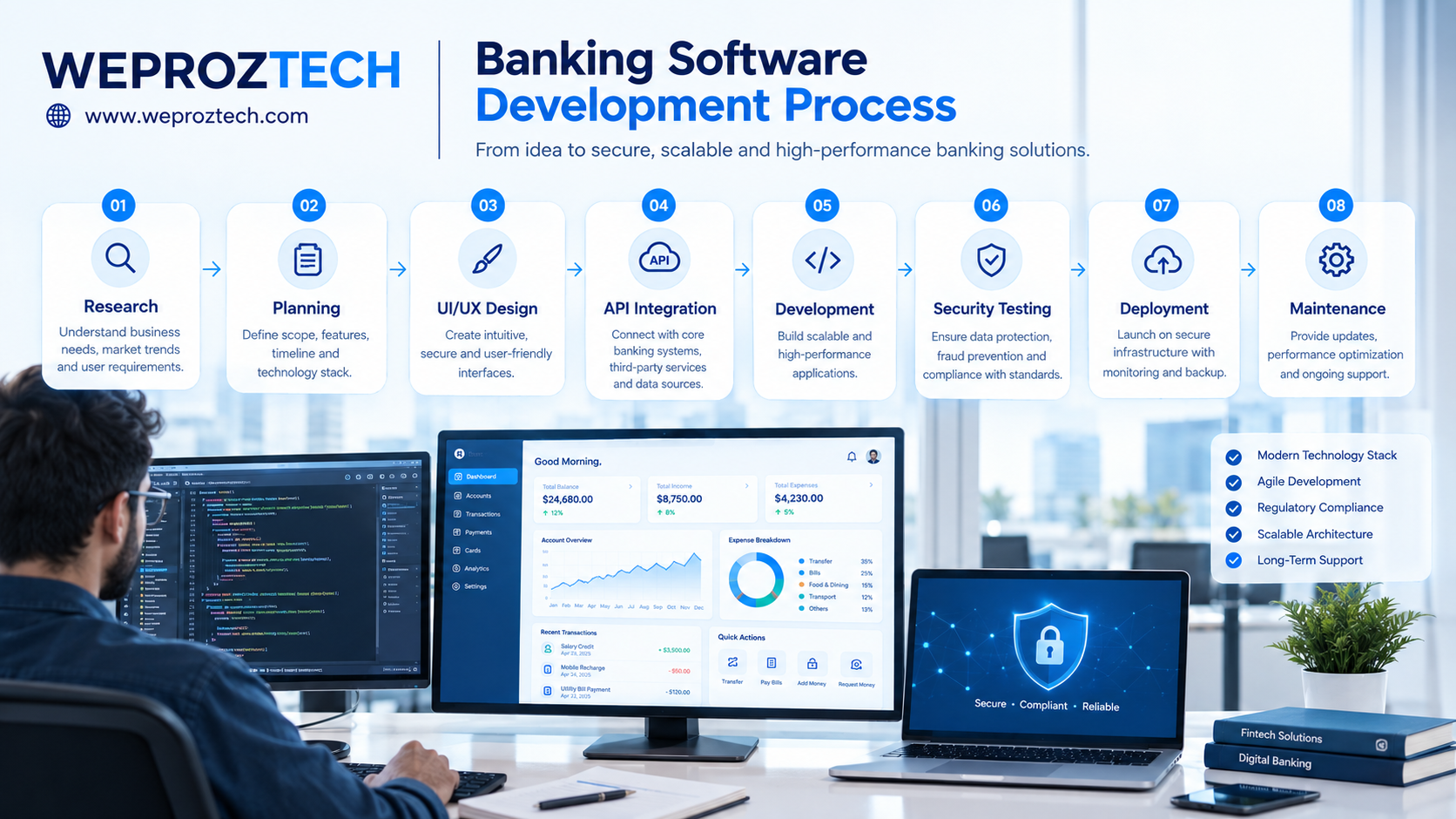
Banking Software Development Process
A professional banking software development company generally follows a structured development process.
1. Market Research and Planning
First, define the target users, business model, regulatory requirements, competitors and required banking workflows.
2. Requirement Analysis
Document features, integrations, user roles, security requirements and business processes.
3. UI/UX Design
Create simple interfaces for customers, employees, administrators and other users.
4. Architecture and API Planning
Design the backend architecture, database, APIs, authentication, integrations and infrastructure.
5. Software Development
Develop the web application, mobile application, backend services, APIs and admin panel.
6. Security and Testing
Test functionality, performance, APIs, authentication, permissions and security before deployment.
7. Deployment
Deploy the software to the required cloud or infrastructure environment and configure monitoring.Implementation & Deployment Services
8. Maintenance and Updates
Banking software requires continuous maintenance, security updates, performance improvements and integration updates.Application Maintenance Services
 Banking Software Development: Custom vs Ready-Made
A ready-made banking solution can work when the business needs standard features and wants faster implementation.
Custom banking software is more suitable when a business needs:
- Unique workflows
- Custom dashboards
- Specific integrations
- Advanced automation
- Custom APIs
- Specialized security requirements
- Business-specific user roles
- Long-term scalability
The right option depends on the organization's requirements, budget, timeline and existing technology infrastructure.
Why Choose WEPROZTECH for Banking Software Development?
WEPROZTECH can help businesses build and integrate custom software solutions around their specific technology requirements.
Our capabilities include:
- Custom web application development
- Mobile application development
- API development
- Systems integration
- ERP solutions
- AI consulting
- Cloud infrastructure
- Software deployment
- Application maintenance
Instead of developing an isolated application, the focus can be on building a complete technology ecosystem that connects your users, backend systems, APIs, databases and third-party services.
Explore: WEPROZTECH Services
Banking Software Development Trends in 2026
Some of the important trends shaping banking technology include:
- AI-powered banking operations
- Real-time fraud detection
- Digital onboarding
- Open banking and API ecosystems
- Personalized financial experiences
- Mobile-first banking
- Payment modernization
- Cloud-based infrastructure
- Automated compliance workflows
- Stronger cybersecurity
- AI-assisted customer support
- Agentic AI for selected financial workflows
The broader direction is moving from basic digital banking toward more intelligent, connected and automated financial platforms.
How Much Does Banking Software Development Cost?
The cost depends on the complexity of the software.
Major cost factors include:
- Number of platforms
- Mobile app requirements
- Backend complexity
- API integrations
- KYC/AML requirements
- Security architecture
- Admin dashboards
- AI features
- Cloud infrastructure
- Testing requirements
- Maintenance and support
A simple financial application and a complete banking platform can have very different development requirements. Therefore, it is better to estimate cost after understanding the exact business and technical requirements.
Conclusion
Banking software development is now an important part of modern financial services. A successful platform needs more than an attractive mobile application. It needs secure architecture, reliable APIs, customer management, transaction processing, compliance workflows, fraud monitoring and scalable infrastructure.
For banks, NBFCs, fintech companies and financial businesses, custom banking software can provide greater control over workflows and integrations while creating a better digital experience for customers.
If you are planning a custom banking software solution, WEPROZTECH can help with software architecture, development, APIs, integrations, AI, deployment and ongoing maintenance.
Discuss Your Software Requirements with WEPROZTECH
FAQs
What is banking software development?
Banking software development is the process of creating digital systems for managing banking and financial operations such as accounts, payments, transactions, customers, KYC, reporting and integrations.
What features should banking software have?
Common features include customer management, account management, payments, transaction processing, KYC, notifications, reporting, admin controls, security and API integrations.
How much does banking software development cost?
The cost depends on features, integrations, security requirements, platforms, compliance requirements and development complexity.
Can banking software include a mobile application?
Yes. A banking platform can include Android and iOS applications connected to a secure backend and API infrastructure.
Can AI be integrated into banking software?
Yes. AI can be used for fraud detection, customer support, document processing, risk analysis, personalization and workflow automation.
Is custom banking software better than ready-made software?
Custom software can be better when a business requires specific workflows, integrations, security controls or scalability that ready-made software cannot provide.