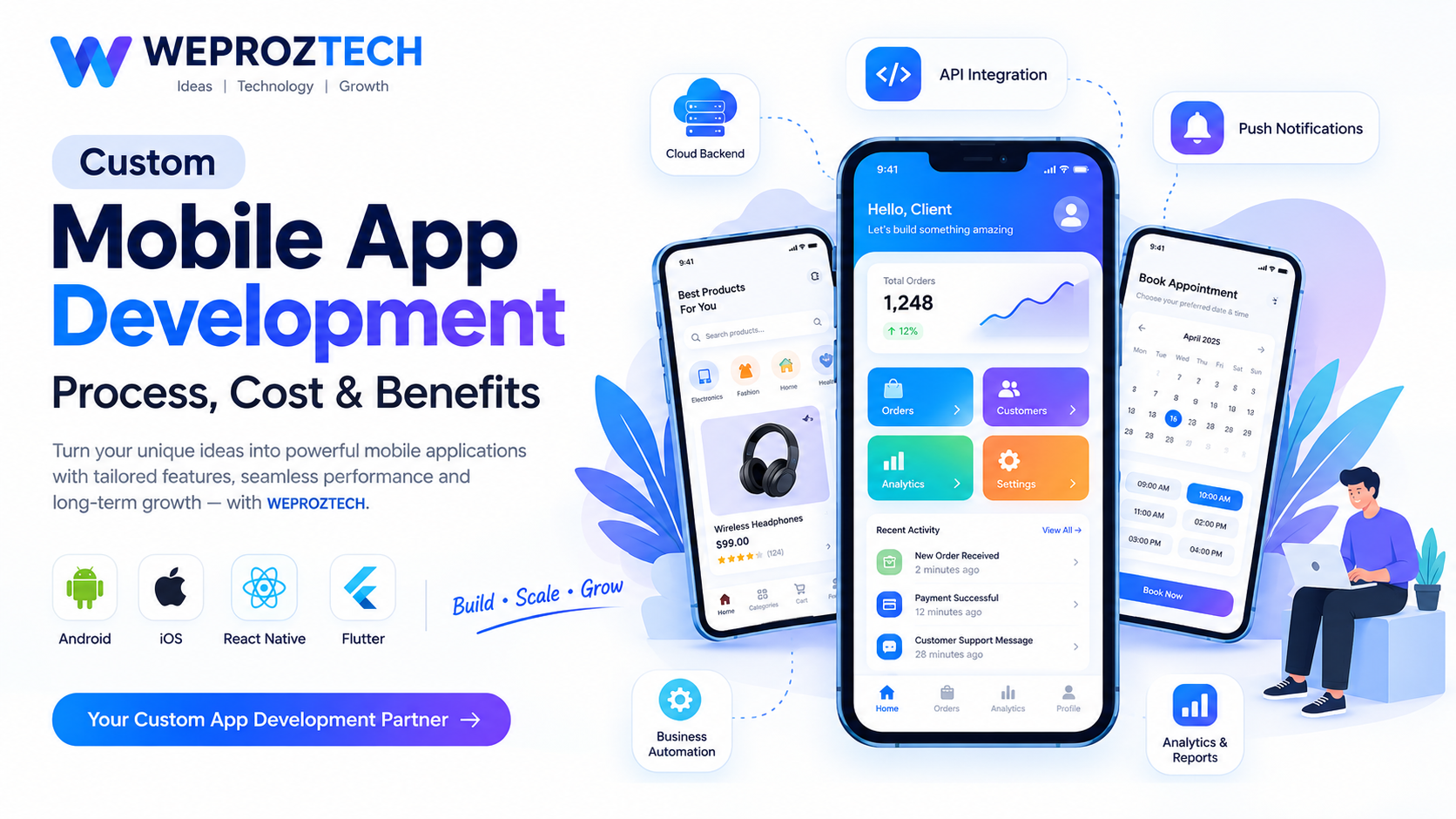
What Is Custom Mobile App Development?
Custom mobile app development is the process of designing and building a mobile application specifically around the requirements, workflows, customers, employees, and business objectives of an organization.
Unlike generic or ready-made applications, custom applications are developed according to the specific functionality a business needs. This may include custom user interfaces, authentication, dashboards, payment systems, APIs, notifications, CRM or ERP integrations, analytics, role-based access, and custom admin panels.
For example, an ecommerce company may require an application for product browsing, online ordering, payments, order tracking, customer support, and notifications. A school may need a mobile application for attendance, fees, assignments, results, notices, and parent communication.
A business can therefore build software around its actual workflow instead of changing its workflow to fit a generic application.
If you are looking for broader technology solutions along with mobile development, you can explore WEPROZTECH's technology services, which include mobile apps, custom web portals, ERP systems, cloud infrastructure, and business automation.
Why Businesses Choose Custom Mobile App Development
Mobile applications can provide businesses with a dedicated digital channel for customers, employees, partners, and internal teams.
While websites are important for visibility and information, mobile applications can provide features such as push notifications, personalized dashboards, mobile authentication, device capabilities, and application-specific workflows.
Custom development becomes especially useful when a business has requirements that cannot be handled efficiently by generic software.
Build Around Exact Business Requirements
A custom application can be designed according to the company's actual processes.
For example, an application can include:
- Customer registration
- Employee login
- Product catalog
- Booking system
- Online payments
- Customer support
- Attendance
- Leave requests
- CRM integration
- ERP integration
- Inventory management
- Delivery tracking
- Reports and analytics
This allows the application to be developed around the business instead of forcing the business to adopt a fixed software workflow.
Deliver a Better Customer Experience
A custom mobile application can provide a more personalized experience for users.
Different interfaces can be created for:
- Customers
- Employees
- Managers
- Teachers
- Students
- Vendors
- Delivery staff
- Administrators
Each user can access features according to their role.
Automate Business Processes
Custom mobile applications can also reduce manual processes.
For example, instead of submitting paper-based leave requests, employees can open the application, select a leave type, choose dates, submit the request, and track approval status from their phones.
The same concept can be applied to sales, customer support, attendance, field operations, bookings, inventory, and many other workflows.
Custom Mobile App Development vs Ready-Made Apps
Businesses generally have two options when they need mobile software: choose an existing application or build a custom solution.
Ready-Made Mobile Applications
Ready-made applications are created for a broad audience and can be useful when a business has common requirements.
However, businesses may face limitations related to:
- Customization
- Integrations
- User roles
- Branding
- Business workflows
- Data control
- Scalability
- Advanced automation
Custom Mobile Applications
Custom mobile applications are developed around specific business requirements.
They can provide:
- Custom features
- Custom UI/UX
- Business-specific workflows
- API integrations
- Custom dashboards
- Role-based access
- Business automation
- Scalable architecture
- Custom admin panels
For organizations with unique processes or long-term software requirements, custom development can provide greater flexibility.
Key Features of a Custom Mobile App
The features required in a mobile application depend on the business model and target audience.
Modern applications commonly include several components.
User Registration and Login
A custom application can provide authentication through:
- Email and password
- Mobile number
- OTP
- Social login
- Multi-factor authentication
- Biometric authentication where supported
The authentication system should be selected according to the application's security and user-experience requirements.
User Profiles
Users can manage:
- Name
- Contact details
- Profile photo
- Address
- Preferences
- Account settings
- Documents
Different user roles can have different profile structures.
Push Notifications
Push notifications allow businesses to communicate directly with application users.
Examples include:
- Order updates
- Appointment reminders
- Payment notifications
- New offers
- New messages
- Task notifications
- Leave approvals
- School announcements
- Service updates
Search and Filters
Applications containing large amounts of information can provide advanced search and filtering.
For example, an ecommerce application may allow customers to filter products according to:
- Category
- Price
- Brand
- Rating
- Availability
Online Payments
Payment gateways can be integrated for supported digital transactions.
Common use cases include:
- Product purchases
- Subscription payments
- Booking payments
- Course fees
- Service payments
Admin Dashboard
A custom mobile application normally requires an administrative system to manage application data.
An admin dashboard may include:
- User management
- Content management
- Orders
- Payments
- Notifications
- Customer support
- Products
- Categories
- Analytics
The mobile application can communicate with the admin system through secure APIs.
Analytics and Reports
Businesses can monitor:
- New users
- Active users
- Orders
- Revenue
- Bookings
- Customer activity
- Product performance
- User engagement
These insights can help businesses make better operational decisions.
Android App Development and iOS App Development
Custom mobile applications can be developed for one or multiple platforms.
Android App Development
Android applications can target a broad range of smartphones and devices.
Businesses may prioritize Android development when their target audience primarily uses Android devices.
iOS App Development
iOS applications are designed for Apple devices such as iPhone and iPad.
Businesses targeting Apple users may require a dedicated iOS application.
Cross-Platform App Development
Cross-platform development allows applications to be developed for multiple platforms using a shared development approach.
Technologies such as React Native can be suitable for many business applications.
WEPROZTECH currently lists Flutter, React Native, Kotlin and Swift among its mobile development technologies.
For technology-specific implementation details, developers can also refer to the official React Native documentation.
React Native for Custom Mobile App Development
React Native is one option for building cross-platform mobile applications.
It can help development teams create Android and iOS applications using a shared technology approach.
React Native can be suitable for applications such as:
- Business applications
- Ecommerce applications
- Education applications
- Booking applications
- Social applications
- Service applications
- Customer portals
- Employee applications
However, technology selection should always be based on the project's requirements.
Some applications may require extensive native functionality, in which case native development using technologies such as Kotlin or Swift may be more appropriate.
Custom Mobile App Development Process
A successful mobile application requires more than coding. The development process generally includes planning, design, development, testing, deployment, and ongoing maintenance.
Step 1: Requirement Analysis
The first stage is understanding what the application needs to accomplish.
The development team should identify:
- Business objectives
- Target users
- User roles
- Required features
- Business workflows
- Third-party integrations
- Security requirements
- Platform requirements
- Scalability requirements
A clear requirements document helps reduce confusion during development.
Step 2: Market and Competitor Research
Before development begins, businesses should understand their market.
Research can identify:
- Competitor features
- Customer expectations
- Common usability problems
- Pricing models
- Market gaps
- Differentiating opportunities
The objective should not simply be to copy competitors but to understand how the new application can provide additional value.
Step 3: UI/UX Design
The design team creates the application's user experience and visual interface.
Typical stages include:
- User flows
- Wireframes
- Screen designs
- Navigation structure
- Prototypes
- Design systems
A good UI should make important actions easy to understand.
Step 4: Technology Selection
The development team selects technologies according to the project's requirements.
Possible technologies include:
- React Native
- Flutter
- Kotlin
- Swift
- Node.js
- Python
- PostgreSQL
- MongoDB
- Redis
- REST APIs
- Cloud infrastructure
Technology should be selected based on performance, scalability, features, budget, maintenance, and project requirements.
Step 5: Backend Development
The backend handles application data and business logic.
It can manage:
- Authentication
- User accounts
- Database operations
- Payments
- Notifications
- APIs
- Business rules
- Reports
- Integrations
The backend connects the mobile application with databases and external systems.
Step 6: Mobile App Development
The development team converts approved designs into functional application screens.
This stage can include:
- Login
- Registration
- Dashboard
- Profile
- Search
- Product pages
- Booking
- Payments
- Notifications
- Chat
- Reports
- Settings
Step 7: API Integration
APIs allow the mobile application to communicate with external systems.
Examples include:
- Payment gateways
- Maps
- CRM
- ERP
- SMS
- Analytics
- Cloud storage
For businesses that need their application to connect with internal software, API architecture becomes particularly important.
Step 8: Testing
Before launch, the application should be tested across relevant scenarios.
Testing may include:
- Functional testing
- UI testing
- API testing
- Performance testing
- Security testing
- Device testing
- Network testing
- User acceptance testing
Testing helps identify problems before users encounter them.
Step 9: Deployment
After testing and approval, the application can be prepared for deployment.
This can include:
- Production server setup
- Application configuration
- Store assets
- Google Play submission
- App Store submission
- Production database
- Analytics configuration
Step 10: Maintenance and Updates
Mobile app development does not necessarily end after launch.
Applications may require:
- Bug fixes
- Security updates
- OS compatibility updates
- New features
- Performance improvements
- UI improvements
- Server maintenance
Ongoing maintenance helps keep the application secure and compatible with changing platforms.
Custom Mobile App Development for Different Industries
Custom applications can be developed for many industries.
Ecommerce
Ecommerce applications can provide:
- Product browsing
- Shopping cart
- Wishlist
- Checkout
- Online payments
- Order tracking
- Customer accounts
- Offers
- Notifications
Education
Educational applications can support:
- Student profiles
- Online classes
- Notes
- Assignments
- Exams
- Results
- Attendance
- Fees
- Notifications
- Discussion features
WEPROZTECH also showcases a Weproz Schools ERP ecosystem with student/parent functionality, digital fee collection, attendance, and report cards.
Healthcare
Healthcare applications may include:
- Doctor discovery
- Appointment booking
- Patient profiles
- Reports
- Prescriptions
- Notifications
- Teleconsultation
- Payments
Healthcare applications require careful consideration of privacy, security, and applicable regulations.
Restaurants and Food Businesses
Restaurant applications can support:
- Digital menus
- Online ordering
- Table booking
- Delivery tracking
- Offers
- Customer accounts
- Loyalty programs
Real Estate
Real estate applications can provide:
- Property listings
- Search
- Filters
- Property details
- Images and videos
- Location maps
- Agent contact
- Inquiry forms
Logistics and Delivery
Logistics applications can support:
- Driver management
- Delivery assignments
- Location tracking
- Delivery status
- Customer notifications
- Proof of delivery
HR and Employee Management
Employee applications can provide:
- Attendance
- Leave requests
- Employee profiles
- Documents
- Payroll information
- Task management
- Notifications
- Internal communication
Custom Mobile App Development for Small Businesses
Custom app development is not limited to large enterprises.
Small and medium-sized businesses can use mobile applications to improve customer engagement and internal operations.
For example, a local service company could build an application that allows customers to:
- Create an account
- Book services
- Make payments
- Track appointments
- Receive notifications
- Contact support
An internal employee application could help manage:
- Attendance
- Tasks
- Leave
- Field employees
- Customer visits
- Reports
The important factor is whether the application solves a genuine business problem.
How Much Does Custom Mobile App Development Cost?
The cost of custom mobile app development depends heavily on the project's scope.
There is no single fixed cost that applies to every application.
Factors include:
Number of Platforms
Developing for Android, iOS, or both can affect project scope.
Number of Features
A basic application requires less development than an application containing:
- Payments
- Chat
- Maps
- Live tracking
- AI
- Complex dashboards
- Multiple user roles
- ERP integrations
UI/UX Complexity
Highly customized interfaces and advanced user experiences may require additional design and development effort.
Backend Requirements
Custom APIs, complex business logic, databases, and integrations can increase development requirements.
Third-Party Integrations
Payment gateways, maps, CRM systems, ERP systems, analytics, messaging platforms, and other integrations can affect development complexity.
Security Requirements
Applications handling sensitive customer or business information may require additional security controls and testing.
Maintenance
Businesses should also consider post-launch maintenance, updates, and infrastructure costs when calculating the overall investment.
For a project-specific estimate, businesses should provide their feature list, target platforms, integrations, expected users, and design requirements to the development company.
Mobile App Development and Business Automation
A custom application can also act as the front end for automated business workflows.
For example:
Mobile App → API → Database → CRM/ERP → Business Team
A customer can submit an inquiry through the mobile application, the backend can store the information, a CRM can create a lead, and the sales team can receive a notification.
Similarly:
Employee App → Attendance → Database → HR Dashboard
or:
Customer Order → Payment → Order Management → Notification → Delivery
WEPROZTECH's ERP solutions include role-based access, attendance telemetry, payroll calculations, and WhatsApp/SMS automation through official Meta Cloud APIs, making this type of connected business workflow relevant for organizations that want mobile apps integrated with broader business systems.
API and Third-Party Integration
Modern mobile applications frequently communicate with external systems through APIs.
Payment APIs
Used for:
- Online payments
- Refunds
- Transaction verification
Maps APIs
Used for:
- Location
- Navigation
- Delivery tracking
- Store discovery
CRM APIs
Used for:
- Lead management
- Customer records
- Sales activity
ERP APIs
Used for:
- Inventory
- Orders
- Accounting workflows
- Business operations
Communication APIs
Used for:
- SMS
- Push notifications
- WhatsApp-based communication
The required integrations depend on the business model and application architecture.
Custom Mobile App Development for Startups
Startups often need to validate their idea without building every possible feature at the beginning.
A practical approach is to define a Minimum Viable Product, or MVP.
An MVP focuses on the essential functionality required to validate the business idea.
For example, a marketplace MVP could include:
- User registration
- Listings
- Search
- Booking or ordering
- Payment
- User profile
- Basic admin panel
Advanced functionality can be introduced after the product is validated with real users.
Custom Mobile App Development for Enterprises
Enterprise applications generally have more complex requirements.
They may require:
- Multiple user roles
- Role-based permissions
- Advanced dashboards
- ERP integration
- CRM integration
- Multiple branches
- Employee management
- Audit logs
- Advanced reporting
- Enterprise authentication
- Scalable infrastructure
For these applications, architecture, security, performance, and maintainability become especially important.
WEPROZTECH's current portfolio includes custom software and application projects such as ConnectApp, Med-e-Pal, and InventorySys ERP, demonstrating work across mobile and business software categories.
You can view the WEPROZTECH portfolio to explore these projects.
Security Considerations for Custom Mobile Apps
Security should be considered from the architecture stage rather than added only after development.
Important areas include:
- Secure authentication
- Authorization
- API security
- Data encryption
- Secure database access
- Input validation
- Session management
- Secure storage
- Access control
- Security testing
For mobile application security best practices, developers can refer to the OWASP Mobile Top 10, which provides guidance around common mobile security risks.
Security requirements should also be evaluated according to the type of data the application processes and the regulations applicable to the business.
Hosting and Backend Infrastructure for Mobile Apps
A mobile application also requires reliable backend infrastructure.
Depending on the application, infrastructure may include:
- Application servers
- API servers
- Databases
- File storage
- Backup systems
- Monitoring
- Security layers
- CDN
- Scaling infrastructure
For applications with heavy backend requirements, server performance can affect the overall user experience.
WEPROZTECH provides cloud and NVMe VPS infrastructure designed for APIs, enterprise applications, databases, and high-concurrency workloads.
You can explore WEPROZTECH cloud and NVMe hosting if your mobile application also requires backend hosting infrastructure.
Common Mistakes to Avoid During App Development
Building Too Many Features Initially
Adding every possible feature can make the first version expensive and difficult to use.
Start with the features that solve the core business problem.
Ignoring User Experience
An application can have excellent technical functionality but still fail if users find it confusing.
Not Planning the Backend Properly
A poorly designed backend can create scalability and maintenance problems.
Ignoring Security
Security should be considered during architecture, development, testing, and deployment.
Not Testing on Real Devices
The application should be tested across relevant devices, operating-system versions, screen sizes, and network conditions.
Choosing Technology Without Understanding Requirements
The newest technology is not automatically the best technology for every application.
Technology should be selected based on the project's actual requirements.
How to Choose a Custom Mobile App Development Company
Selecting the right development partner can have a significant impact on the success of the project.
Check Technical Expertise
Look for experience with technologies relevant to your project.
Review Previous Projects
A company's portfolio can help you evaluate its previous application and software work.
You can explore WEPROZTECH's app development portfolio before discussing your project.
Understand the Development Process
Ask how the company handles:
- Requirements
- UI/UX
- Development
- Testing
- Deployment
- Maintenance
Ask About Security
Understand how user data, APIs, authentication, databases, and infrastructure will be protected.
Check Scalability
The application should be designed with future growth in mind.
Discuss Ownership
Before development begins, clarify ownership of:
- Source code
- Design files
- Database
- Domain
- Hosting
- APIs
- Third-party accounts
This helps avoid confusion later.
Why Choose WEPROZTECH for Custom Mobile App Development?
WEPROZTECH develops customized mobile and software solutions for businesses, startups, institutions, and organizations.
Its current services include cross-platform and native mobile applications, with technologies including Flutter, React Native, Kotlin, and Swift.
Depending on the project, a custom application can include:
- Android applications
- iOS applications
- Cross-platform applications
- Custom UI/UX
- Backend APIs
- Admin dashboards
- CRM integration
- ERP integration
- Payment integration
- Push notifications
- Business automation
- Cloud deployment
The mobile application can also be connected to broader business systems such as ERP, CRM, databases, and automated workflows.
If you are planning a new application, you can contact WEPROZTECH's technical team with your requirements, preferred platforms, features, and integrations.
Frequently Asked Questions About Custom Mobile App Development
What is custom mobile app development?
Custom mobile app development is the process of creating a mobile application specifically according to a business's requirements, workflows, users, and functionality.
How is custom app development different from a ready-made app?
A ready-made application provides predefined functionality for a broad audience, while custom app development allows the software to be designed around the specific requirements of a business.
How much does custom mobile app development cost?
The cost depends on features, platforms, UI/UX complexity, backend requirements, integrations, security requirements, and maintenance. A detailed quotation requires understanding the complete project scope.
How long does it take to develop a custom mobile app?
The timeline depends on the application's complexity, number of screens, platforms, integrations, backend requirements, testing, and revisions.
Can one app work on both Android and iOS?
Yes. Cross-platform technologies such as React Native and Flutter can be used for suitable projects. Native development can also be selected when platform-specific functionality requires it.
Can a mobile app connect with an existing CRM or ERP?
Yes. A custom mobile application can communicate with CRM, ERP, databases, and other business systems through APIs where the required integration capabilities are available.
Can a custom mobile app include online payments?
Yes. Supported payment gateways can be integrated into mobile applications according to the business model and payment requirements.
Can a custom mobile app be upgraded later?
Yes. A well-designed application can be maintained and expanded with new features, integrations, performance improvements, and security updates.
Is custom app development suitable for small businesses?
Yes. Small businesses can use custom applications when an app can solve a specific customer, operational, booking, sales, or employee-management problem.
Why should businesses invest in custom mobile app development?
Custom applications can provide greater control over functionality, user experience, integrations, automation, and future scalability compared with generic solutions.
Final Thoughts
Custom mobile app development can help businesses turn specific ideas, workflows, and customer requirements into dedicated digital products.
From ecommerce and education to healthcare, logistics, real estate, HR, and enterprise operations, a custom application can be designed around the actual needs of its users.
The most important part of app development is not simply building more features. It is identifying the right problem, designing a simple user experience, selecting appropriate technology, creating a secure architecture, testing thoroughly, and planning for future growth.
If your business is planning an Android app, iOS application, cross-platform solution, customer application, employee application, ecommerce app, or connected business software ecosystem, the first step is to clearly define the business objective, target users, core features, integrations, platform requirements, and long-term goals.
Ready to Build Your Custom Mobile App?
Share your application idea, required features, target platform, integrations, and business objectives with the WEPROZTECH technical team.
Contact WEPROZTECH for Custom Mobile App Development
Phone: +91 8881033200
Email: info@weproztech.com