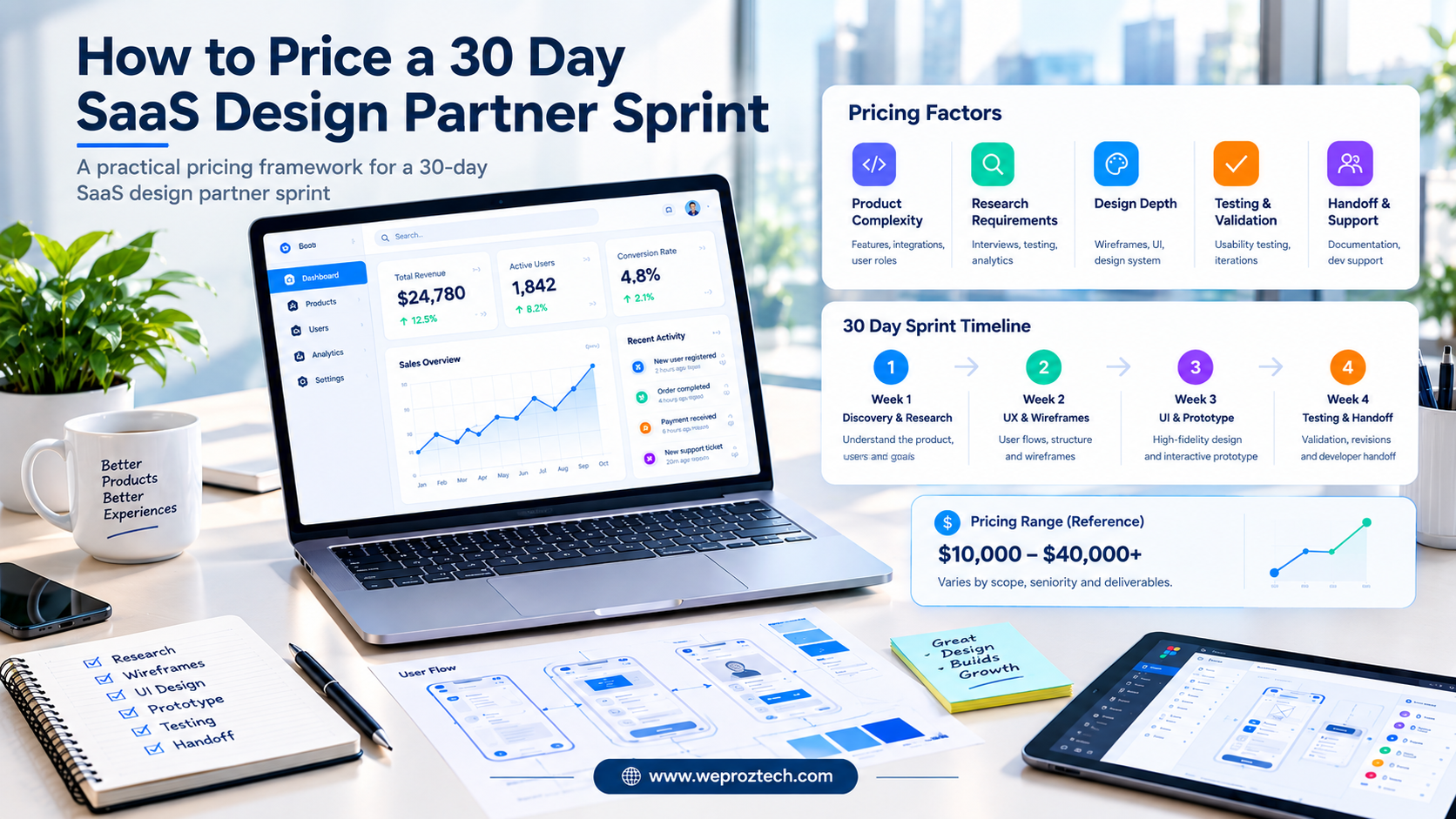
Pricing a 30 day SaaS design partner sprint can be difficult because the work is not simply about creating screens. A design partner may help understand the product, identify user problems, improve workflows, create prototypes, test ideas and prepare designs for development.
The right price depends on what the sprint needs to achieve, how much research is required, how complex the product is and how involved the designer will be with the product team.
For a SaaS company, the goal should be to define a clear outcome first and then build the price around the work required to reach it. Current 2026 market references show that SaaS design sprint pricing can vary widely, with published ranges changing according to scope, seniority, research and whether development is included.
What Does a 30 Day SaaS Design Partner Sprint Include?
A 30 day sprint usually works best when it focuses on one important product problem rather than trying to redesign the entire SaaS platform.
The work may include product discovery, UX analysis, user-flow planning, wireframes, UI design, interactive prototypes, usability testing and developer handoff. Some projects may require only a few of these activities, while others need the complete process.
For example, improving a SaaS onboarding experience may require analysing where users leave, redesigning the onboarding flow and testing the new experience. A complex dashboard redesign may require much more work because different users, permissions, data states and workflows need to be considered.
Before deciding the price, clearly define:
- What product problem is being solved?
- Which screens or workflows are included?
- Is user research required?
- How much UI design is expected?
- Will usability testing be performed?
- What will developers receive at the end?
- How many review and revision rounds are included?
This makes the project easier to estimate and prevents scope problems later.
User research is particularly useful when the team needs to understand how real users interact with a product before making design decisions. GOV.UK user research guidance
How Much Should You Charge for a 30 Day SaaS Design Sprint?
There is no single price that applies to every SaaS design sprint. Published 2026 sources currently show design-only and design-plus-development engagements ranging from roughly $10,000 to $40,000, while other senior fixed-fee sprint benchmarks extend beyond that depending on the scope and level of involvement.
A practical planning range can look like this:
| Sprint Type | Approximate Range | Typical Work |
|---|---|---|
| UX Audit Sprint | $5,000–$12,000 | Product review, UX issues, recommendations |
| Focused Design Sprint | $10,000–$25,000 | One important workflow, UX/UI and prototype |
| Research-Based Sprint | $20,000–$35,000 | Research, design, testing and validation |
| Senior Product Design Sprint | $30,000–$50,000+ | Strategy, complex UX/UI, testing and detailed handoff |
These figures should be treated as directional market references rather than fixed industry prices. The same 30-day period can represent very different amounts of work.
For Indian SaaS companies, pricing should also account for local team costs, product complexity, research requirements and the seniority of the people involved instead of simply converting an overseas price into INR. Current Indian 2026 pricing guides also show wide variation in SaaS UI/UX costs based on complexity and delivery scope.
What Actually Determines the Price?
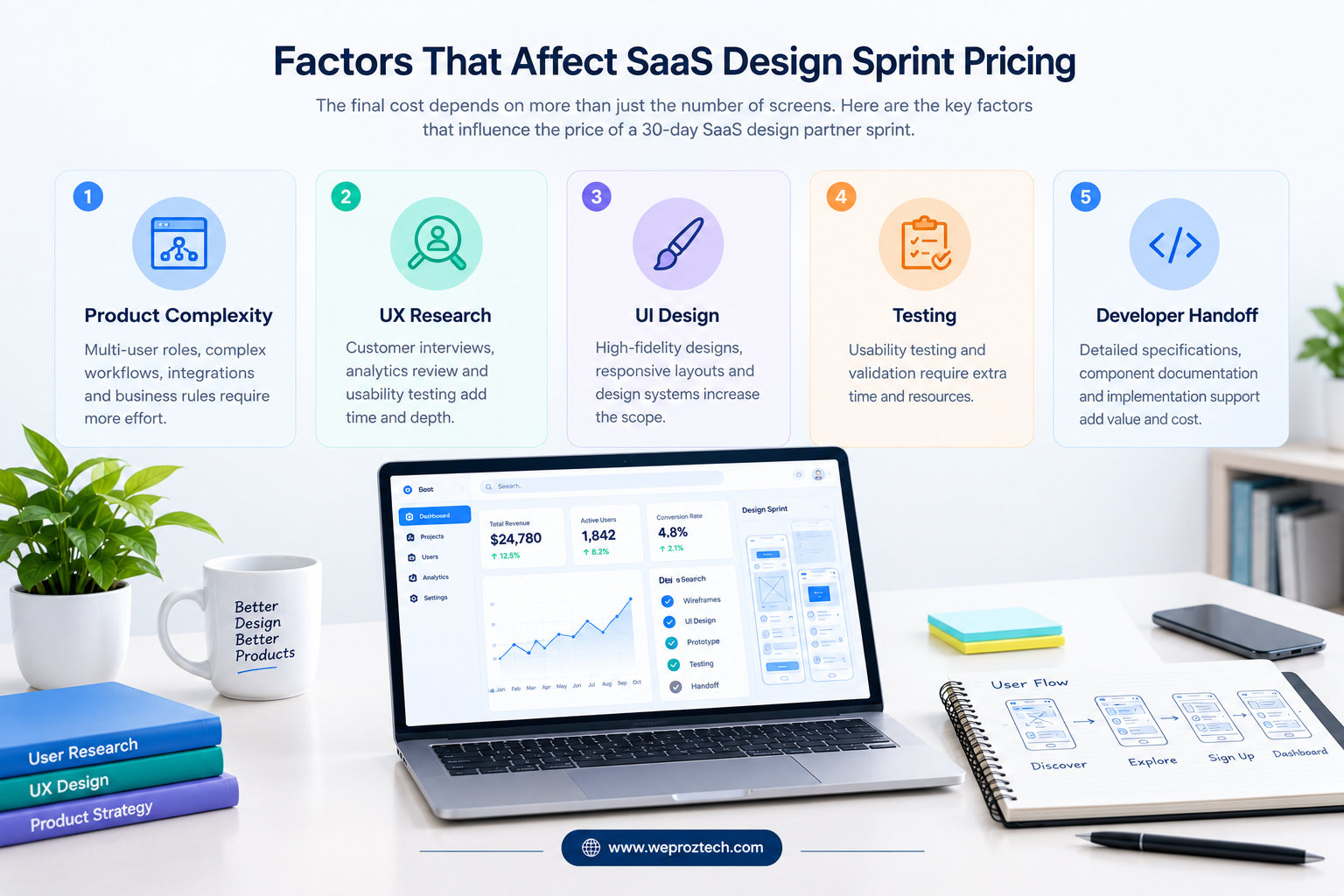
The number of screens is only one part of the calculation.
A five-screen workflow with multiple user roles, permissions, error states and complex business rules can require more work than twenty simple screens.
Research is another major factor. If the design partner needs to interview customers, review analytics, study support tickets or conduct usability testing, additional time is required.
Product complexity also matters. A basic SaaS dashboard is different from an enterprise platform involving administrators, managers, customers, vendors and multiple workflows.
Design quality and fidelity affect the scope as well. A basic wireframe is faster to produce than a polished responsive interface with reusable components, interaction states and a complete design system.
Finally, consider handoff responsibility. If the design partner only provides Figma screens, the engagement is different from one where the designer prepares detailed specifications, explains interactions to developers and supports implementation.
Accessibility can also become part of the design scope when a product needs to support a wider range of users. The current W3C WCAG 2.2 recommendation provides accessibility guidance for web content across devices. W3C WCAG 2.2
 How Should the 30 Days Be Structured?
A 30-day sprint should have a clear working plan so the project does not become a collection of meetings and revisions.
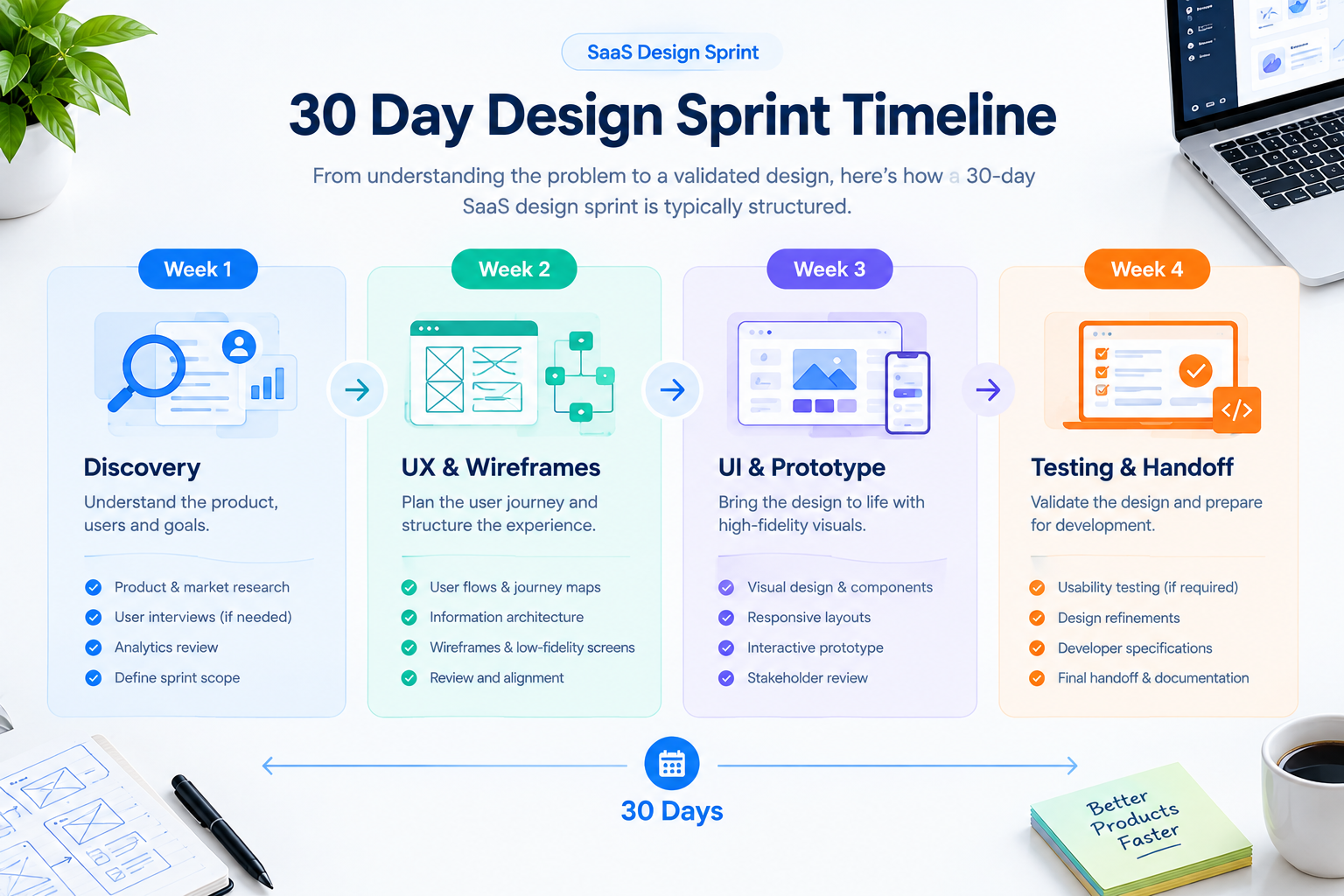
During the first week, the team can understand the product, review existing research and analytics, identify the main problem and agree on the sprint scope.
The second week can focus on user journeys, information architecture, wireframes and early design concepts.
The third week can move into high-fidelity UI and interactive prototypes. If testing is part of the project, this is a good stage to validate important assumptions with representative users.
The fourth week can be used for refinement, final design decisions, documentation and developer handoff.
The exact schedule can change depending on the product, but the important point is that every week should have a clear purpose and expected output.
 Which Things Should Increase the Price?
A higher fee can be justified when the design partner is taking on more responsibility or dealing with greater complexity.
For example, the price may increase when the project includes customer interviews, usability testing, analytics research, complex dashboards, multiple user roles, responsive web and mobile designs, accessibility requirements or a new design system.
The involvement of senior product designers can also affect pricing. A senior partner may be expected to participate in product decisions, challenge assumptions, communicate with founders and product managers, and help the team decide what should actually be built.
Engineering support can also add value. A handoff that includes component specifications, interaction states, edge cases and implementation guidance requires more work than simply exporting design files.
When Can the Price Be Lower?
Not every project requires a large research and strategy engagement.
A lower fee may be appropriate when the company already has strong customer research, clear analytics and an established design system.
The project may also be smaller if it focuses on one well-defined workflow rather than several product areas.
Fast client feedback can reduce delays as well. If there is one decision-maker and design reviews happen quickly, the team can spend more time solving the actual product problem.
If the budget is limited, reducing the scope is usually better than simply asking for a discount while keeping all deliverables unchanged.
For example, instead of redesigning an entire SaaS platform, the sprint could focus only on onboarding, checkout, reporting or the main dashboard.
Fixed Fee, Hourly Pricing or Monthly Retainer?
For a clearly defined 30-day sprint, a fixed fee is often the easiest model because both sides know the expected budget and deliverables before work starts. Current 2026 pricing guides also commonly position fixed-fee pricing as a practical model for clearly defined sprint outcomes.
Hourly pricing can be useful when the problem is still unclear and the scope is likely to change during discovery. The disadvantage is that the final cost becomes less predictable.
A monthly retainer makes more sense when the company needs continuous product design after the initial sprint. This can include new features, UX improvements, design-system maintenance and ongoing design support.
Whatever model is selected, clearly mention the number of meetings, revision rounds, included workflows and additional-scope rules.
What Should a SaaS Design Sprint Proposal Include?
A good proposal should make it easy for the client to understand what they are paying for.
Start with the business problem and explain what the sprint is expected to improve. Then define the product area, users, deliverables, timeline and responsibilities.
The proposal should clearly separate included work and excluded work.
For example, development may not be included in a design-only engagement. Branding, additional product modules, unlimited revisions and ongoing design support should also be listed separately if they are outside the sprint.
A simple proposal structure can be:
Project Goal → Scope → Research → UX/UI Deliverables → Testing → Timeline → Client Responsibilities → Handoff → Price → Additional Work
This makes the price easier to understand and reduces the chance of disagreement later.
Why the Value of the Sprint Is More Than the Design Files
A SaaS design partner is not only being paid to make interfaces look better.
Good product design can help a company identify confusing workflows, reduce unnecessary steps, improve onboarding, clarify product information and validate an idea before development resources are committed.
For a startup, avoiding one poorly planned feature can save significant development time. That is why the value of the engagement should be connected to the product decision being improved rather than only the number of screens delivered.
This approach also changes the pricing conversation. Instead of asking How many screens will I get?, the better question is What product problem will this sprint help us solve?
How to Build a Practical 30 Day Pricing Formula
A simple way to calculate the price is to divide the engagement into four areas:
Discovery and Strategy: Product understanding, research review, UX analysis and planning.
UX and UI Design: User flows, wireframes, high-fidelity screens and responsive layouts.
Validation: Prototypes, customer feedback and usability testing where required.
Handoff and Support: Design documentation, developer communication, specifications and implementation guidance.
For a focused senior SaaS engagement, a working range of $15,000–$35,000 can be used as a planning reference, while more complex engagements may go beyond this range. This is consistent with several current 2026 published market references, although actual quotes depend heavily on scope and seniority.
For an Indian company, calculate the final INR price based on the actual people involved, working hours, research, product complexity and deliverables.
If development is also included, keep the design and development scope clearly separated. A design-only sprint and a design-plus-build engagement should not be priced as the same service.
For SaaS teams that need both product design and development, WEPROZTECH provides custom web application development, SaaS-style dashboards, API integrations and ERP-connected business applications. custom web application development by WEPROZTECH
For businesses that need an ERP-connected SaaS workflow, WEPROZTECH also provides custom ERP and business software solutions. WEPROZTECH custom ERP solutions
What If the SaaS Product Needs Development After Design?
A design sprint can be used as the first stage of a larger product-development process.
Once the UX and UI are validated, the next stage may include frontend development, backend APIs, database architecture, authentication, payment integration, third-party APIs and cloud deployment.
For startups, this can be particularly useful when the team wants to validate the product experience before committing to a larger development budget. WEPROZTECH's MVP process similarly includes product analysis, interactive wireframes, scope definition, UI/UX design and subsequent development stages. WEPROZTECH MVP development
If the product requires AI features, automation or integrations, those requirements should also be scoped separately. AI workflows can involve additional API, data, security and testing requirements. WEPROZTECH currently offers AI consulting and implementation services for custom business workflows. WEPROZTECH AI consulting and implementation
Businesses exploring AI-enabled SaaS workflows can also read WEPROZTECH's existing guide on AI agents for small businesses in India, which covers AI workflows, CRM connections, customer communication and business automation. AI Agents for Small Businesses in India
Where a SaaS product needs backend connectivity or third-party integrations, custom API development can also be scoped as a separate part of the project rather than mixing it into the design sprint. WEPROZTECH Custom API Development Services
Final Thoughts
Pricing a 30 day SaaS design partner sprint should start with the problem being solved, not the number of days on the calendar.
A clear scope, defined deliverables, realistic timeline and suitable pricing model make the engagement easier for both the SaaS company and the design partner.
The most useful pricing question is not simply What does 30 days of design cost? It is What level of product thinking, design work, validation and handoff does this 30-day engagement require?
Once those requirements are clear, the price becomes much easier to calculate and explain.
Frequently Asked Questions
How much does a 30 day SaaS design sprint cost?
A 30-day SaaS design sprint can vary considerably depending on scope. Current 2026 market references commonly place focused engagements in the $10,000–$40,000 range, while senior or complex projects can exceed that range.
What is included in a SaaS design partner sprint?
Depending on the project, it can include product discovery, UX research, user flows, wireframes, UI design, interactive prototypes, usability testing and developer handoff.
Should I charge a fixed fee for a 30 day design sprint?
A fixed fee can work well when the problem, scope and deliverables are clearly defined. If the project is highly uncertain, hourly or time-and-materials pricing may provide more flexibility.
Does the number of screens determine SaaS design pricing?
Not by itself. User roles, workflow complexity, research, interaction states, responsive requirements and developer handoff can have a greater effect on effort than the raw number of screens.
Should development be included in a design sprint?
Not necessarily. A design sprint can end with validated designs and developer-ready documentation. If development is required, it is usually clearer to define the engineering scope separately.