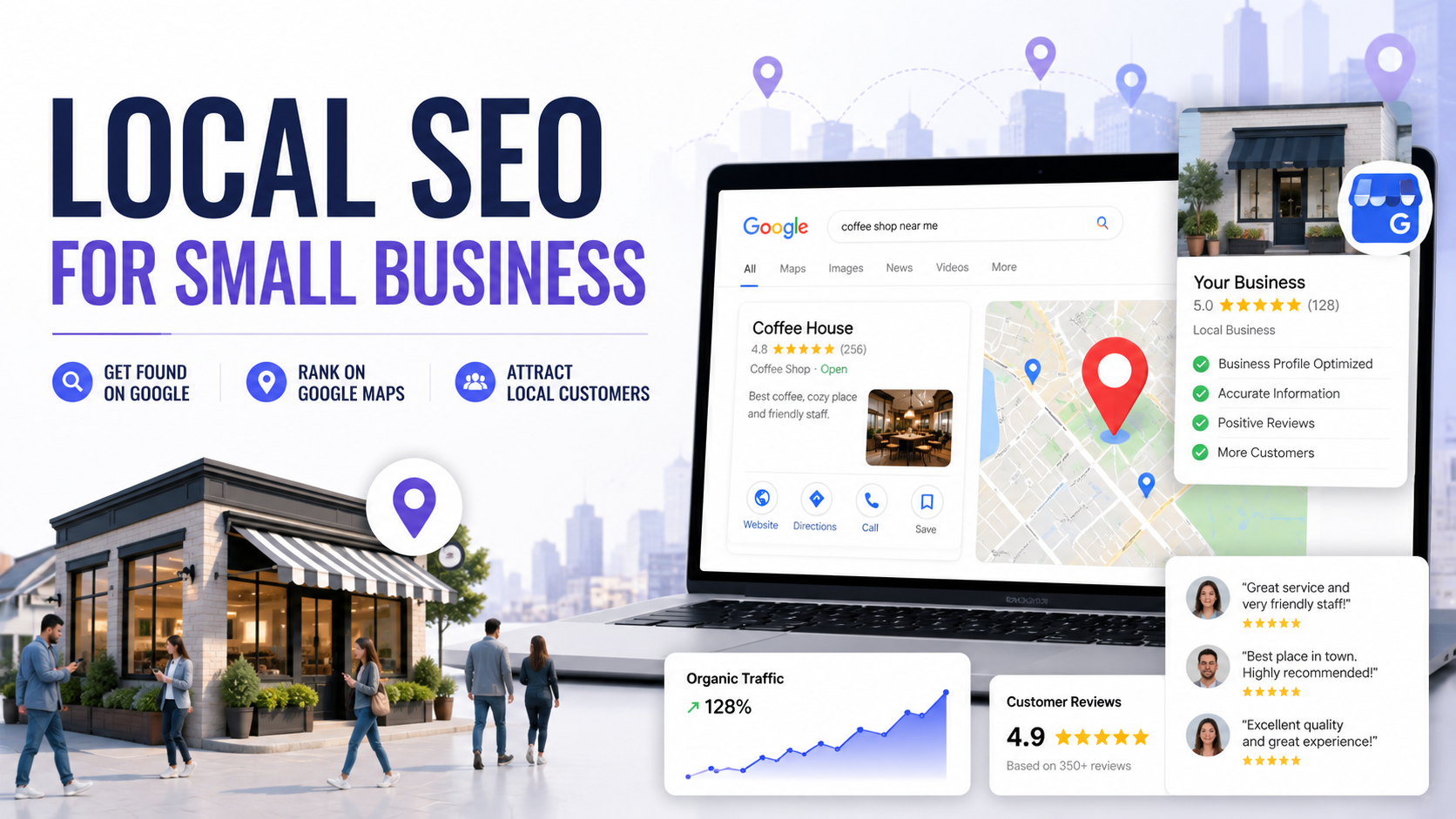
Get More Local Customers with a Strong Local SEO Strategy
If you own a local business, being visible when potential customers search on Google can make a significant difference to your growth.
People search every day for businesses and services near their location. Whether they are looking for a restaurant, salon, architect, doctor, coaching institute, hotel, repair service, consultant, store, or any other local business, Google and Google Maps are often the first places they look.
That is where Local SEO for Small Business becomes important.
Local SEO helps businesses improve their visibility in local search results, Google Maps, and location-based searches. Instead of competing only for broad national or international keywords, a local SEO strategy focuses on helping your business appear when people in your target area are actively searching for the products or services you offer.
For example, potential customers may search for:
- SEO company near me
- Web development company in Lucknow
- Best architect in my area
- Digital marketing agency near me
- Salon near me
- Restaurant in Lucknow
- Interior designer near me
- Small business SEO services
- Local services near me
A well-planned local SEO strategy can help your business improve its online visibility across Google Search and Google Maps.
At WEPROZTECH, we help businesses improve their digital presence through website development, SEO, software development, mobile applications, and business technology solutions.
Whether you are starting from scratch or already have a website and Google Business Profile, the right local SEO strategy can help you identify opportunities to improve your local search presence.
What Is Local SEO for Small Business?
Local SEO is the process of improving a business's online visibility for location-based searches.
It focuses on helping search engines understand:
- What your business does
- Where your business is located
- Which areas you serve
- Which products or services you offer
- Whether your business information is accurate
- How relevant your business is to a user's search
For a small business, Local SEO may involve improving multiple digital assets, including:
- Your business website
- Google Business Profile
- Google Maps presence
- Service pages
- Location pages
- Business information
- Customer reviews
- Local citations
- On-page SEO
- Technical SEO
- Local backlinks
The goal is to make it easier for potential customers to discover relevant information about your business when searching online.
Example of Local SEO
Suppose you operate an architecture firm in Lucknow.
A potential customer might search:
Architect in Lucknow
Best architecture firm near me
Interior designer in Lucknow
Turnkey construction company Lucknow
Your Local SEO strategy should help search engines understand that your business provides those services and is relevant to users searching in your target location.
Why Is Local SEO Important for Small Businesses?
Small businesses often have a major advantage: they understand their local market, customers, services, and service areas.
However, that advantage may not automatically translate into online visibility.
If your business information is difficult to find, your website is poorly optimized, or your Google Business Profile is incomplete, potential customers may discover competitors instead.
A strong small business local SEO strategy can help improve several areas of your online presence.
Improve Visibility in Local Search Results
Local SEO can help search engines better understand your business and its geographic relevance.
This can support visibility for searches related to:
- Your services
- Your business category
- Your city
- Your locality
- Your service areas
- "Near me" searches
Get Discovered on Google Maps
Google Maps is an important discovery platform for local businesses.
Customers can use Maps to:
- Find nearby businesses
- Check business information
- Read reviews
- Get directions
- Visit websites
- Call businesses
- Check opening hours
An optimized business presence can make it easier for customers to access this information.
Attract More Relevant Website Visitors
Local SEO focuses on people who are searching for specific services in specific locations.
For example:
Generic search:
Web development company
Local search:
Web development company in Lucknow
The second search has clearer geographic intent.
Build Trust with Accurate Information
Customers expect basic information to be consistent across the web.
This includes:
- Business name
- Address
- Phone number
- Website
- Business hours
- Services
Consistent information can improve the customer experience and reduce confusion.
How Does Google Local Search Work?
When Google shows local search results, several factors can influence which businesses and pages appear for a particular query.
Google's official local ranking guidance explains that local results are influenced primarily by relevance, distance, and prominence. Google Business Profile Help – Local Ranking
In practical terms, your local SEO strategy should focus on helping Google understand these three major areas.
1. Relevance
Relevance refers to how closely your business matches what the user is searching for.
For example, if someone searches for:
Digital marketing agency in Lucknow
Your website and business information should clearly communicate:
- That you provide digital marketing services
- Which specific services you offer
- Which locations you serve
This information can appear across your:
- Website pages
- Service pages
- Google Business Profile
- Business descriptions
- Structured data
2. Distance
Distance relates to the relationship between the user's location or specified location and relevant businesses.
For example:
Restaurant near Hazratganj
Google may prioritize businesses that are geographically relevant to that area.
This is why accurate location and service-area information is important.
3. Prominence
Prominence generally relates to how well-established or recognized a business appears across the web.
Factors may include:
- Reviews
- Links
- Online mentions
- Website authority
- Business information
- Overall online presence
There is no single shortcut that guarantees top rankings.
A sustainable strategy focuses on improving the overall quality and accuracy of your business's online presence.
Local SEO for Small Business: A Complete Step-by-Step Strategy
A successful local SEO campaign usually involves multiple activities working together.
Below is a practical framework.
Step 1: Audit Your Current Local SEO Presence
Before making changes, understand where your business currently stands.
A local SEO audit can help identify issues and opportunities.
Review areas such as:
- Google Business Profile
- Website structure
- Local keywords
- Service pages
- Location pages
- Title tags
- Meta descriptions
- Indexing
- Technical SEO
- Mobile usability
- Page speed
- Internal linking
- Business information
- Local citations
- Customer reviews
- Backlinks
For website-related improvements, you can explore our Web Development Services.
Questions to Ask During a Local SEO Audit
- Can Google clearly understand what my business does?
- Is my location information accurate?
- Do I have dedicated pages for important services?
- Do I target relevant local keywords?
- Is my website mobile-friendly?
- Are important pages indexed?
- Is my Google Business Profile complete?
- Are customers leaving reviews?
- Is my NAP information consistent?
- Do competitors have stronger local content or backlinks?
Step 2: Optimize Your Google Business Profile
Your Google Business Profile can be one of the most important components of your local search presence.
Make sure your profile contains accurate and complete information.
Business Name
Use your actual business name consistently. Avoid unnecessarily adding extra keywords to the business name.
Business Category
Choose categories that accurately represent your business. Your primary category should closely match your main business activity.
Business Description
Clearly explain:
- What your business does
- Which services you provide
- Who you help
- Which locations you serve
Address or Service Area
Make sure your location or service-area information is accurate.
Business Hours
Keep business hours updated, especially during holidays or special schedules.
Website Link
Connect users to the most relevant page on your website.
Photos
Upload relevant and high-quality business photos, such as:
- Office
- Store
- Team
- Products
- Projects
- Services
- Work environment
Reviews
Encourage genuine customers to share honest feedback.
For official profile management guidance, visit Google Business Profile Help.
Step 3: Research Local Keywords
Keyword research helps you understand how potential customers search for your services.
For small businesses, avoid targeting only broad keywords.
Instead, look for combinations of:
Service + Location
Examples:
- SEO services in Lucknow
- Web development company in Lucknow
- Digital marketing agency in Lucknow
- Architect in Lucknow
- Interior designer in Gomti Nagar
- Salon in Hazratganj
Location-Based Keywords
- near me
- in [city]
- in [area]
- best [service] in [location]
- affordable [service] in [location]
Service-Based Keywords
For an SEO-focused business, relevant keyword clusters may include:
- Local SEO services
- Ecommerce SEO services
- Technical SEO services
- SEO audit services
- Small business SEO
Problem-Based Keywords
- How to rank business on Google Maps
- How to get more local customers
- Why is my business not showing on Google
- How to improve local search ranking
The best strategy is to map keywords to relevant pages instead of forcing every keyword onto one page.
Step 4: Create Dedicated Service Pages
One common problem with small business websites is trying to explain every service on the homepage.
Instead, create dedicated pages for important services.
For example:
- SEO Services
- Local SEO Services
- Ecommerce SEO Services
- Web Development Services
- Mobile App Development
- Software Development
Each page should clearly explain:
- What the service is
- Who it is for
- What problems it solves
- The process involved
- Related services
- FAQs
- How customers can contact you
Relevant internal links for WEPROZTECH can include:
- Web Development Services
- Mobile App Development Services
- ERP and Business Solutions
- WEPROZTECH Homepage
These internal connections can help users navigate between related services.
Step 5: Create Location-Specific Content
If your business serves multiple locations, location relevance should be handled carefully.
Instead of creating hundreds of nearly identical pages, create useful pages with genuinely relevant local information.
For example:
SEO Services in Lucknow
The page could include:
- Services offered in Lucknow
- Types of businesses served
- Local SEO strategy
- Relevant case studies
- Service process
- FAQs
- Contact information
Avoid publishing thin pages that only replace one city name with another.
Each location page should provide unique value.
Step 6: Optimize Your Website for Local Search
Your website should clearly communicate your services and location relevance.
Title Tag
Example:
Local SEO Services for Small Businesses | WEPROZTECH
Meta Description
Example:
Improve your small business visibility on Google and Google Maps with professional local SEO strategies, website optimization and business profile improvements.
Primary Page Heading
Your page title should clearly communicate the primary topic.
Example:
Local SEO for Small Business
Headings
Use relevant H2 and H3 sections to organize content, such as:
- What Is Local SEO?
- Why Is Local SEO Important?
- Google Business Profile Optimization
- Local Keyword Research
- Google Maps SEO
- Local Link Building
Local Information
Where appropriate, include:
- City
- Service area
- Business address
- Phone number
- Local projects
- Relevant customer information
Step 7: Keep Your NAP Information Consistent
NAP stands for:
- Name
- Address
- Phone Number
Your business information should be accurate and consistent wherever it appears.
Check:
- Website
- Google Business Profile
- Social profiles
- Business directories
- Local listings
- Industry websites
Avoid situations where different websites contain outdated or conflicting information.
Step 8: Build and Manage Local Citations
A local citation is an online mention of your business information.
Depending on your industry and location, relevant citations may appear on:
- Business directories
- Industry directories
- Local business websites
- Professional associations
- Chamber of commerce websites
- Relevant platforms
The goal is not simply to submit your business to every directory available.
Focus on:
- Relevance
- Accuracy
- Quality
- Industry relevance
- Geographic relevance
Step 9: Get Genuine Customer Reviews
Customer reviews can influence how potential customers perceive your business.
A good review strategy focuses on genuine feedback from real customers.
You can create a simple process:
- Complete the service.
- Follow up with the customer.
- Ask whether they are satisfied.
- Provide a convenient way to leave feedback.
- Respond professionally where appropriate.
Avoid:
- Fake reviews
- Buying reviews
- Review manipulation
- Misleading incentivized reviews
Reviews should reflect genuine customer experiences.
Step 10: Optimize for Google Maps
Google Maps SEO for small business involves improving the overall information and signals that help users discover and understand your business.
Important areas include:
- Accurate business information
- Correct category selection
- Updated business hours
- Relevant photos
- Customer reviews
- Website optimization
- Local relevance
- Business prominence
Google Maps visibility should not be treated as a one-time setup.
Business information should be reviewed regularly.
Step 11: Build Relevant Local Backlinks
Backlinks are links from other websites to your website.
For local businesses, relevant links may come from:
- Local news websites
- Industry publications
- Local organizations
- Business associations
- Event websites
- Partner businesses
- Relevant blogs
The focus should be on earning relevant links rather than building large numbers of low-quality links.
Examples include:
- Sponsoring a relevant local event
- Publishing useful research
- Creating local guides
- Partnering with industry organizations
- Contributing expert insights
For general search and website optimization guidance, you can refer to Google Search Central.
Step 12: Make Your Website Mobile-Friendly
Many local searches happen on mobile devices.
A potential customer may search while:
- Travelling
- Shopping
- Looking for directions
- Comparing businesses
- Trying to contact a service provider
Your website should make it easy to:
- Read information
- Call your business
- Send an enquiry
- Find directions
- Access services
Website usability and performance should be part of your overall SEO strategy.
Step 13: Improve Website Speed and Technical SEO
Technical issues can affect how search engines crawl and understand your website.
Important areas include:
- HTTPS
- Mobile responsiveness
- Page speed
- Crawlability
- XML sitemap
- Robots.txt
- Broken links
- Duplicate content
- Redirects
- Structured data
- Indexing
Useful tools include:
These tools can help identify technical opportunities and issues.
Local Business Schema Markup
Structured data can help search engines better understand certain information on a page.
Depending on the business type, relevant schema may include:
- LocalBusiness
- Organization
- ProfessionalService
- Restaurant
- Product
- FAQPage
You can learn more through Schema.org and Google Structured Data Documentation.
Schema should accurately represent the information available on your website.
Common Local SEO Mistakes Small Businesses Should Avoid
1. Using an Incomplete Google Business Profile
Missing categories, business hours, descriptions, or contact details can create an incomplete customer experience.
2. Targeting Only Broad Keywords
A small local business may struggle to compete for extremely broad keywords. Local keyword targeting can often provide more relevant opportunities.
3. Creating Thin Location Pages
Changing only the city name on hundreds of pages does not create useful content.
Focus on unique and relevant location information.
4. Ignoring Customer Reviews
Reviews can be useful for both customer trust and reputation management.
5. Having Inconsistent Business Information
Outdated addresses or phone numbers can confuse users.
6. Ignoring Mobile Users
A poor mobile experience can result in lost enquiries.
7. Buying Low-Quality Backlinks
Low-quality link schemes can create unnecessary SEO risks.
8. Expecting Instant Rankings
SEO is an ongoing process involving content, technical improvements, authority, competition, and search engine evaluation.
A Practical Local SEO Workflow for Small Businesses
A structured local SEO campaign can follow this workflow:
Business Analysis
↓
Local Keyword Research
↓
Website SEO Audit
↓
Google Business Profile Optimization
↓
Service Page Optimization
↓
Location Content Development
↓
Technical SEO Improvements
↓
Citation and Business Information Review
↓
Review Strategy
↓
Local Link Building
↓
Performance Monitoring
↓
Continuous Optimization
How Long Does Local SEO Take?
There is no fixed timeline for every business.
Results can depend on:
- Your current website
- Competition
- Target location
- Keyword difficulty
- Existing online presence
- Google Business Profile
- Website authority
- Technical issues
- Content quality
Some improvements may be visible after technical fixes or profile optimization, while competitive keywords can require a longer-term strategy.
A sustainable approach focuses on continuous improvement rather than guaranteed ranking positions.
Local SEO vs Traditional SEO
| Local SEO | Traditional SEO |
|---|---|
| Focuses on geographic relevance | Can target national or global audiences |
| Google Maps is important | Maps may not be a primary focus |
| Uses local keywords | Can target broader keywords |
| Google Business Profile is important | Business Profile may be less relevant |
| Local citations can matter | Broader authority may be prioritized |
| Targets nearby customers | Targets users regardless of location |
Many businesses benefit from using both strategies.
Who Needs Local SEO?
Local SEO can be useful for many types of businesses.
Restaurants and Cafes
Help customers discover:
- Menu information
- Location
- Opening hours
- Reviews
Salons and Beauty Businesses
Improve visibility for:
- Hair services
- Makeup
- Beauty treatments
- Bridal services
Architects and Interior Designers
Target local searches related to:
- Architecture
- Interior design
- Construction
- Turnkey projects
Healthcare Businesses
Improve access to accurate business and service information.
Educational Institutes
Help students discover:
- Courses
- Location
- Contact information
- Admission details
Professional Services
Useful for:
- Consultants
- Agencies
- Accountants
- Lawyers
- Technology companies
Local Stores
Help customers find:
- Products
- Store location
- Contact information
- Business hours
When Should a Small Business Hire a Local SEO Company?
Managing Local SEO requires time and expertise.
A professional SEO team can help with:
- SEO audits
- Keyword research
- On-page SEO
- Technical SEO
- Content strategy
- Google Business Profile optimization
- Local citation analysis
- Internal linking
- Performance monitoring
When choosing an SEO company, look for a team that understands your:
- Business model
- Target audience
- Location
- Services
- Competition
- Growth goals
SEO should be based on a clear strategy rather than generic promises.
How WEPROZTECH Can Help with Local SEO for Small Businesses
At WEPROZTECH, we help businesses build and improve their digital presence.
Depending on your requirements, a local SEO strategy can involve:
- Local SEO audit
- Keyword research
- Website optimization
- Service page development
- Location-based content
- Technical SEO improvements
- Internal linking
- Google Business Profile optimization
- Content strategy
- Website development
A strong SEO strategy works best when your website, content, business information, and overall digital presence work together.
You can also explore related WEPROZTECH services:
- Web Development Services
- Mobile App Development Services
- ERP & Business Solutions
Frequently Asked Questions About Local SEO for Small Business
What is Local SEO for a small business?
Local SEO is the process of improving a business's visibility for location-based searches on search engines and platforms such as Google Maps.
Why does my small business need Local SEO?
Local SEO can help potential customers discover your business when they search for relevant products or services in your target location.
How do I rank my small business on Google Maps?
A strong strategy typically involves maintaining accurate business information, optimizing your Google Business Profile, improving your website, earning genuine reviews, and building a credible online presence.
Is Google Business Profile important for Local SEO?
Yes. Google Business Profile can be an important source of business information for users searching on Google and Google Maps.
What keywords should I target for Local SEO?
Focus on relevant combinations such as:
- Service + city
- Service + locality
- Best + service + location
- Affordable + service + location
- Near me searches
How much does Local SEO cost for a small business?
The cost depends on competition, number of locations, website condition, required services, content requirements, and campaign scope.
Can I do Local SEO myself?
Yes. Some activities such as updating business information, collecting genuine reviews, and improving website content can be managed internally. More technical or competitive SEO work may require professional expertise.
How long does Local SEO take to show results?
The timeline depends on competition, website condition, existing visibility, technical issues, content, and the target market. SEO should generally be viewed as an ongoing process.
Does Local SEO help generate leads?
Improved visibility can help relevant users discover your business. However, lead generation also depends on your website, services, pricing, user experience, competition, and how effectively visitors are converted.
Can Local SEO help service-area businesses?
Yes. Businesses that serve customers across specific geographic areas can create an SEO strategy around relevant services and locations while ensuring business information accurately represents their operating model.
Ready to Improve Your Local Business Visibility?
If potential customers are searching online for the products or services you provide, your business should have a clear and useful digital presence.
A well-planned Local SEO for Small Business strategy can help improve your website, optimize business information, target relevant local searches, and create better opportunities for customers to discover your business.
Whether you need help with a new website, SEO strategy, technical optimization, custom software, or digital business solutions, the WEPROZTECH team can help you plan the right approach for your requirements.
Get Started with Your Local SEO Strategy
✓ Analyse Your Current Website
✓ Identify Local SEO Opportunities
✓ Target Relevant Local Keywords
✓ Improve Your Google and Maps Presence
✓ Build a Long-Term SEO Strategy
Let's Help Your Business Get Found Online.
Get a Free Consultation
Discuss Your SEO Requirements
Request a Custom SEO Strategy