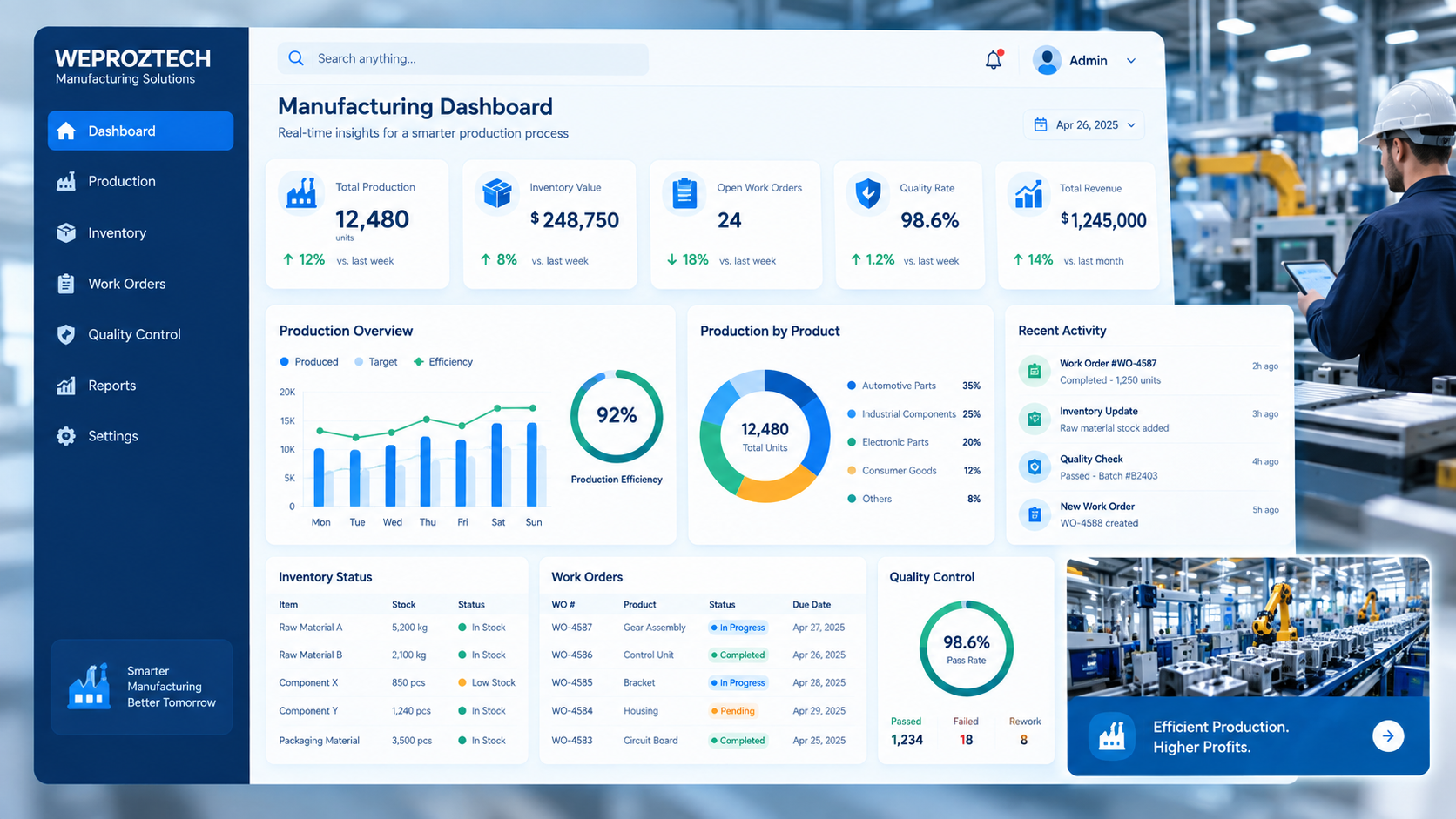
Manufacturing companies manage production, raw materials, inventory, purchasing, quality checks, machines, employees, orders and deliveries every day. When these activities are managed through spreadsheets or disconnected systems, it becomes difficult to maintain accurate data and track operations.
Manufacturing software development helps businesses build a central system for production planning, inventory, purchasing, quality management, maintenance, reporting and other important workflows. Modern manufacturing software can also connect business applications with MES, machines, sensors and shop-floor systems.
What Is Manufacturing Software Development?
Manufacturing software development is the process of designing and developing software specifically for manufacturing operations. Depending on the business, the system may include production planning, work orders, inventory, BOM, purchasing, quality control, maintenance, employee management and reporting.
A small factory may need production and inventory management, while a larger manufacturer may require a complete manufacturing ERP software connected with MES, warehouse, accounting, CRM and production systems.
This is where custom software becomes useful because the system can be designed around the company's actual workflow instead of forcing the business to change its processes around a generic application.
custom ERP solutions here → WEPROZTECH ERP Solutions
Why Manufacturing Businesses Need Custom Software
Every manufacturing business has different processes. A garment manufacturer, automobile supplier and food-processing company may have completely different production, inventory and quality requirements.
Custom manufacturing software can bring important information into one system, reduce repetitive manual work and provide better visibility into daily operations. It can also help management track production status, inventory levels, pending orders and other business data from a single dashboard.
Businesses that are already moving towards automation can also explore AI agents for small businesses in India to understand how AI-based workflows can support repetitive business tasks.
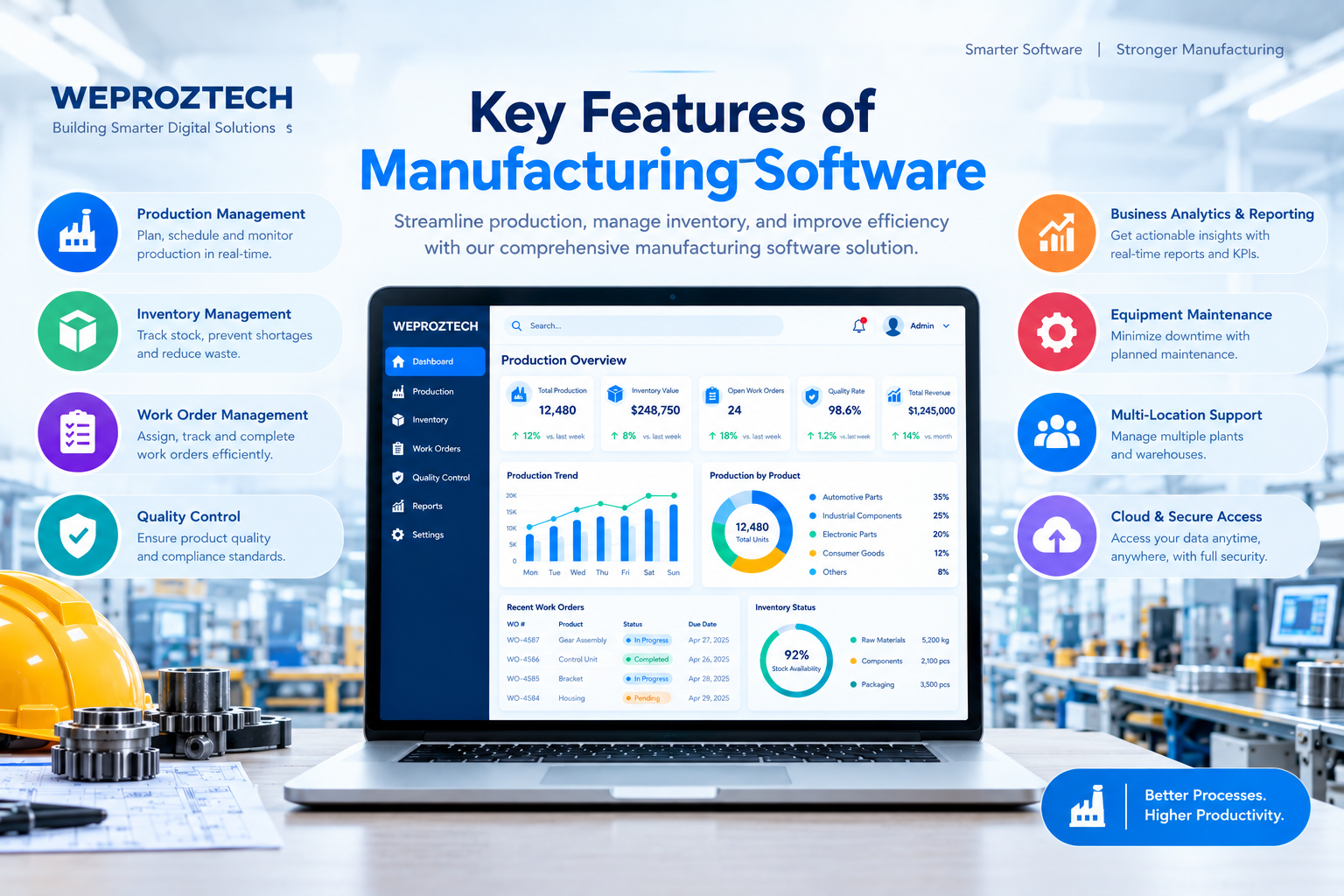
Key Features of Manufacturing Software
A good manufacturing software solution should focus on the processes that matter most to the business.
Production Management: Manage production planning, work orders, production schedules and production status.
Inventory Management: Track raw materials, finished goods, stock movement and inventory levels.
BOM and Material Planning: Manage bills of materials and calculate the materials required for production.
Purchase and Supplier Management: Manage purchase orders, suppliers, material requirements and purchasing records.
Quality Management: Record inspections, quality checks, rejected products and corrective actions.
Maintenance Management: Track equipment maintenance, service schedules, breakdowns and maintenance history.
Reports and Dashboards: Provide real-time information about production, inventory, orders, quality and operational performance.
These features can be combined into a manufacturing ERP based on the company's size, industry and requirements.
 Manufacturing ERP, MES and System Integration
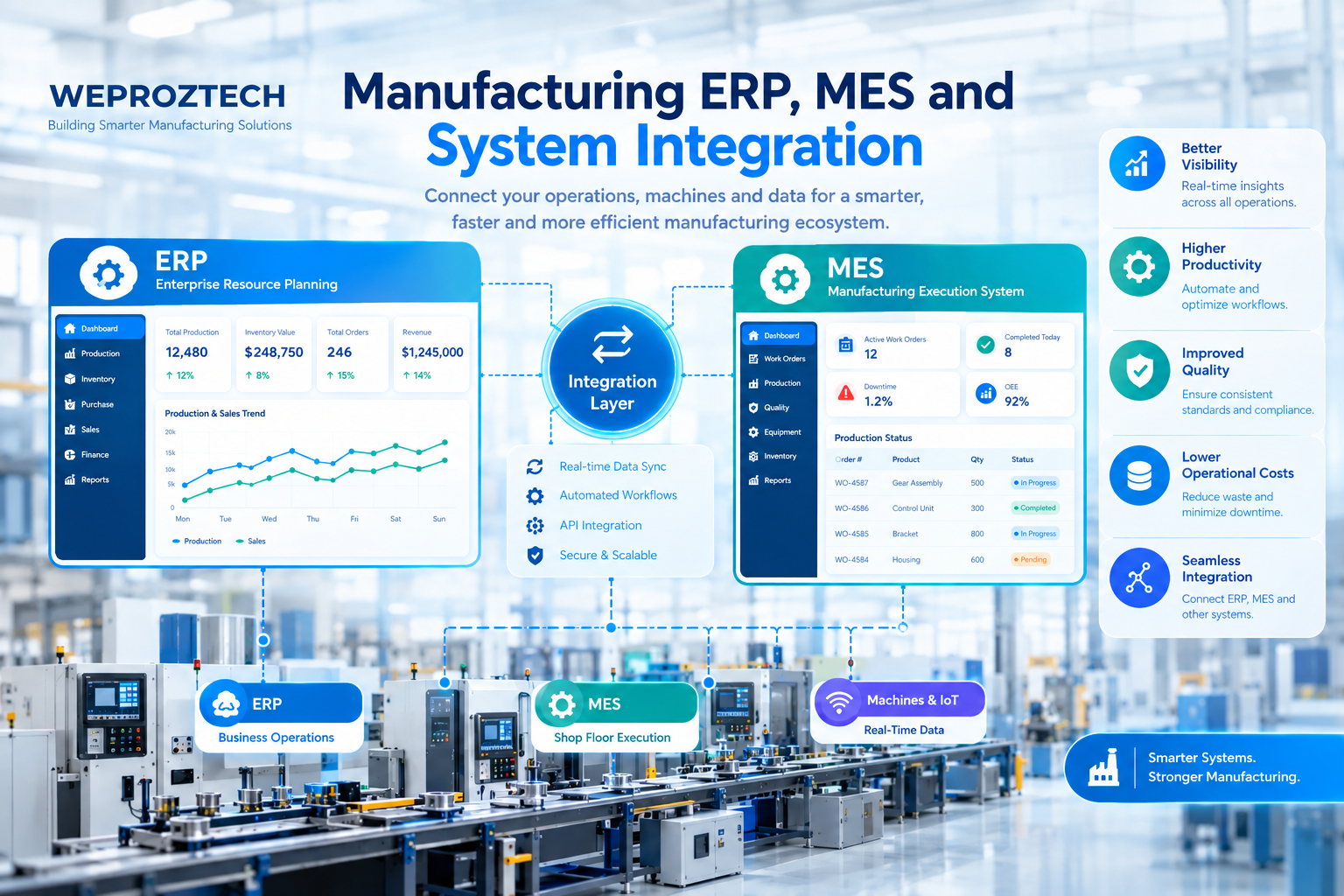
Manufacturing ERP generally handles business-level processes such as purchasing, inventory, finance, orders and planning, while MES focuses more closely on manufacturing operations and shop-floor execution. ISA-95 provides a framework for understanding the relationship between enterprise systems and manufacturing-control systems, including the interface between ERP-level business systems and Level 3 manufacturing systems.
Manufacturing software may also need to communicate with barcode scanners, RFID systems, machines, sensors, warehouse systems and other business applications. For example, Zebra provides manufacturing technologies covering barcode scanning, RFID, traceability, asset tracking and factory connectivity. barcode and RFID technologies
This should remain a supporting external reference, while the main solution discussion and CTA should stay focused on WEPROZTECH's custom ERP and software development services.
If different applications need to exchange data, WEPROZTECH systems integration becomes an important part of the overall architecture.
 Manufacturing Software Development Process
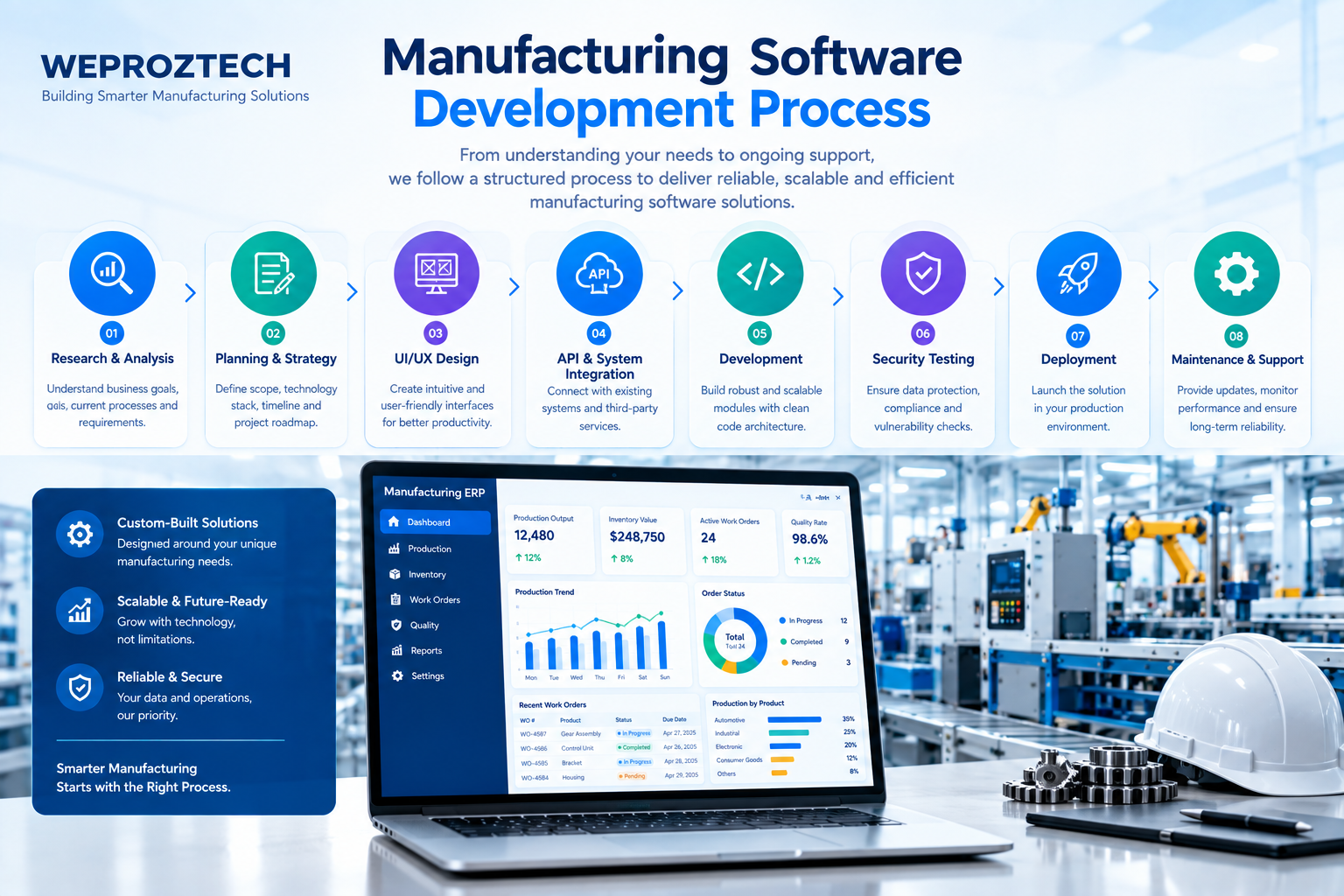
A successful manufacturing software project should begin with the actual business workflow rather than technology alone.
The process generally includes:
Requirement Analysis → Workflow Mapping → UI/UX Design → Database & Architecture → MVP Development → Integration → Testing → Deployment → Maintenance
During requirement analysis, developers understand how production, inventory, purchasing, quality and other departments currently work. The MVP can then focus on the most important modules before additional features are introduced.
As the business grows, features such as mobile applications, analytics, automation, machine integration and AI-based tools can be added.
 Security and Integration
Manufacturing systems often connect business applications with operational and shop-floor environments. This makes security and controlled access important considerations. NIST highlights the cybersecurity risks that can arise when IT and industrial control environments become more connected and recommends capabilities such as authentication, authorization, monitoring, change control and other protective measures.
Manufacturing software should therefore consider role-based access, secure APIs, backups, audit logs, encryption, controlled permissions and proper deployment practices from the beginning.
How Much Does Manufacturing Software Development Cost?
The cost depends mainly on the scope of the project. A simple production and inventory system will have different requirements from a complete manufacturing ERP with multiple locations, mobile applications, machine integrations, dashboards and automation.
Major cost factors include the number of modules, users, integrations, mobile requirements, reporting, automation, security and ongoing maintenance.
For many businesses, starting with an MVP and gradually adding modules can make the development process easier to manage.
How to Choose a Manufacturing Software Development Company
Before selecting a development partner, check whether the company understands manufacturing workflows as well as software development.
The development team should be able to handle ERP, APIs, databases, dashboards, cloud infrastructure, integrations, automation, security, testing and long-term maintenance.
The objective should not simply be to replace Excel with another application. The software should make important business information easier to access and reduce unnecessary manual work.
For businesses that want to automate customer and internal communication, solutions such as WhatsApp automation and WhatsApp CRM can also be connected with a broader business software ecosystem.
Final Thoughts
Manufacturing software development can bring production, inventory, purchasing, quality, maintenance and reporting into a connected digital environment. The right solution depends on the company's processes, size and future requirements.
Instead of implementing unnecessary features from the beginning, businesses can start with their most important workflows and gradually add integrations, automation and analytics.
WEPROZTECH provides custom ERP software, business software, system integration, automation and digital solutions for businesses looking to improve their operations with technology.
For businesses planning a custom manufacturing ERP or manufacturing software solution, the next step is to map the existing workflow and identify which processes should be automated first.
Frequently Asked Questions
Manufacturing software development is the process of creating software to manage production, inventory, purchasing, quality, maintenance, reporting and other manufacturing operations.
Manufacturing ERP software connects important business processes such as production, inventory, purchasing, sales, finance and reporting within one system.
ERP mainly manages business planning and enterprise processes, while MES focuses more on manufacturing operations and shop-floor execution. ISA-95 provides a framework for understanding the connection between these levels.
Yes. Manufacturing software can be integrated with barcode scanners, RFID systems and other data-capture technologies depending on the business requirements. Zebra, for example, provides barcode, RFID, traceability and manufacturing technology solutions.
Yes. Custom software can be designed to communicate with existing ERP, CRM, warehouse, accounting, MES and other systems through APIs and integration layers.