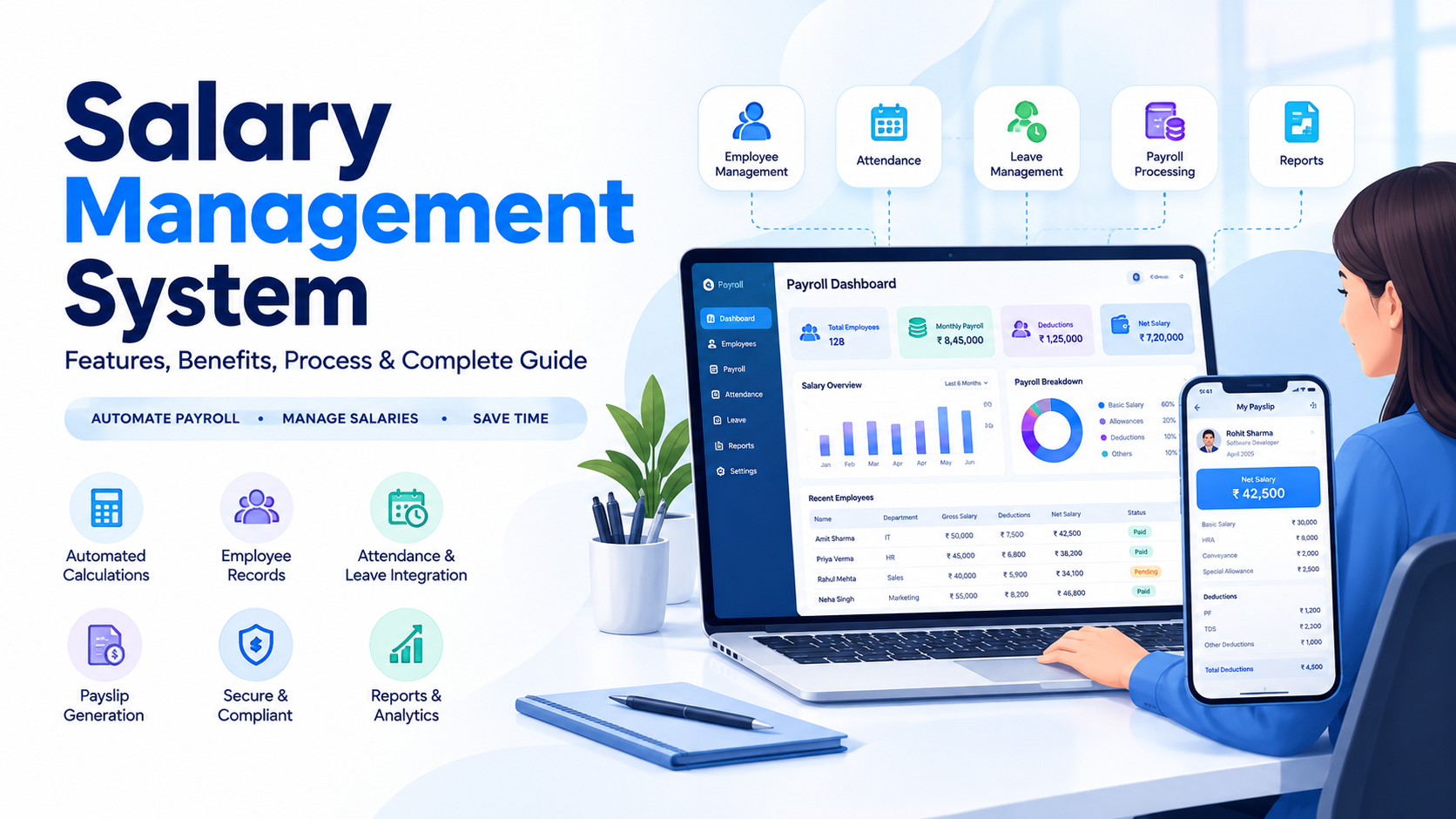
What Is a Salary Management System?
A salary management system is a software solution that helps businesses manage employee salaries, payroll calculations, deductions, allowances, attendance-related adjustments, payslips and salary records from a centralized platform.
Traditional salary processing often depends on spreadsheets, manual calculations and multiple files. As the number of employees increases, managing salary components manually can become time-consuming and can increase the risk of calculation or data-entry errors.
A salary management system automates many repetitive payroll activities and provides HR and finance teams with a structured way to manage employee compensation.
Modern payroll platforms can include automated salary processing, employee management, salary configurations, leave and attendance integration, reports, employee self-service and role-based access.
For businesses that need a broader digital infrastructure, salary management can also be integrated into an ERP and business workflow solution.
Why Do Businesses Need a Salary Management System?
Salary processing becomes more complicated as an organization grows.
A business may have employees working in different departments, locations or roles with different salary structures. Some employees may receive allowances, incentives, overtime payments or bonuses, while others may have deductions, loans or unpaid leave adjustments.
Managing all of these components manually can create unnecessary administrative work.
Common problems with manual salary management include:
- Repetitive salary calculations
- Spreadsheet-based employee records
- Manual attendance adjustments
- Difficulty tracking deductions
- Delayed payslip generation
- Salary calculation mistakes
- Difficult payroll reporting
- Lack of centralized employee salary history
- Repetitive HR queries
- Limited visibility into payroll information
A properly designed salary management system can centralize these processes and make payroll administration more organized.
 How Does a Salary Management System Work?
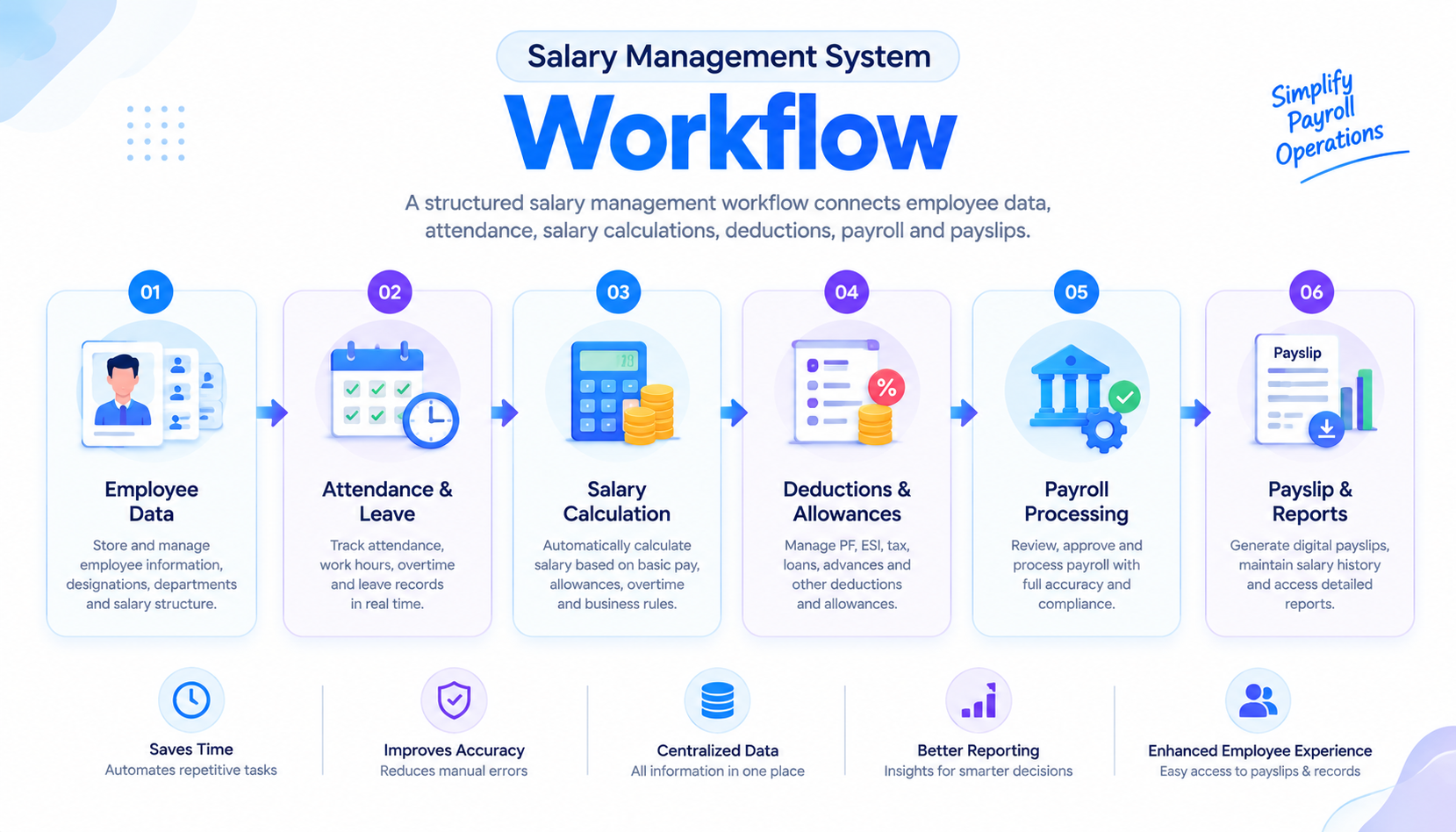
A salary management system generally follows a structured payroll workflow.
The process can look like this:
Employee Data → Attendance & Leave → Salary Components → Calculations → Deductions → Payroll Processing → Payslip → Reports
First, employee information and salary structures are stored in the system.
Attendance, leave and overtime information can then be connected to payroll calculations where applicable. The system calculates salary components such as basic pay, allowances, incentives and deductions according to configured rules.
After payroll is reviewed and approved, the system can generate payslips and payroll reports.
This type of workflow reduces the need for HR teams to repeatedly calculate and transfer information between different spreadsheets.
Key Features of a Salary Management System
Employee Salary Management
A salary management system should provide a centralized employee salary record.
Depending on the organization's requirements, the system can maintain:
- Employee ID
- Employee name
- Department
- Designation
- Joining date
- Salary structure
- Basic salary
- Allowances
- Incentives
- Deductions
- Salary revisions
- Payroll history
Centralized employee information makes it easier for authorized HR and finance users to manage salary records.
Automated Salary Calculation
Automated salary calculation is one of the most important features of salary management software.
Instead of manually calculating every employee's salary, the system can use predefined salary structures and payroll rules.
For example, the system can process:
Basic Salary + Allowances + Incentives + Overtime − Deductions = Net Pay
The exact calculation depends on the company's salary structure and applicable rules.
Automation helps reduce repetitive calculations and makes monthly payroll processing more consistent.
Attendance and Leave Integration
Salary calculations are often connected to employee attendance and leave data.
A salary management system can potentially use information such as:
- Present days
- Working days
- Paid leave
- Unpaid leave
- Absence
- Half days
- Overtime
- Late attendance
Integrating attendance and leave with payroll reduces the need for HR employees to manually transfer information every month.
Businesses looking for a wider employee-management workflow can also explore WEPROZTECH's technology and business software services.
Allowance Management
Employees may receive different allowances based on their job role, company policies or salary structure.
A salary management system can be configured to handle different salary components such as:
- HRA
- Travel allowance
- Conveyance allowance
- Communication allowance
- Performance allowance
- Special allowance
- Other company-defined allowances
Flexible salary components are important because every organization may have a different compensation structure.
Deduction Management
Payroll may also include different deductions.
Depending on the organization and applicable regulations, deductions can include:
- Unpaid leave adjustments
- Employee advances
- Loan repayments
- Tax-related deductions
- Other authorized deductions
A centralized system can help maintain these deductions and include them in payroll calculations.
Overtime Management
For organizations where employees work beyond their standard working hours, overtime can be an important part of payroll.
A salary management system can connect approved overtime records with payroll processing.
This can be particularly useful for industries such as:
- Manufacturing
- Logistics
- Retail
- Hospitality
- Healthcare
- Field services
Bonus and Incentive Management
Businesses may use performance-based bonuses or incentives to reward employees.
For example, a sales organization may calculate incentives according to monthly targets.
Instead of maintaining separate spreadsheets for every incentive calculation, a properly configured salary management system can include approved bonuses and incentives within payroll.
Payslip Generation
Generating employee payslips manually can consume significant HR time.
Salary management software can generate digital payslips containing information such as:
- Employee details
- Salary period
- Earnings
- Allowances
- Deductions
- Net salary
- Applicable payroll information
Digital payslips also make it easier for employees to access their salary records.
Salary Revision Management
Employee compensation can change because of:
- Annual increments
- Promotions
- Performance reviews
- Role changes
- Revised salary structures
A salary management system can maintain salary revision records so HR teams can track historical changes.
Payroll Reports
Payroll reports help HR, finance and management understand salary-related information.
Common reports include:
- Monthly payroll summary
- Employee salary report
- Department-wise payroll
- Deduction report
- Overtime report
- Incentive report
- Salary revision report
- Payroll history
Reporting can reduce the amount of manual spreadsheet work required during payroll review.
Salary Management System vs Manual Salary Processing
| Manual Salary Processing | Salary Management System |
|---|---|
| Spreadsheet-based records | Centralized database |
| Manual calculations | Automated calculations |
| Manual payslip preparation | Digital payslip generation |
| Difficult salary history tracking | Structured salary history |
| Separate attendance records | Attendance integration |
| Manual reporting | Automated reports |
| Higher administrative workload | Reduced repetitive work |
| Limited employee access | Employee self-service options |
For a very small team, spreadsheets may initially be sufficient. However, as the organization grows, dedicated payroll and salary management software can make the process more scalable.
Benefits of a Salary Management System
Saves Time
Automating repetitive salary calculations and payroll activities can save HR and finance teams considerable administrative time.
Reduces Manual Errors
Manual data entry and repeated calculations can introduce mistakes. Automated workflows can improve consistency.
Centralizes Employee Information
Salary information, employee records and payroll history can be maintained in one centralized system.
Improves Payroll Transparency
Employees and authorized HR users can have clearer visibility into salary components, deductions and payslips.
Simplifies Reporting
Instead of manually combining information from multiple spreadsheets, HR teams can generate structured payroll reports.
Supports Business Growth
A scalable salary management system can support increasing employee numbers, departments, locations and salary structures.
Improves Employee Experience
Employee self-service features can allow employees to access payslips and other permitted payroll information without repeatedly contacting HR.
Salary Management System for Small Businesses
Small businesses often start with spreadsheets because their payroll requirements are relatively simple.
However, when employee numbers increase, manual salary management can become difficult to maintain.
A salary management system can help small businesses organize:
- Employee records
- Salary structures
- Attendance
- Leave
- Deductions
- Payslips
- Payroll reports
This can help business owners and HR teams spend less time on repetitive administrative tasks.
Salary Management System for Enterprises
Large organizations may have significantly more complex payroll requirements.
They may operate across multiple branches and have different departments, employee categories and salary structures.
An enterprise salary management system may therefore require:
- Multi-location support
- Role-based access
- Approval workflows
- Attendance integration
- Leave management
- Overtime calculation
- Incentive management
- Payroll reporting
- Employee self-service
- API integrations
- Audit history
- Secure backups
For enterprises, payroll can also be integrated into a broader custom ERP solution rather than operating as a completely separate system.
Salary Management and Employee Self-Service
Employee self-service can make salary administration more efficient.
Depending on the system, employees may be able to:
- View salary details
- Download payslips
- View salary history
- Check attendance
- View leave balances
- Submit requests
- Receive payroll notifications
This reduces routine HR queries and gives employees quicker access to information they are authorized to view.
Salary Management System Security
Salary information is sensitive business and employee data, so security should be a major consideration when implementing payroll software.
Important security features can include:
- Secure authentication
- Role-based access control
- Permission management
- Data encryption
- Audit logs
- Secure database architecture
- Regular backups
- Controlled administrative access
For example, an employee should only be able to access their own authorized payroll information, while HR and finance users may have broader permissions according to their responsibilities.
Security and access controls are especially important when payroll systems are connected with other business applications.
Salary Management System and Payroll Compliance
Payroll systems used in India may need to support applicable statutory and tax-related requirements depending on the organization, employee category and location.
Modern payroll software can provide functionality for statutory calculations and reporting. For example, payroll platforms may support workflows related to PF, ESI, professional tax and income-tax calculations.
However, businesses should ensure that their actual payroll configuration is reviewed against current legal and tax requirements rather than assuming that software alone guarantees compliance.
For official tax and regulatory requirements, businesses should rely on applicable government and professional guidance.
Cloud-Based Salary Management System
A cloud-based salary management system allows authorized users to access payroll applications through the internet.
Potential advantages include:
- Centralized data
- Remote accessibility
- Easier software updates
- Scalable infrastructure
- Centralized backups
- Multi-location access
However, organizations should evaluate authentication, permissions, encryption, backup procedures and infrastructure security before selecting a cloud payroll platform.
Businesses requiring cloud infrastructure for applications, APIs and business platforms can explore WEPROZTECH's cloud and NVMe hosting.
Custom Salary Management System vs Ready-Made Software
Businesses can choose between ready-made salary management software and a custom-built salary management system.
Ready-made software can be a practical option when its features closely match the organization's requirements.
Custom development may be more suitable when a company requires specific workflows or integrations.
For example, a custom system may need to connect salary processing with:
- Biometric attendance
- Employee mobile applications
- ERP
- CRM
- Accounting software
- Banking systems
- WhatsApp notifications
- Custom approval workflows
- Internal business APIs
The right choice depends on the organization's size, workflow complexity, budget and integration requirements.
How Much Does a Salary Management System Cost?
There is no single fixed price for a salary management system because development and implementation costs depend on the required functionality.
A basic system containing employee records, salary calculations and payslip generation will have different requirements from a complete HR and payroll platform.
Major cost factors include:
Number of Employees
A system designed for 20 employees may have different infrastructure requirements from one designed for thousands of employees.
Features
Features such as attendance, leave, payroll, employee self-service, reports and automated notifications increase system complexity.
Integrations
Integrating biometric devices, accounting platforms, ERP systems, banking APIs or other business software can increase development requirements.
Mobile Application
If employees need a dedicated Android or iOS application for payslips, attendance and leave management, mobile development adds to the overall scope.
Security
Payroll systems require appropriate authentication, permissions, backups and data protection.
Custom Workflows
Organization-specific salary rules and multi-level approval workflows can require additional development.
Therefore, businesses should define their complete requirements before comparing the cost of different salary management solutions.
How to Choose the Right Salary Management System
Before selecting a salary management platform, businesses should evaluate:
- Employee capacity
- Salary structures
- Attendance integration
- Leave management
- Overtime
- Allowances
- Deductions
- Payslip generation
- Payroll reports
- Employee self-service
- User permissions
- Security
- Backup
- Scalability
- API integration
- Mobile accessibility
- Support and maintenance
The best solution should solve the company's current payroll problems while also supporting future growth.
Why Choose WEPROZTECH for Salary Management Software?
WEPROZTECH develops custom software and business automation solutions designed around specific organizational workflows.
A salary management system can be developed as an independent HR platform or integrated into a broader ERP and employee-management ecosystem.
Depending on requirements, the system can include employee records, salary structures, attendance, leave, deductions, payroll processing, payslips, reports, permissions and automation.
You can explore the WEPROZTECH portfolio to see examples of software and business platforms.
If your organization requires a customized salary management, payroll or ERP solution, you can contact WEPROZTECH's technical team to discuss the required features and workflow.
Common Mistakes to Avoid in Salary Management
Relying Completely on Spreadsheets
Spreadsheets can become difficult to maintain when employee numbers and salary components increase.
Ignoring Attendance Integration
If attendance and payroll remain completely separate, HR teams may continue doing manual calculations.
Not Defining User Permissions
Payroll information should only be accessible to authorized users.
Ignoring Backup and Security
Employee salary data is sensitive, so businesses should have appropriate security and backup practices.
Choosing Software Without Checking Integrations
A payroll system should work effectively with the other tools already used by the organization.
Not Planning for Growth
Businesses should consider future employee numbers, branches, departments and workflow requirements before selecting a system.
Frequently Asked Questions About Salary Management System
What is a salary management system?
A salary management system is software that helps businesses manage employee salary records, salary calculations, deductions, allowances, payroll processing and payslips.
Is a salary management system the same as payroll software?
The terms are often used interchangeably. However, a salary management system can be broader and may include employee records, salary structures, attendance, leave, payroll, payslips and reporting.
Can salary management software integrate with attendance?
Yes. Salary management software can be integrated with attendance and leave systems so payroll calculations can use relevant attendance information.
Can employees download their payslips?
Yes. Systems with employee self-service functionality can allow employees to securely view or download their authorized payslips.
Can a salary management system be customized?
Yes. A custom salary management system can be designed around an organization's specific salary structures, approval workflows, attendance policies and integrations.
Is salary management software useful for small businesses?
Yes. Even small businesses can benefit from centralized employee salary records, automated calculations and easier payroll reporting.
Final Thoughts
A salary management system can help businesses move from manual salary processing to a more structured and automated payroll workflow.
By connecting employee information, salary structures, attendance, leave, allowances, deductions, overtime, incentives, payslips and reporting, businesses can reduce repetitive administrative work and improve payroll organization.
For small businesses, salary management software can simplify everyday HR tasks. For growing organizations and enterprises, a customized solution can provide additional scalability, integrations, security and workflow automation.
The most important consideration is not simply choosing software with the largest number of features. Businesses should select a system that matches their actual payroll workflow, security requirements, employee structure and future growth plans.