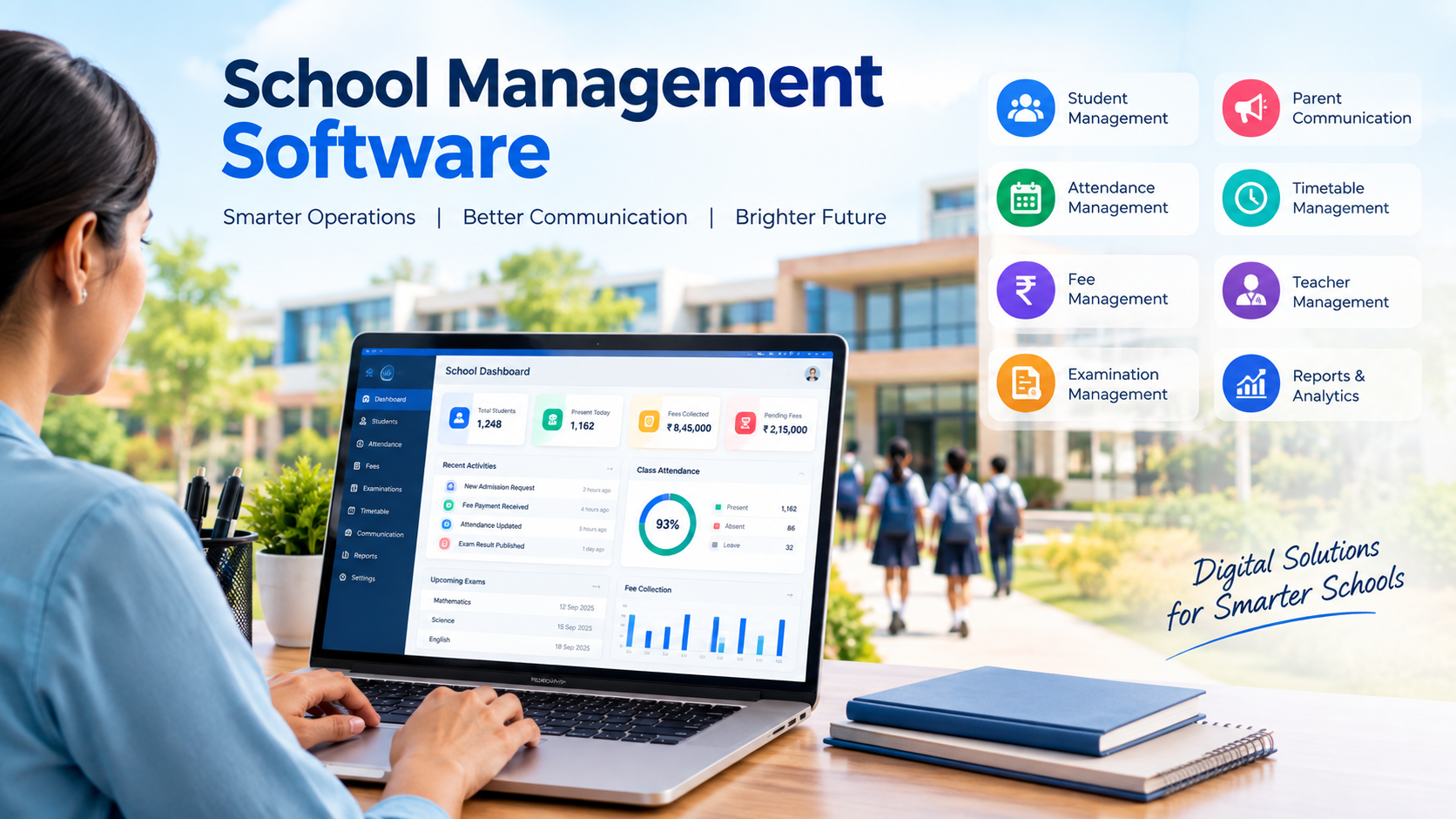
Every day, school administrators and teachers have to deal with admissions, student records, attendance, fees, examinations, timetables, parent communication, staff management and reports. When all of this is handled through registers, Excel sheets and different applications, even simple tasks can take a lot of time.
This is where school management software becomes useful.
A good school management system brings important academic and administrative activities into one place. Instead of maintaining different records for different departments, schools can manage their day-to-day operations through a centralized digital platform.
For schools that are planning to move from traditional paperwork to a digital system, understanding what school management software actually does is the first step.
 What Is School Management Software?
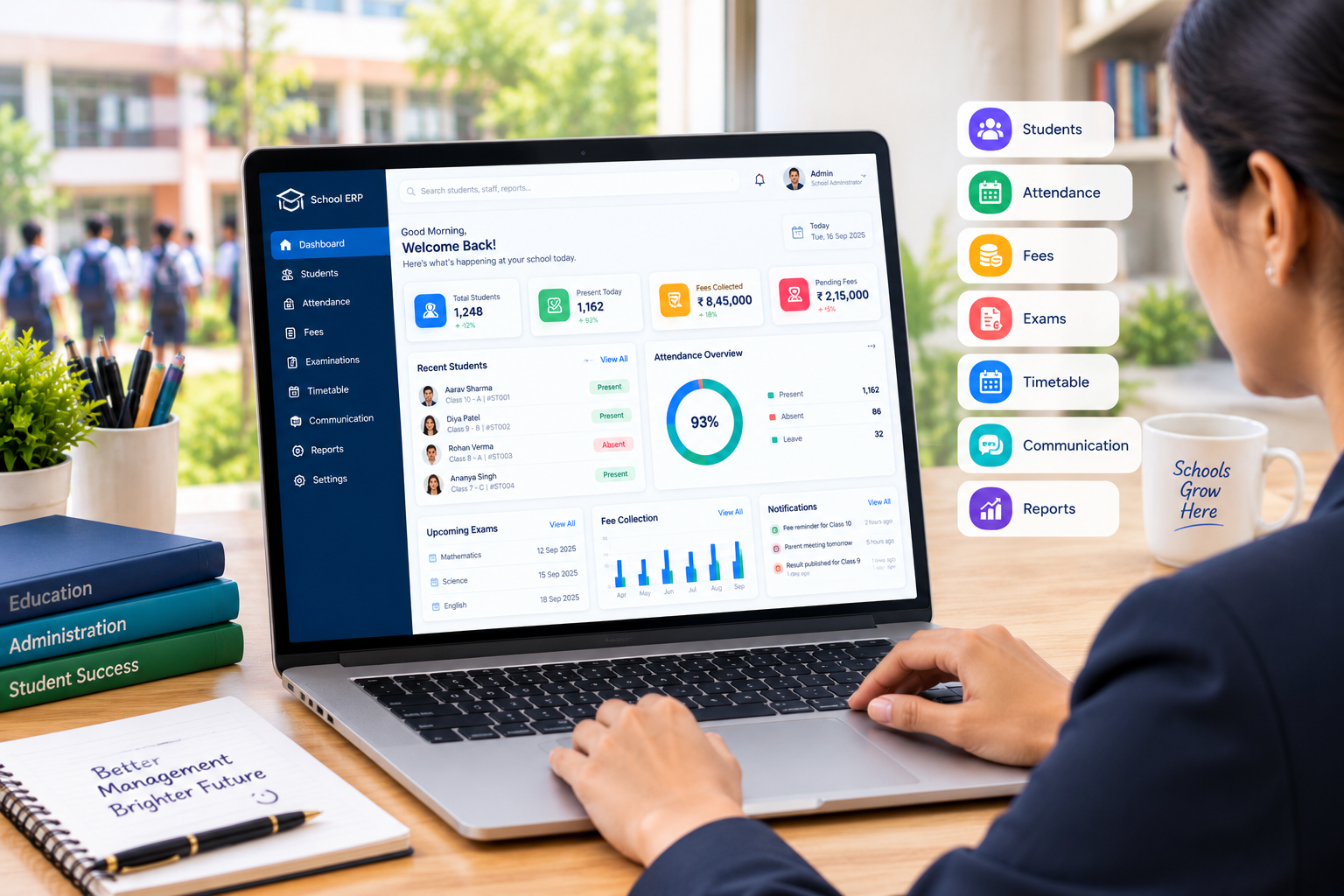
School management software is a digital platform that helps schools manage their academic, administrative and operational activities.
Depending on the software and the school's requirements, it can be used to manage:
- Student records
- Admissions
- Attendance
- School fees
- Examinations
- Results
- Timetables
- Teachers
- Parents
- Communication
- Reports
- Library
- Transport
- Staff information
- Online payments
A complete school management system can bring these activities together so that administrators, teachers, students and parents can access the information relevant to them.
For larger institutions, a school management system can also work as a school ERP software, connecting different departments and workflows through a single platform.
Why Are Schools Moving to Digital Management Systems?
Many schools still depend on a combination of registers, Excel files, printed documents and messaging applications to manage their operations.
That approach may work when the number of students is small. But as the school grows, managing thousands of records manually becomes increasingly difficult.
Consider a simple example.
A parent wants to know whether their child's fee has been paid, while the administrator needs to check the student's attendance and the teacher needs to update the academic record.
If all three pieces of information are stored separately, someone may have to search through multiple records before providing the answer.
With a centralized school management system, the relevant information can be available from the same platform.
Government education technology initiatives in India have also moved towards centralized digital management of school information. For example, the Ministry of Education's Shaala Darpan initiative includes areas such as student profiles, employee information, attendance, leave management, report cards and alerts.
The goal is simple: less paperwork, better organization and easier access to information.
 Key Features of School Management Software
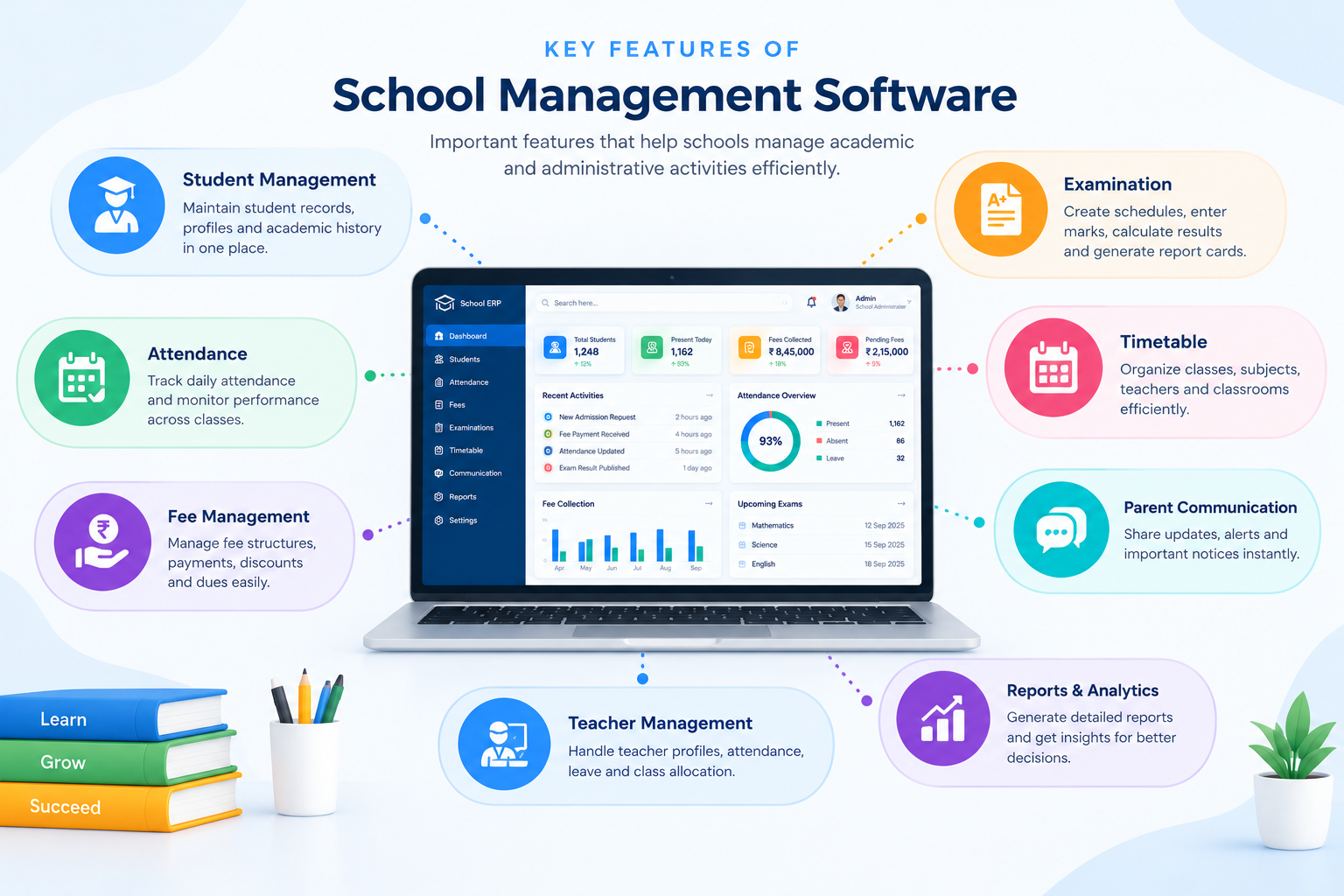
A modern school management system can include many different modules. Schools don't necessarily need every feature; the right combination depends on the size and requirements of the institution.
1. Student Management
Student information is at the heart of any school management system.
Instead of keeping student information in different files, schools can maintain centralized digital profiles.
A student profile can include:
- Student name
- Admission number
- Class and section
- Date of birth
- Parent or guardian information
- Contact details
- Academic history
- Attendance
- Examination results
- Documents
- Fee information
Authorized staff members can access and update information according to their permissions.
This becomes particularly useful when a school has hundreds or thousands of students.
2. Online Admission Management
Admission is one of the first areas where schools can benefit from digitalization.
A school management software can allow schools to manage the admission process digitally, including:
- Online admission forms
- Student registration
- Application tracking
- Document collection
- Application verification
- Admission status
- Student onboarding
- Class and section allocation
Instead of asking parents to repeatedly visit the school for every small update, much of the initial admission process can be handled online.
3. Attendance Management
Attendance may look like a simple task, but managing it for hundreds of students every day can become time-consuming.
A school ERP can help teachers record attendance digitally and allow administrators to monitor attendance across classes.
Common attendance features include:
- Daily attendance
- Student attendance
- Teacher attendance
- Monthly attendance reports
- Absence records
- Leave management
- Attendance history
- Attendance notifications
Some systems can also integrate biometric devices or location-based attendance systems.
WEPROZTECH's current school ERP ecosystem includes biometric/geofenced attendance along with other school-management features.
4. School Fee Management
Fee management is another area where automation can save considerable administrative effort.
A school management system can help administrators manage:
- Fee structures
- Student invoices
- Paid fees
- Pending fees
- Discounts
- Late fees
- Payment history
- Receipts
- Fee reports
- Online payments
Parents can also be given access to their fee information through a parent portal.
This makes it easier for both the school and parents to keep track of payments.
5. Examination and Result Management
Examination management involves several activities, including creating schedules, entering marks, calculating results and preparing report cards.
With a digital system, schools can manage:
- Examination schedules
- Subjects
- Marks
- Grades
- Results
- Report cards
- Student performance
- Class performance
- Examination reports
This can reduce the amount of manual calculation required by teachers and administrative staff.
WEPROZTECH's school ERP offering also includes digital report card generation as part of its education-management ecosystem.
6. Timetable Management
Creating a timetable manually can become complicated when there are many teachers, subjects, classrooms and sections.
A school management system can help organize:
- Classes
- Subjects
- Teachers
- Periods
- Classrooms
- Weekly schedules
Teachers and students can then access the timetable digitally instead of relying entirely on printed schedules.
7. Parent Communication
Parents want timely information about their children and school activities.
A school management system can help schools communicate information such as:
- School announcements
- Attendance alerts
- Fee reminders
- Examination updates
- Holiday notices
- Important circulars
- Homework information
- Events
Depending on the platform, communication can be connected with SMS, email, WhatsApp or mobile notifications.
This is especially useful when schools want to reduce the dependency on multiple communication channels.
8. Parent and Student Portal
A parent portal gives parents access to important information without requiring them to contact the school for every routine question.
A portal may allow parents to check:
- Attendance
- Fees
- Examination results
- Timetable
- Homework
- Announcements
- Academic information
Students can also receive access to information relevant to their studies.
A unified student and parent view is one of the features currently highlighted by WEPROZTECH for its school ERP ecosystem.
9. Teacher Management
School management isn't only about students.
Teachers and other staff members also need to be managed efficiently.
A school management system can maintain:
- Teacher profiles
- Attendance
- Leave records
- Class allocation
- Subject allocation
- Timetables
- Academic responsibilities
Administrators can use this information to get a clearer picture of staffing and daily operations.
10. Reports and Analytics
Reports are important for school administrators because they provide a quick overview of what is happening within the institution.
A school ERP can generate reports related to:
- Student attendance
- Fee collection
- Pending fees
- Admissions
- Examination results
- Student performance
- Teacher attendance
- Class performance
Instead of manually preparing every report, administrators can generate reports from the data already stored in the system.
Benefits of School Management Software
The biggest advantage of a school management system is not simply that it replaces paper.
The real benefit is that it can make everyday school operations more organized.
Reduces Manual Work
Teachers and administrators don't have to repeatedly maintain the same information in different places.
Saves Time
Digital workflows can make activities such as attendance, fee tracking and report generation faster.
Centralizes Information
Important school information can be maintained in one place rather than scattered across registers and spreadsheets.
Improves Parent Communication
Parents can receive updates and access information without depending entirely on manual communication.
Makes Reporting Easier
Administrators can generate reports using information already available in the system.
Reduces Repetitive Errors
Automated calculations and structured data entry can help reduce certain types of manual errors.
Provides Better Visibility
Administrators can get a clearer view of attendance, fees, admissions and academic performance.
School Management Software vs Traditional School Management
| Traditional Management | School Management Software |
|---|---|
| Paper-based records | Digital records |
| Manual attendance | Digital attendance |
| Separate Excel files | Centralized database |
| Manual fee tracking | Digital fee management |
| Manual report preparation | Automated reports |
| Phone/WhatsApp-based communication | Centralized communication |
| Difficult record searching | Quick data access |
| More repetitive work | Automated workflows |
The important thing is not whether a school uses software simply because it is modern. The software should actually solve operational problems and make everyday work easier.
How Much Does School Management Software Cost in India?
There isn't one fixed price for school management software in India.
The cost depends on what the school actually needs.
For example, a small school may only require:
- Student management
- Attendance
- Fees
- Examination
- Basic reports
A larger school or school group may require:
- Complete school ERP
- Multiple branches
- Parent and student applications
- Online payments
- Biometric attendance
- WhatsApp integration
- Custom reports
- Accounting integration
- Website integration
- Custom workflows
Other factors that can affect the cost include:
- Number of students
- Number of users
- Customization
- Hosting
- Mobile applications
- Integrations
- Data migration
- Technical support
- Maintenance
For this reason, schools should compare software based on their actual requirements rather than choosing a platform only because it has the lowest price.
What Should You Check Before Buying School Management Software?
Choosing a school management system is a long-term decision.
Before purchasing one, school administrators should look at more than just the feature list.
Ease of Use
Teachers and administrative staff should be able to use the platform without extensive technical knowledge.
Security
School systems contain student, parent and staff information, so access controls, authentication, backups and other security measures should be carefully evaluated.
Scalability
The software should be able to support the school if the number of students or branches increases.
Mobile Access
Parents and teachers increasingly use smartphones, so mobile-friendly access is important.
Customization
Every school has slightly different processes. The ability to customize workflows, reports and integrations can be valuable.
Technical Support
Check whether the software provider offers ongoing support, updates, maintenance and troubleshooting.
Data Migration
If the school is moving from an existing system, ask how existing student and administrative records will be migrated.
School Management Software for Indian Schools
Indian schools can have different requirements depending on their size, curriculum, administration and number of students.
A school management system should therefore be flexible enough to accommodate different workflows.
For example, UDISE+ is the Government of India's education management information system used for structured education data and reporting. The platform covers information relating to schools, students and teachers.
Commercial school ERP systems serve a different purpose. They focus on the day-to-day management of individual schools or school groups, including students, fees, attendance, examinations, communication and administrative workflows.
School ERP Software vs School Management Software
The terms school management software and school ERP software are often used interchangeably, but there can be a difference in scope.
A basic school management system may focus mainly on:
- Students
- Attendance
- Fees
- Exams
- Communication
A more comprehensive school ERP can connect multiple departments and processes, such as:
- Student management
- Finance
- Staff management
- Attendance
- Admissions
- Communication
- Reports
- Multiple branches
- Integrations
The right option depends on the size and complexity of the school.
Why Choose a Customized School ERP?
A school doesn't necessarily operate exactly like another school.
One institution may have a simple fee structure, while another may have multiple campuses, different fee categories, transportation, hostels, online payments and complex reporting requirements.
In such cases, customized school ERP software can be useful.
A customized solution can include:
- Custom admission workflow
- Custom fee structure
- Multiple campuses
- Parent portal
- Student portal
- Mobile application
- Custom reports
- Payment gateway integration
- WhatsApp integration
- Biometric attendance
- Website integration
- Accounting integration
- API integrations
Instead of changing the school's workflow to fit the software, the software can be designed around the school's actual workflow.
WEPROZTECH School Management Software
WEPROZTECH develops custom ERP and software solutions for organizations that want to digitize their operations.
Its education-focused Weproz Schools ERP provides a centralized school-management ecosystem with features including a unified student and parent view, online fee collection, digital report cards and biometric/geofenced attendance.
Schools that require additional functionality can also explore customized ERP development, integrations and workflow automation through WEPROZTECH.
Explore: WEPROZTECH Custom ERP Solutions
Explore: WEPROZTECH IT & Software Development Services
How Does School Management Software Work?
Implementing school management software generally involves several stages.
Step 1: Understand the School's Requirements
The software provider first understands how the school currently manages admissions, students, fees, attendance, examinations and communication.
Step 2: Select the Required Modules
The school chooses the modules it actually needs.
Step 3: Configure the System
The software is configured according to the school's workflow, classes, departments, fee structures and users.
Step 4: Migrate Existing Data
Existing student and administrative records can be transferred into the new system where required.
Step 5: Create User Accounts
Administrators, teachers, students and parents receive appropriate access.
Step 6: Train the Staff
Teachers and administrative staff are shown how to use the system.
Step 7: Start Using the Platform
Once everything is ready, the system becomes part of the school's daily workflow.
Step 8: Ongoing Support
The system can be updated, maintained and customized as the school's requirements change.
Is School Management Software Useful for Small Schools?
Yes.
A school doesn't need thousands of students to benefit from digital management.
Even a small school can save time by managing:
- Student records
- Attendance
- Fees
- Examinations
- Parent communication
- Reports
The important thing is to choose software that matches the school's actual requirements.
A small school doesn't necessarily need a complex enterprise system with dozens of modules.
Is School Management Software Useful for Large Schools?
Large schools and school groups can benefit even more because they typically manage larger volumes of data.
A larger institution may require:
- Multiple branches
- Thousands of students
- Multiple administrators
- Complex fee structures
- Staff management
- Advanced reporting
- Parent applications
- Online payments
- Multiple integrations
In these cases, a scalable school ERP can provide a centralized system for managing different departments and locations.
Frequently Asked Questions
What is school management software?
School management software is a digital platform that helps schools manage students, admissions, attendance, fees, examinations, communication, reports and other administrative activities.
What is school ERP software?
School ERP software is a broader school management platform that connects multiple academic, administrative and operational processes through one system.
Can parents use school management software?
Yes. Depending on the platform, parents can access attendance, fees, examination results, announcements and other information through a web portal or mobile application.
Can school management software be customized?
Yes. Schools can choose customized software when they have specific workflows, reports, integrations or requirements that aren't covered by a standard platform.
How much does school management software cost?
The price depends on the number of students, required modules, customization, integrations, hosting, mobile applications and support requirements.
Is school management software suitable for small schools?
Yes. Small schools can start with essential modules such as students, attendance, fees and examinations and add additional features as they grow.
Does school management software include attendance?
Most modern school management systems include attendance management. Some platforms also support biometric or location-based attendance.
WEPROZTECH School ERP: Built Around Your School's Workflow
A school management system should make administration easier, not create another complicated system for teachers and staff to manage.
Whether the requirement is student management, attendance, fee collection, examination management, parent communication or a complete school ERP, the right solution should fit the way the institution actually works.
WEPROZTECH works on customized ERP and software solutions for organizations that need technology built around their operational requirements.
If your school is currently using registers, Excel sheets or multiple disconnected systems and wants to move to a centralized platform, you can discuss your requirements with the WEPROZTECH team.
Talk to WEPROZTECH about a School ERP Solutio