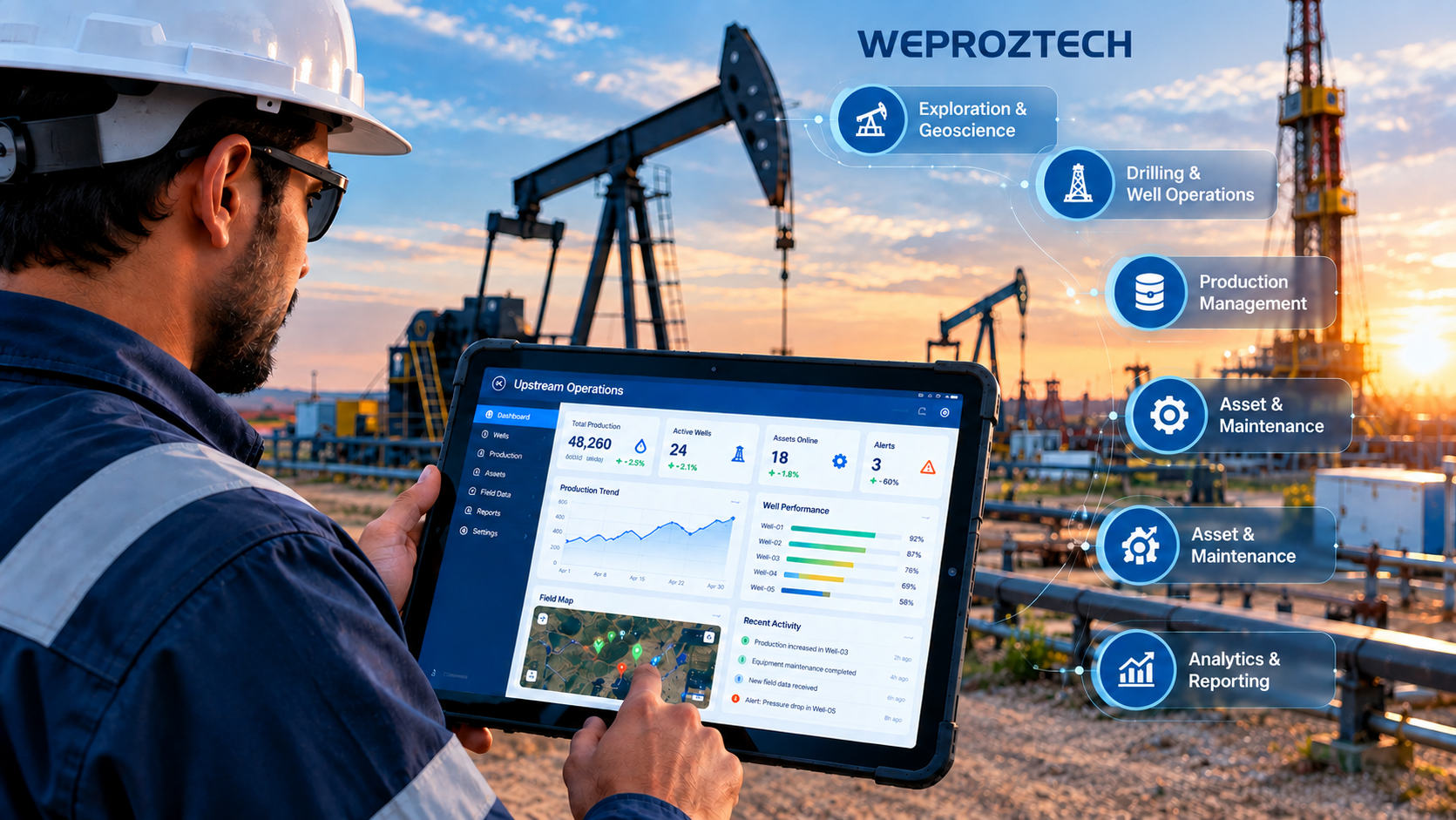
The oil and gas industry deals with complex operations, large amounts of data and expensive equipment. From exploration and drilling to production and field management, even a small delay or data error can affect business performance.
Upstream oil and gas software helps companies manage these activities through connected digital systems. It brings operational data, field activities, production information, assets and reports into a more organised workflow.
For companies working across multiple wells, fields or locations, having the right software is becoming increasingly important.
What Is Upstream Oil and Gas Software?
Upstream oil and gas software is designed for the exploration and production (E&P) side of the oil and gas industry.
Depending on the company's requirements, it can manage areas such as:
- Exploration and geoscience
- Seismic and well data
- Drilling operations
- Reservoir management
- Production monitoring
- Field data collection
- Asset and equipment management
- Maintenance
- Land and lease information
- Production accounting
- Analytics and reporting
The main purpose is simple: help teams collect, manage and use operational information more effectively.
Why Do Oil and Gas Companies Need This Software?
Many oil and gas operations still involve a combination of spreadsheets, separate applications, manual reports and disconnected data sources.
This can make it difficult for teams to get a complete view of what is happening in the field.
A dedicated software platform can bring important information together and help companies:
- Reduce manual data entry
- Monitor production more effectively
- Improve access to field information
- Reduce reporting delays
- Track equipment and assets
- Automate repetitive workflows
- Improve communication between field and office teams
- Make decisions using more reliable data
Modern upstream platforms increasingly connect field operations with production, accounting, land management and reporting instead of keeping these functions completely separate.
Major Benefits of Upstream Oil and Gas Software
1. Better Operational Efficiency
Employees spend less time collecting information manually and preparing repetitive reports. Automated workflows can handle routine activities while teams focus on more important operational decisions.
2. Centralised Data
Production, well, equipment, maintenance and field information can be managed from a common system. This reduces the problem of important information being spread across different files and applications.
3. Faster Decision-Making
When current operational information is available through dashboards and reports, engineers and managers can identify problems and respond faster.
4. Reduced Downtime
Monitoring equipment and production performance can help teams identify unusual conditions earlier. This can support preventive and predictive maintenance and reduce unexpected operational interruptions.
5. Improved Data Accuracy
Digital data collection and automated validation can reduce errors that commonly occur with manual entry and repeated data handling.
6. Better Cost Control
Companies can track production, maintenance, equipment and operational activities more systematically. This gives management better information for evaluating costs and resource usage.
7. Improved Safety and Compliance
Digital records, alerts, maintenance workflows and reporting can help companies manage operational and regulatory requirements more consistently.
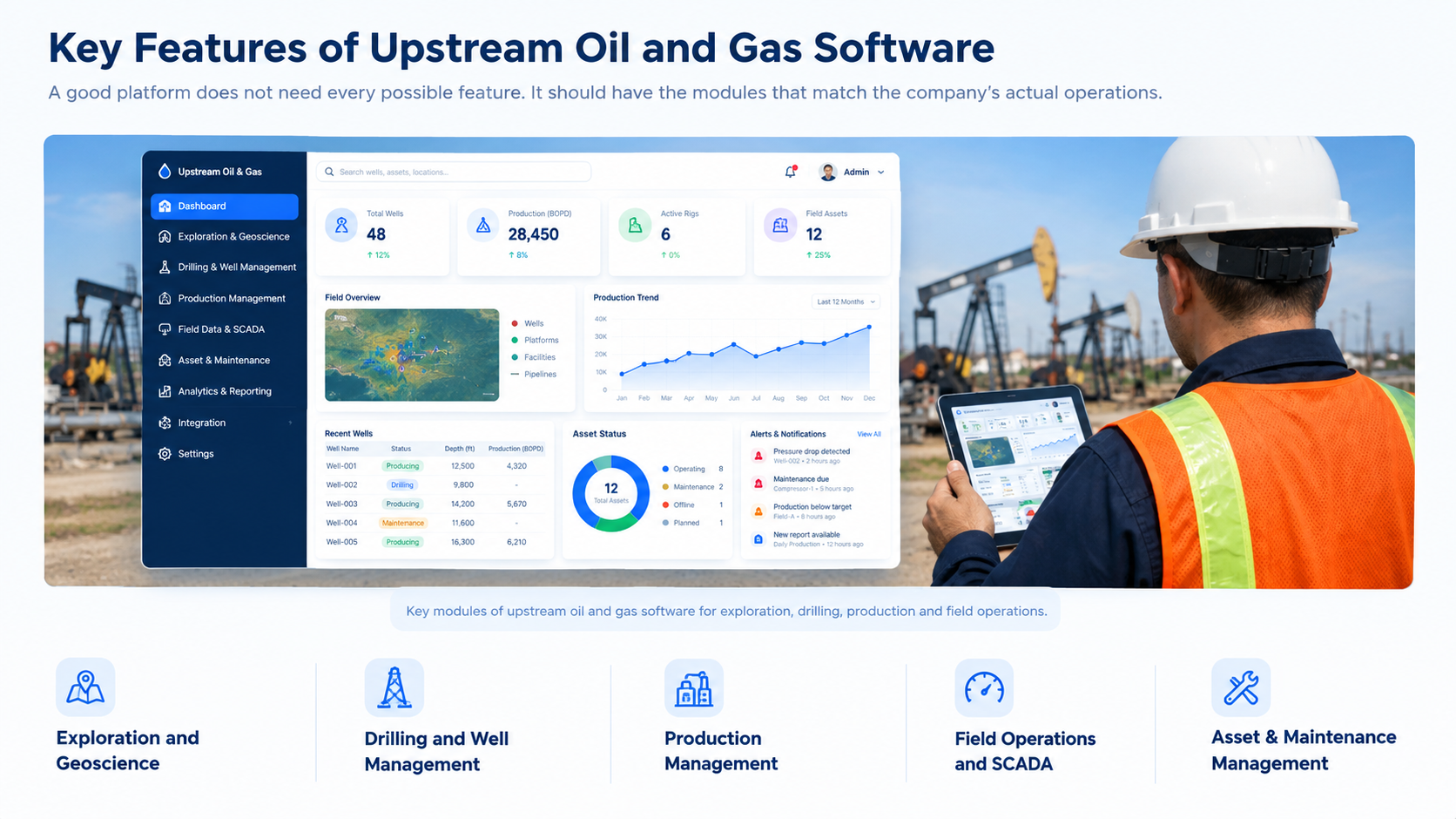
Key Features of Upstream Oil and Gas Software
A good platform does not need every possible feature. It should have the modules that match the company's actual operations.
Exploration and Geoscience
Software can help teams manage seismic information, geological data, well information and subsurface analysis during exploration and field evaluation. Modern platforms also combine seismic and well information for better subsurface understanding.
Drilling and Well Management
Possible features include well planning, drilling data, operational reports, well performance and drilling-related analytics.
Production Management
Production modules can track well output, field performance, production data, allocation and operational reports.
Field Data and SCADA
Field teams can capture information through mobile applications, while SCADA and other connected systems can provide operational data for monitoring and analysis.
Asset and Maintenance Management
The system can maintain equipment records, maintenance schedules, work orders, inspections and asset history.
Analytics and Dashboards
Custom dashboards can show production trends, equipment status, alerts, maintenance information and other KPIs in a single view.
Integration
The software can connect with existing systems such as SCADA, ERP, accounting, GIS, sensors and other business applications, depending on the company's technical environment.
 Why Should a Company Build Custom Upstream Oil and Gas Software?
This is one of the most important considerations.
A ready-made product can be useful when a company's requirements are standard. But oil and gas companies often have their own field processes, reporting formats, approval systems, equipment structures and business rules.
For such companies, forcing existing operations into a generic application may create unnecessary limitations.
Custom software is built around the company's workflow instead.
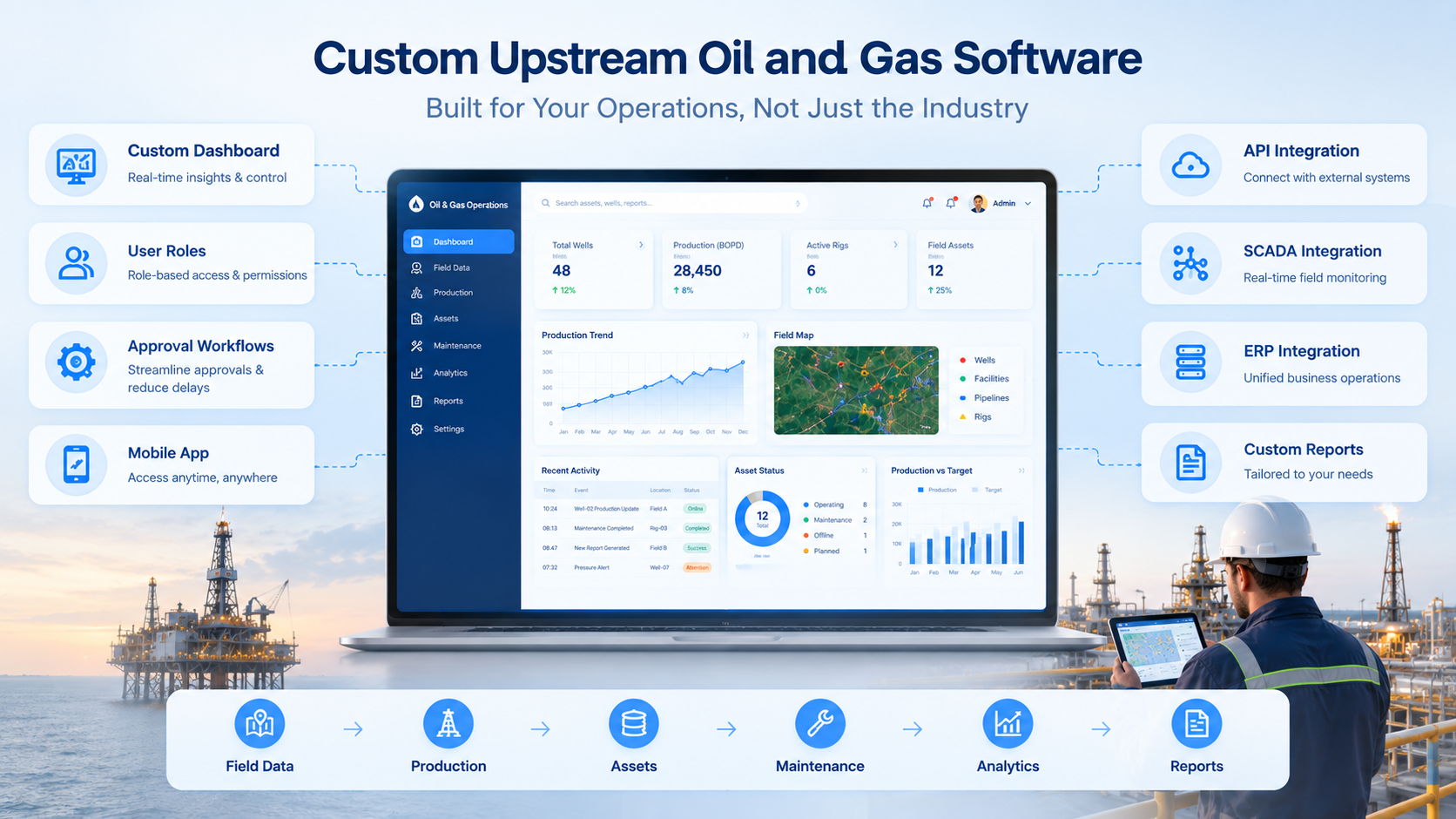
For example, a company may want one connected system like:
Field Data → Production → Assets → Maintenance → Analytics → Reports
A custom platform can also provide:
- Company-specific dashboards
- Custom user roles
- Special approval workflows
- Mobile field applications
- API integrations
- Custom reports
- SCADA/data integrations
- ERP integration
- Role-based security
- Future module expansion
Custom software is particularly useful when the organisation needs control over workflows, integrations and scalability rather than simply adopting a fixed feature set.
For businesses looking for custom software solutions, the system can be planned around their existing processes instead of changing the entire workflow to fit the software.
 Cloud, AI and Automation
Cloud technology can make operational applications accessible to teams working across different locations.
Automation can handle repetitive activities such as:
- Alerts
- Data processing
- Report generation
- Approvals
- Notifications
- Routine monitoring
AI and analytics can be considered for specific use cases such as anomaly detection, production forecasting and predictive maintenance. The important point is to use these technologies where they solve a genuine business problem rather than adding them simply as features.
How Does Upstream Software Improve Business ROI?
Software investment should not be measured only by the number of features.
Companies should look at the business impact.
For example:
Manual Work ↓
Data Errors ↓
Downtime ↓
Reporting Time ↓
Operational Visibility ↑
Decision Speed ↑
Before investing in a platform, companies should evaluate development or licensing cost, integration, training, maintenance, scalability and expected operational benefits.
A system that saves significant employee time, reduces avoidable downtime or improves production visibility can provide value beyond its initial technology cost.
How to Choose the Right Upstream Software?
Before purchasing or developing software, companies should clearly identify:
- What problems need to be solved?
- Which teams will use the system?
- What data needs to be collected?
- Which existing systems need integration?
- Is mobile or remote access required?
- What reports and dashboards are required?
- What security controls are needed?
- Can the software grow with the business?
- What will implementation and maintenance cost?
- Can the system be customised in the future?
The best software is not necessarily the one with the most features. It is the one that fits the company's actual workflow.
The Future of Upstream Oil and Gas Software
The industry is moving towards more connected operations, real-time data, automation, cloud platforms and advanced analytics.
The future is not simply about collecting more data. The real objective is to turn operational data into useful information that helps engineers, field teams and management make better decisions.
Companies can gradually introduce advanced capabilities such as AI, predictive maintenance, digital twins and automated analytics as their data and digital infrastructure mature.
Conclusion
Upstream oil and gas software can help companies manage the complete E&P workflow more efficiently — from exploration and drilling to production, field operations, maintenance and reporting.
The major benefits are better data visibility, less manual work, improved asset management, faster decisions and stronger operational control.
For companies with unique workflows, custom upstream oil and gas software can be a better long-term option because the platform can be designed around their actual processes, integrations and future requirements.
If your company needs a custom software platform, ERP integration or industry-specific digital solution, you can discuss your software requirements with WEPROZTECH.
Frequently Asked Questions
It is software designed to support oil and gas exploration and production activities, including drilling, production, field data, assets, maintenance and reporting.
It helps reduce manual work, organise operational data, improve production visibility, manage assets and support faster business decisions.
Common features include production management, field data capture, well management, asset management, maintenance, SCADA integration, analytics, dashboards and reporting.
Yes. Depending on the existing infrastructure, custom software can integrate with SCADA, ERP, accounting, GIS, sensors and other business systems.
Custom software allows companies to build workflows, dashboards, integrations and user roles around their specific operational requirements instead of depending completely on fixed features.
Not always. AI should be added where it provides measurable value, such as anomaly detection, forecasting, predictive maintenance or advanced data analysis.