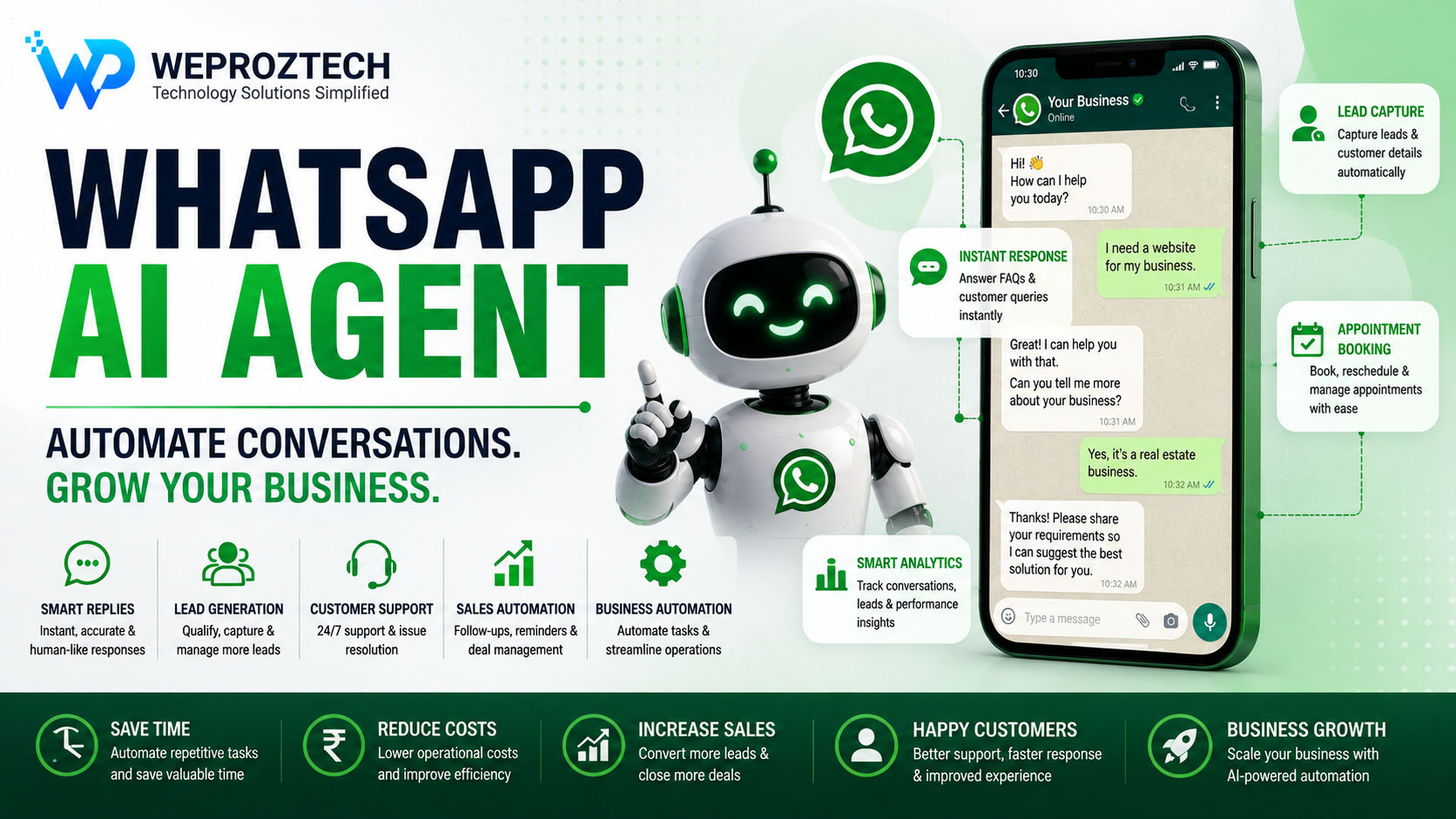
What Is a WhatsApp AI Agent?
A WhatsApp AI agent is an AI-powered software system designed to help businesses handle conversations and perform defined tasks through WhatsApp.
Unlike a basic system that simply sends a fixed reply when a user types a specific keyword, an AI-powered agent can be designed to understand natural-language questions, retrieve approved business information, ask follow-up questions, collect lead details and trigger connected workflows.
For example, imagine that a potential customer sends:
“Hi, I need a website for my business. What services do you provide and how much will it cost?”
A properly configured WhatsApp AI agent could:
- Understand that the person is interested in website development.
- Provide approved information about relevant services.
- Ask what type of business the customer operates.
- Collect project requirements.
- Identify the level of buying intent.
- Create or update a lead record.
- Notify the sales team when human assistance is required.
This makes a WhatsApp AI agent useful for businesses that receive frequent customer enquiries and want to reduce repetitive manual work.
However, an important distinction should be made: an AI agent is only as useful as the information, integrations, permissions and workflows behind it. It should not be allowed to invent prices, make unsupported promises or take sensitive actions without appropriate controls.
For businesses in India, possible use cases include:
- Customer support automation
- Lead qualification
- Sales enquiry handling
- Appointment booking
- Follow-up workflows
- Service information
- CRM updates
- Internal team notifications
- FAQ automation
The goal is not simply to “add AI to WhatsApp.” The goal should be to improve a specific business process.
How Does a WhatsApp AI Agent Work?
A WhatsApp AI agent generally works as part of a larger automation system.
A simplified workflow may look like this:
Customer sends a WhatsApp message
↓
The system receives and processes the message
↓
AI identifies the customer's intent
↓
Relevant approved business information is retrieved
↓
The AI generates an appropriate response
↓
The workflow may collect additional information
↓
CRM, calendar or internal systems can be updated
↓
A human takes over when required
For example, a customer may write:
“I want to develop an Android and iPhone app for my startup.”
The AI system could identify the enquiry as a mobile app development lead.
It could then ask relevant questions such as:
- What problem will the application solve?
- Who will use the application?
- Do you need Android, iOS or both?
- Do you already have a design?
- What features are important?
- When are you planning to start?
The conversation can then be summarized and forwarded to the appropriate team member.
The Four Main Parts of an AI Agent
1. The Conversation Layer
This is where the customer interacts with the business.
For this use case, WhatsApp is the primary communication channel.
2. The Intelligence Layer
This is responsible for understanding the message and determining what should happen next.
Depending on the implementation, the AI may classify the customer's intent, extract information and determine whether additional questions are required.
3. The Knowledge Layer
The AI needs access to reliable business information.
This may include:
- Services
- Products
- FAQs
- Policies
- Pricing guidelines
- Business processes
- Documentation
The information should be reviewed and kept up to date.
4. The Action Layer
This is where the AI connects to business tools.
For example:
- CRM
- Calendar
- Database
- Internal notification system
- Website
- Custom software
This combination can turn a simple conversation system into a useful business workflow.
Businesses implementing WhatsApp automation should also use appropriate approved integrations and follow the applicable platform rules. Official developer information is available through Meta for Developers – WhatsApp documentation.
WhatsApp AI Agent vs Traditional WhatsApp Chatbot
The terms “AI chatbot” and “AI agent” are sometimes used interchangeably, but there can be meaningful differences.
| Feature | Traditional WhatsApp Chatbot | WhatsApp AI Agent |
|---|---|---|
| Fixed keyword responses | Common | Possible |
| Natural language understanding | Limited or structured | More flexible |
| Follow-up questions | Basic | Context-aware workflows possible |
| Knowledge retrieval | Limited | Can use approved knowledge sources |
| CRM integration | Possible | Can be integrated into multi-step workflows |
| Lead qualification | Rule-based | AI-assisted |
| Human handoff | Yes | Yes |
| Multi-step actions | Limited | Possible with defined permissions |
| Business workflow automation | Basic | More advanced potential |
A traditional chatbot may be sufficient when the business only needs something simple.
For example:
Customer: What are your working hours?
Bot: We are open Monday to Saturday from 10 AM to 7 PM.
That does not necessarily require an advanced AI system.
An AI agent becomes more useful when the workflow is more complex.
For example:
Customer asks about a service → AI identifies the requirement → asks qualification questions → checks available consultation slots → creates a CRM lead → notifies the sales team.
The right choice depends on the actual business problem.
How Businesses Can Automate Customer Support on WhatsApp
Customer support teams often answer the same questions repeatedly.
Common examples include:
- What services do you offer?
- What is the price?
- Where are you located?
- What are your working hours?
- How can I book an appointment?
- How long does the process take?
- How can I speak with a team member?
A WhatsApp AI agent can be trained or connected to approved business information to help handle these routine questions.
A Practical Customer Support Workflow
A useful structure is:
Level 1: AI Handles Routine Questions
The AI responds to common questions using approved information.
Level 2: AI Collects Context
If the customer has a more specific problem, the AI can collect useful details.
For example:
- Name
- Order or enquiry reference
- Type of problem
- Preferred contact details
Level 3: Human Support Takes Over
Complex, sensitive or unusual situations should be transferred to a human.
This approach can help businesses reduce repetitive support work while ensuring customers still have access to a real person when necessary.
Example
Customer: My website is not loading properly.
The AI should not simply invent a technical solution.
Instead, it can:
- Ask for the website URL.
- Collect information about the issue.
- Ask when the issue started.
- Create a support request.
- Route the information to the technical team.
The human team receives context instead of starting the conversation from zero.
How AI Can Qualify and Manage Leads
Lead management is one of the most valuable applications of WhatsApp automation.
A business may receive enquiries throughout the day.
Without a structured process, leads can be:
- Forgotten
- Delayed
- Incorrectly assigned
- Poorly documented
- Lost between team members
A WhatsApp AI agent can help create a more consistent lead workflow.
Example Lead Qualification Process
A potential customer writes:
“I need digital marketing for my business.”
The AI agent can ask:
- What type of business do you operate?
- Which city or market do you want to target?
- Are you currently running digital campaigns?
- Which services are you interested in?
- What is your approximate monthly marketing budget?
- When would you like to start?
The system can summarize the information and classify the enquiry based on the business's own criteria.
For example:
High-Intent Lead
The customer has a clear requirement and wants to speak with the sales team.
Active Research Lead
The customer is comparing options and collecting information.
Early-Stage Lead
The customer has an interest but no immediate buying timeline.
These classifications should be treated as workflow signals, not as unquestionable predictions. The business should define its own qualification rules and allow human teams to review important opportunities.
WhatsApp AI Automation for Sales Teams
Sales teams frequently lose time on repetitive communication.
An AI-powered WhatsApp workflow can support the sales process before a salesperson becomes directly involved.
Example Workflow
New WhatsApp Enquiry
↓
AI responds immediately
↓
Customer requirement is identified
↓
Qualification questions are asked
↓
Lead details are captured
↓
Lead is added to CRM
↓
Sales team receives summary
↓
Human sales representative continues the conversation
The benefit is not that AI should close every sale independently.
Instead, the objective can be to ensure that:
- Every enquiry receives an initial response.
- Basic information is collected consistently.
- Sales teams receive qualified context.
- Follow-up opportunities are less likely to be forgotten.
AI-Assisted Follow-Up
Follow-up is another important area.
A customer may ask for a proposal and then stop responding.
A workflow can be designed to trigger appropriate reminders based on customer actions and approved messaging rules.
However, automation should not become spam.
Businesses should respect customer preferences, applicable laws and messaging platform policies. Sending repeated unsolicited messages may damage customer trust and create compliance issues.
Industries That Can Benefit From WhatsApp AI Agents
1. Real Estate
Real estate businesses receive a large number of repetitive enquiries.
A WhatsApp AI agent can help collect:
- Property type
- Preferred location
- Budget range
- Number of bedrooms
- Investment or residential purpose
- Site visit preference
A qualified lead can then be transferred to a sales representative.
Example
Customer: I am looking for a 3 BHK in Lucknow.
The AI can ask for:
- Preferred locality
- Budget
- Purchase timeline
- Financing requirements
The final conversation summary can help the salesperson prepare before contacting the prospect.
2. Salons and Beauty Businesses
A salon may receive regular questions about:
- Services
- Pricing
- Availability
- Appointments
- Bridal packages
- Offers
A WhatsApp AI workflow can assist with initial conversations and appointment requests.
Possible automation includes:
- Service FAQs
- Appointment enquiry collection
- Booking reminders
- Basic after-service communication
3. Coaching Institutes and Educational Businesses
Educational organizations often receive enquiries about:
- Courses
- Fees
- Duration
- Eligibility
- Admission process
- Demo classes
An AI agent can provide approved information and collect student requirements before transferring the conversation to a counsellor.
For example:
“I want to learn web development. Which course is suitable for me?”
The AI can ask about the student's current experience, goals and preferred learning format.
4. E-commerce Businesses
E-commerce businesses may receive questions about:
- Product details
- Sizes
- Availability
- Shipping
- Returns
- Order support
A WhatsApp AI agent can assist with repetitive pre-sale and support conversations when connected to accurate product and order information.
Sensitive actions and account-specific information should use appropriate authentication and security controls.
5. Healthcare Businesses
Healthcare-related businesses can potentially use automation for administrative workflows such as:
- Appointment enquiries
- General service information
- Location details
- Reminder workflows
However, healthcare communication requires additional care around privacy, accuracy and sensitive information.
An AI agent should not be presented as a substitute for qualified medical professionals.
6. Restaurants and Hospitality Businesses
Restaurants can use automation for:
- Reservation enquiries
- Operating hours
- Location information
- Menu-related questions
- Event enquiries
The system can collect the required information before confirming or routing the request.
7. Professional and Service Businesses
Agencies, consultants, software companies, designers and other service providers can use WhatsApp AI automation for:
- Initial enquiries
- Requirement gathering
- Consultation booking
- Lead qualification
- FAQ support
- Project enquiry routing
For a technology company, this can be particularly useful because different customers may require websites, applications, hosting, software or AI solutions.
How to Build a WhatsApp AI Agent
Building an effective WhatsApp AI agent requires more than connecting an AI model to a messaging account.
A practical implementation can follow the steps below.
Step 1: Identify the Business Problem
Start with a specific problem.
For example:
“Our team spends several hours every day answering the same initial customer questions.”
That is a clearer objective than simply saying:
“We need an AI chatbot.”
Step 2: Map the Existing Conversation
Document what currently happens.
For example:
Customer sends message
↓
Employee reads the enquiry
↓
Employee asks questions
↓
Customer provides requirements
↓
Employee copies information into CRM
↓
Salesperson follows up
Once the existing workflow is mapped, repetitive steps become easier to identify.
Step 3: Prepare the Knowledge Base
The AI should use reliable information.
This can include:
- Service descriptions
- Product information
- FAQs
- Company policies
- Pricing rules
- Support procedures
The knowledge base should be reviewed regularly.
Step 4: Design the Conversation Logic
The system should know:
- What questions it can answer
- What questions require escalation
- What information it should collect
- What actions it is allowed to take
- When a human should take over
Step 5: Connect Required Systems
Depending on the project, this could include:
- CRM
- Database
- Website
- Calendar
- Internal dashboard
- Custom application
Step 6: Define Permissions
Do not give the AI unrestricted access.
For example, it may be allowed to:
- Create a lead
- Schedule an available meeting
- Send approved information
But it may not be allowed to:
- Change financial records
- Access unnecessary customer data
- Offer unapproved discounts
- Make contractual commitments
Step 7: Test Real Conversations
Test:
- Simple questions
- Multiple questions in one message
- Misspellings
- Hindi-English mixed messages
- Requests outside the knowledge base
- Incorrect assumptions
- Requests requiring a human
Step 8: Monitor and Improve
Review:
- Customer conversations
- Failed responses
- Escalation frequency
- Lead conversion
- Common unanswered questions
This information can help improve the system over time.
AI Agent + CRM + Website Integration
A WhatsApp AI agent becomes more useful when it connects with the systems already used by the business.
Website + AI Agent
A customer may submit an enquiry on a website.
The workflow can:
- Capture the enquiry.
- Store the lead.
- Trigger a follow-up process.
- Continue communication through approved channels.
If your business needs a custom website designed around automation workflows, explore WEPROZTECH Website Development Solutions.
You can also connect this article internally to the WEPROZTECH guide:
Best Website Development Company in Lucknow
CRM + AI Agent
A CRM integration can help centralize lead information.
For example:
Customer enquiry
↓
AI qualification
↓
Lead details extracted
↓
CRM record created or updated
↓
Salesperson notified
This can reduce manual copying of information between systems.
Hosting + AI Infrastructure
Custom AI applications, APIs and automation workflows also require appropriate infrastructure.
Depending on the project architecture, cloud or VPS infrastructure may be required for backend applications and connected services.
Explore:
WEPROZTECH Fast NVMe Cloud & VPS Hosting
The infrastructure requirements should be selected based on expected traffic, integrations, security needs and application architecture rather than choosing a server purely based on price.
Benefits of WhatsApp AI Automation for Small Businesses in India
1. Faster Initial Responses
Customers do not always send enquiries during business hours.
An automated system can assist with initial responses based on the workflow configuration.
2. More Consistent Information
When employees answer manually, responses can vary.
An approved knowledge base can help improve consistency.
3. Better Lead Capture
The system can be configured to collect required information systematically.
4. Reduced Repetitive Work
Teams can spend less time answering the same basic questions repeatedly.
5. Improved Sales Handover
Sales representatives can receive customer requirements and conversation summaries.
6. Scalable Communication
As enquiry volume increases, businesses can improve their ability to manage initial conversations.
This does not mean an AI system has unlimited capacity or should replace every employee. Complex or sensitive cases still require human involvement.
7. Better Business Insights
Conversation data can help businesses understand:
- Common customer questions
- Frequent objections
- Popular services
- Lead sources
- Repeated support issues
These insights can also help improve websites, FAQs, sales processes and service offerings.
Cost of WhatsApp AI Automation in India
The cost of a WhatsApp AI automation system depends heavily on the implementation.
There is no single “WhatsApp AI agent price” that applies to every business.
The total cost can depend on:
- Number of workflows
- Conversation volume
- AI model usage
- Knowledge base size
- CRM integration
- Website integration
- Database requirements
- Custom dashboard requirements
- Human handoff system
- Infrastructure
- Monitoring and maintenance
A basic FAQ workflow may require significantly less development than a custom AI system connected to multiple business tools.
A Better Way to Evaluate Cost
Instead of only asking:
“How much does an AI agent cost?”
Businesses should also ask:
- How many hours of repetitive work can this reduce?
- How many leads are currently missed?
- How quickly are customers receiving responses?
- How much manual data entry is involved?
- What business metric should improve?
The best starting point is usually a clearly defined workflow with measurable objectives.
Common Mistakes to Avoid When Building a WhatsApp AI Agent
1. Automating Everything at Once
Start with one useful workflow.
For example:
Initial lead qualification.
Once that process works reliably, additional automation can be added.
2. Using AI Without Approved Information
An AI system should not be expected to “know everything” about the business.
Provide accurate and regularly reviewed information.
3. Allowing AI to Invent Prices or Commitments
Pricing, discounts and commitments should follow clearly defined rules.
4. Forgetting Human Handoff
Customers should have a clear path to reach a human when required.
5. Giving Excessive System Permissions
Use the principle of minimum necessary access.
An AI agent should only access the information and tools needed for its assigned tasks.
6. Ignoring Security and Privacy
Customer information should be handled carefully.
Authentication, access controls, secure integrations and appropriate data management should be considered during system design. For broader application security guidance, businesses can review resources from OWASP.
7. Turning Automation Into Spam
Automation should improve communication, not overwhelm customers.
Businesses should follow applicable platform rules and respect customer preferences.
8. Launching Without Testing
Test the system with realistic conversations before depending on it for important customer communication.
How WEPROZTECH Can Build Custom AI Automation
Every business has different processes.
A salon does not need the same AI workflow as a real estate company.
An e-commerce company does not need the same automation as a coaching institute.
For this reason, the best AI solution is often based on the actual workflow of the business.
WEPROZTECH can help businesses explore custom technology and automation solutions involving:
- AI-powered business workflows
- WhatsApp automation
- AI customer support systems
- AI-assisted lead qualification
- Custom web applications
- CRM integrations
- Website integrations
- Mobile applications
- Custom software development
- Cloud and VPS infrastructure
A typical project can begin by identifying one repetitive business process.
For example:
“Our sales team receives 100 WhatsApp enquiries every week and spends significant time asking the same qualification questions.”
That process can be mapped, improved and evaluated for automation.
WEPROZTECH can then help design a solution around the business's requirements rather than forcing every business into the same template.
For related digital growth services, you can also link internally to:
Best Digital Marketing Agency in Lucknow | WEPROZTECH
And for businesses planning a mobile application:
Best App Development Company in Lucknow | WEPROZTECH
For a discussion about a custom technology, website, application or AI automation requirement, visit:
Frequently Asked Questions
What is a WhatsApp AI agent?
A WhatsApp AI agent is an AI-powered system that can help businesses handle customer conversations and perform defined tasks or workflows through WhatsApp. Depending on its configuration, it may answer approved questions, collect lead information, retrieve business knowledge and connect with other systems.
Can a WhatsApp AI agent generate leads?
An AI agent can assist with lead generation and qualification by responding to enquiries, collecting customer details and identifying relevant requirements. Final sales results depend on factors such as the quality of leads, service offering, pricing and human sales processes.
Is a WhatsApp AI agent different from a chatbot?
A traditional chatbot often relies on predefined flows and fixed responses. An AI agent can support more flexible language understanding and may be connected to knowledge sources and business tools to perform multi-step workflows.
Can AI automate customer support on WhatsApp?
Yes, AI-powered workflows can assist with common customer questions, initial troubleshooting, information collection and support routing. Complex or sensitive issues should be escalated to qualified human employees.
Can an AI agent connect with a CRM?
Yes. Depending on the CRM and technical architecture, an AI workflow can be designed to create leads, update records, add conversation summaries and notify sales teams.
Is WhatsApp AI automation suitable for small businesses?
It can be useful for small businesses that receive repetitive enquiries or spend significant time on manual lead qualification and customer communication. The business should first identify a specific workflow that automation can improve.
How much does it cost to build a WhatsApp AI agent in India?
The cost varies based on complexity, integrations, AI usage, conversation volume, infrastructure and custom development requirements. A simple workflow can be substantially different from a fully integrated custom business automation system.
Can a WhatsApp AI agent speak Hindi and English?
Depending on the AI model and implementation, an agent can be designed to handle multiple languages and mixed-language conversations. Testing with the actual language patterns used by customers is important.
Will an AI agent replace my sales team?
In most practical business implementations, AI works best as a support system. It can reduce repetitive work and provide structured information, while human employees continue to handle complex decisions, negotiations and relationship building.
How do I start with AI automation?
Start by identifying one repetitive process. Map the current workflow, define the desired outcome, prepare reliable business information and decide when human involvement is required.
Final Thoughts
WhatsApp is already an important communication channel for businesses in India. The opportunity with AI is not simply to send automated replies.
The more useful opportunity is to build better workflows around real business problems.
A well-designed WhatsApp AI agent can help businesses:
- Respond to enquiries more efficiently
- Collect lead information
- Reduce repetitive customer support work
- Improve sales handover
- Connect conversations with CRM systems
- Support everyday business operations
The best approach is to start with one clearly defined problem.
Do not begin by trying to automate an entire company.
Start with something measurable.
For example:
“Can we reduce the time spent qualifying new WhatsApp leads?”
or:
“Can we provide faster answers to common customer questions?”
Once the workflow is working reliably, additional automation can be introduced.
For businesses exploring custom AI-powered automation, websites, applications or software solutions, visit WEPROZTECH.