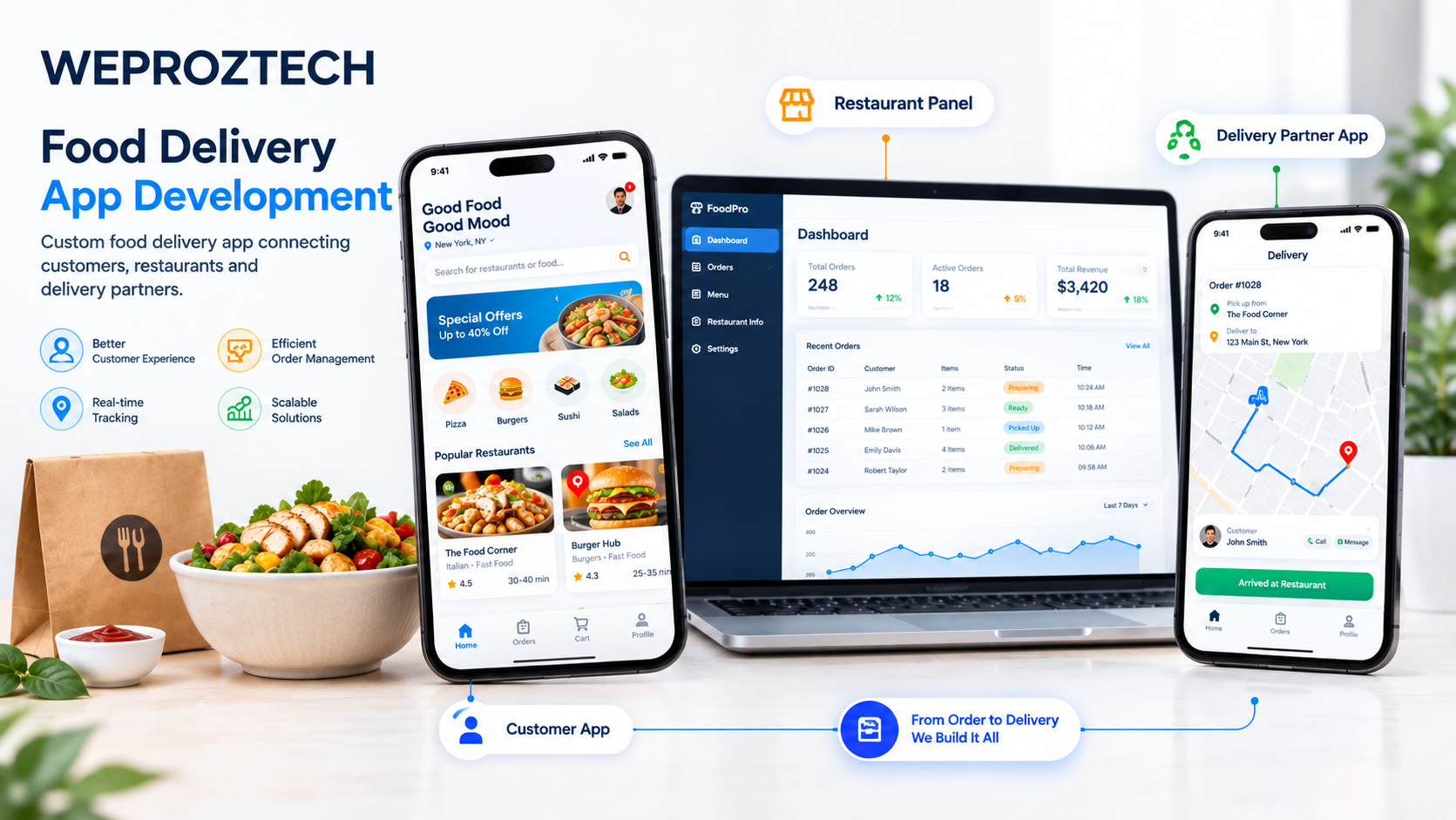
Food delivery has become an important part of the digital food business. Customers now expect to browse restaurants, check menus, customize items, place orders, make payments and track deliveries from their phones. For restaurants and food businesses, a well-designed application can make order management easier while creating a direct digital channel for customers.
Food delivery app development involves much more than creating a mobile ordering screen. A complete solution may include customer applications, restaurant panels, delivery partner apps, an admin dashboard, payment integration, location services, notifications, order management and backend APIs.
For businesses planning their own food delivery platform, the right technology approach depends on the business model, delivery area, number of restaurants, expected orders and required features.
What Is Food Delivery App Development?
Food delivery app development is the process of creating software that allows customers to discover food, select items, place orders and receive them through a delivery system.
A typical platform connects three major users: customers, restaurants and delivery partners. An administrator manages the overall platform, restaurants, users, orders, payments, offers and other operational settings.
A small restaurant may only need a customer ordering app with an admin panel, while a multi-restaurant marketplace may require separate applications for customers, restaurants and delivery partners.
The technology can also include APIs, databases, cloud infrastructure, payment gateways, location services and third-party integrations.
Key Features of a Food Delivery App
A successful food delivery application should make ordering simple from beginning to end. Customers should be able to search for restaurants, browse menus, select food items, customize orders and complete checkout without unnecessary steps.
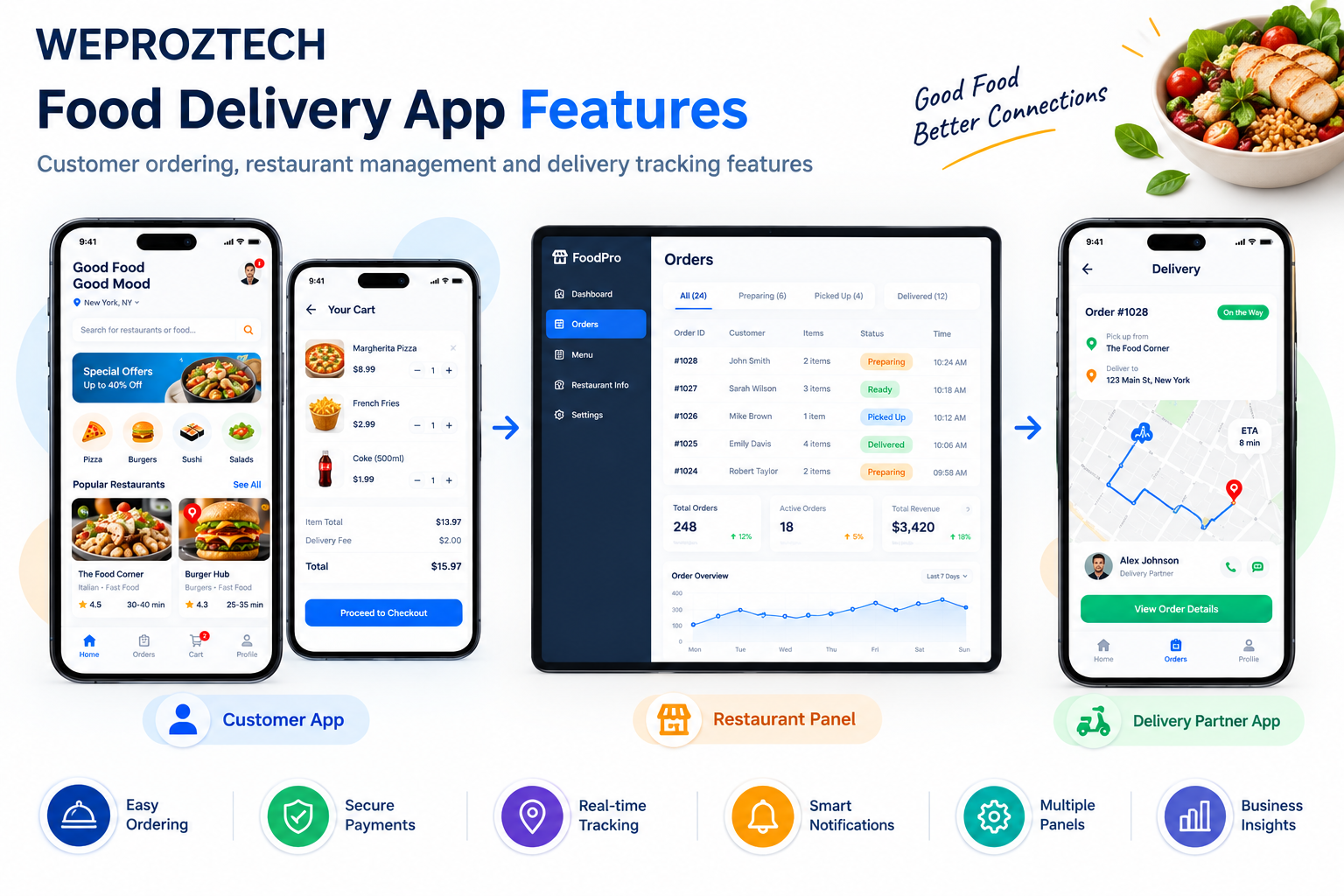
The customer application can include user registration, restaurant discovery, food categories, menu browsing, search, cart management, coupons, multiple addresses, online payments, order history, ratings and order tracking.
Restaurants need a separate interface to manage menus, prices, availability and incoming orders. They should be able to accept or reject orders, update preparation status and view relevant order information.
Delivery partners need features such as order assignment, pickup information, navigation, delivery status and location sharing. For real-time delivery tracking, mapping and routing services can provide location, route and ETA information. Google Maps Platform provides APIs and mobility tools designed for delivery and logistics use cases.
 Restaurant Panel and Admin Dashboard
The restaurant side of the platform is just as important as the customer application. Restaurants should have control over their menus, categories, pricing, food availability and order status.
A restaurant dashboard can allow staff to receive new orders, update preparation times, manage products and check previous orders. This reduces the need for manual communication between restaurants and customers.
The admin dashboard provides broader control over the complete platform. It can include restaurant management, customer management, delivery partner management, order monitoring, commission settings, coupons, reports, payments and support tools.
For a growing food delivery business, the admin system should also be designed to handle increasing restaurants and order volumes without making daily operations difficult.
How Does a Food Delivery App Work?
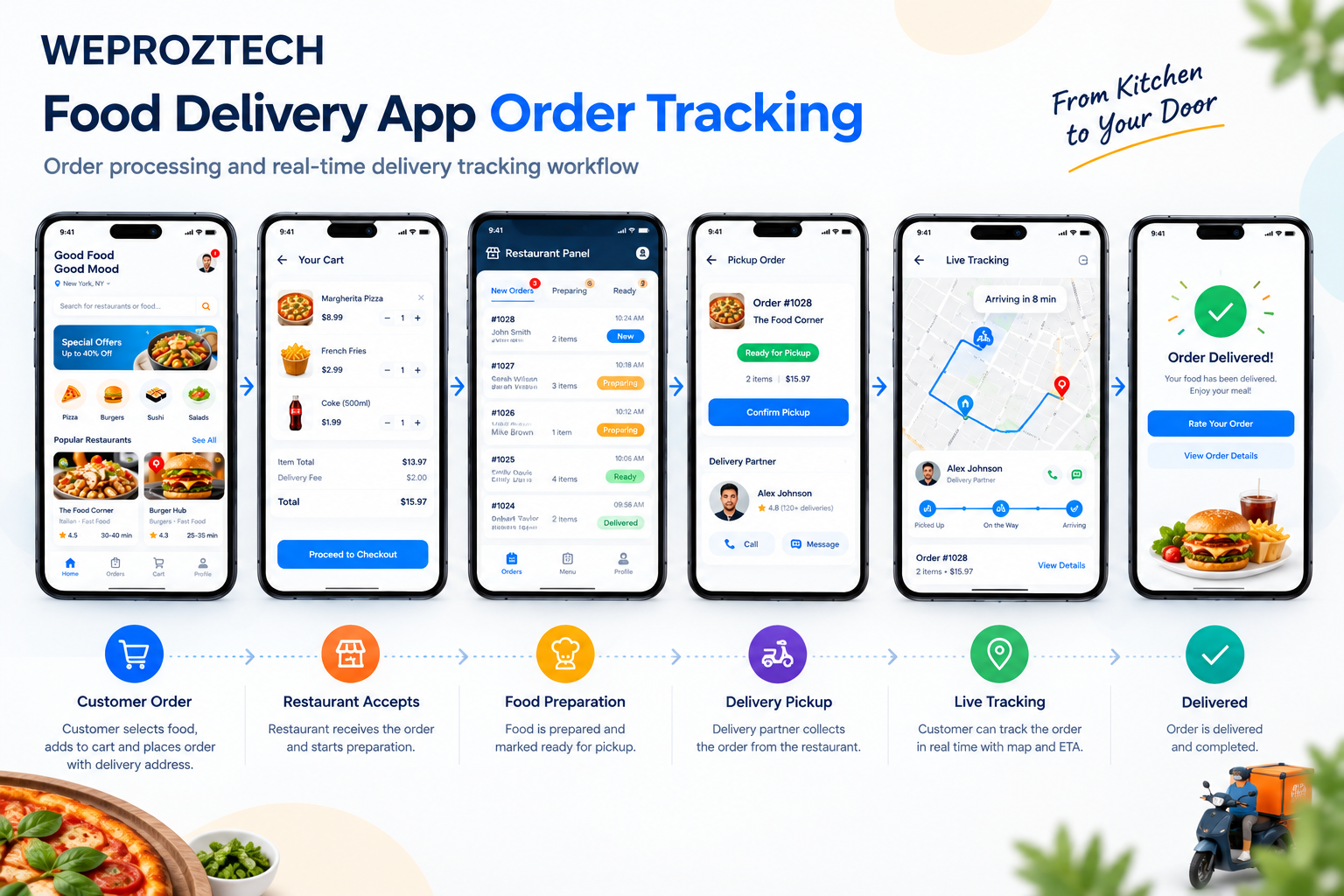
The basic process starts when a customer opens the application and selects a restaurant. The customer chooses food items, adds them to the cart and enters a delivery address.
After checkout, the order is sent to the restaurant. The restaurant accepts the order and begins preparation. A delivery partner can then be assigned to collect the order and deliver it to the customer.
The backend connects these different stages and keeps the order status updated. APIs allow the mobile applications, restaurant system, admin dashboard, payment services and other connected systems to exchange information.
Location technology is especially important when customers want to see the delivery status or estimated arrival time. Google Maps Mobility Services provides technical capabilities for food delivery and other on-demand driver services, including routing, real-time visibility and delivery workflows. For more technical information, businesses can refer to the Google Maps Mobility Services documentation.
 Online Payments, Notifications and Integrations
Payments are a major part of food delivery app development. Depending on the target market, a platform may support UPI, cards, wallets, net banking, cash on delivery or other supported payment methods.
The application should also provide useful notifications for order confirmation, restaurant acceptance, food preparation, pickup and delivery updates.
Other integrations can include maps, SMS, email, push notifications, analytics, customer support tools and accounting or business software. Maps and address validation can also help customers confirm their delivery location during checkout and reduce address-related delivery issues. For technical guidance, businesses can refer to the Google Maps Platform Checkout implementation guide. For larger businesses, the food ordering platform may also need integration with an existing ERP, CRM or inventory system
WEPROZTECH provides custom API development and systems integration, which can be useful when a food delivery platform needs to connect multiple applications or third-party services.
Technology Used for Food Delivery App Development
The technology stack depends on the application's size and requirements. A typical solution can include a mobile frontend, backend APIs, database, cloud infrastructure and an admin web dashboard.
For mobile applications, businesses can choose native Android/iOS development or cross-platform technologies depending on their requirements. The backend may handle authentication, restaurant data, orders, payments, delivery assignments and notifications.
Cloud infrastructure can help the application scale as traffic and order volume increase. Proper database design and API architecture are also important because food delivery platforms can generate a large number of transactions and status updates.
For a custom platform, WEPROZTECH's mobile app development services can be linked here naturally.
Food Delivery App Development Cost
There is no fixed price for food delivery app development because the total cost depends on the features and architecture.
A basic application for one restaurant will normally require less development than a multi-vendor marketplace with separate customer, restaurant and delivery applications.
Cost can be affected by:
- Customer app features
- Restaurant management panel
- Delivery partner application
- Admin dashboard
- Payment gateway integration
- Maps and live tracking
- Coupons and loyalty features
- API integrations
- Backend and cloud infrastructure
- Security and testing
- Ongoing maintenance
A practical approach is to begin with an MVP containing the most important ordering and management features. Once the business model is validated, advanced features can be added.
Businesses planning an MVP can also explore WEPROZTECH's MVP development services.
How to Choose a Food Delivery App Development Company
Choosing a development partner should not be based only on the initial quotation. Look at whether the company understands mobile applications, backend development, APIs, databases, payments, location services and third-party integrations.
It is also important to discuss scalability. If the platform starts with a few restaurants but later expands to hundreds or thousands, the application architecture should be able to support that growth.
Security, testing, maintenance and post-launch support should also be discussed before development begins.
For businesses that need a broader technology partner, WEPROZTECH provides web and custom application development services along with mobile applications, APIs and software solutions.
Food Delivery App Development for Different Business Models
Not every food delivery application needs the same features.
A single-restaurant app can focus on menu browsing, ordering, payments, delivery and customer management.
A multi-restaurant marketplace needs restaurant onboarding, commissions, restaurant dashboards, delivery management, offers and more advanced administration.
A cloud kitchen platform may focus more on direct ordering, delivery zones, menu management and customer retention.
Businesses can also build a food ordering system specifically for corporate meals, local restaurant networks or specialized food categories. The application should be designed around the actual business model rather than adding unnecessary features.
For businesses interested in automation around customer conversations, WEPROZTECH's existing article on WhatsApp automation can also be useful as an internal reference.
Benefits of a Custom Food Delivery App
A custom food delivery application gives a business more control over its ordering process, customer experience and operational data.
Instead of depending completely on third-party marketplaces, a business can create its own customer relationship and develop features around its specific workflow.
Custom software can also be connected with other systems. For example, order information can be connected with inventory, accounting, CRM or customer communication workflows.
For businesses exploring automation and intelligent customer interactions, the existing WEPROZTECH article on AI Agents for Small Businesses in India can be linked naturally when discussing future automation possibilities.
Final Thoughts
Food delivery app development requires more than a customer-facing mobile application. A complete platform needs reliable ordering, restaurant management, delivery operations, payments, notifications, location services and a backend capable of connecting everything together.
The best approach is to define the business model first, identify the essential features and build a practical MVP before investing in advanced functionality.
If you are planning a restaurant ordering app, multi-vendor food delivery marketplace or custom food-tech platform, WEPROZTECH can help with mobile app development, backend APIs, dashboards, integrations and custom software development.
Frequently Asked Questions
Food delivery app development involves creating a complete digital platform that connects customers, restaurants and delivery partners. It can include customer ordering, restaurant management, delivery tracking, payments, notifications and admin management.
Important features include restaurant and menu browsing, search, cart, online payments, order placement, order status, ratings, offers, address management and delivery tracking. Restaurant and delivery panels are also important for managing orders and operations.
Yes. A custom food delivery app can provide map-based tracking so customers can follow delivery progress, while delivery partners can receive routes and navigation support.
The cost depends on the app's features, business model, number of user types, UI/UX requirements, payment integration, maps, backend infrastructure and third-party integrations. An MVP with essential features can be developed first and expanded later.
Yes. A custom solution can include separate customer, restaurant, delivery partner and admin interfaces, allowing menus, orders, availability, delivery assignments, tracking and other operations to be managed from one connected system.